
Gray-bellied Grass Mouse
Akodon simulator
Red List assessment
Least Concernon the IUCN Red List
- EXExtinct
- EWExtinct in the Wild
- CRCritically Endangered
- ENEndangered
- VUVulnerable
- NTNear Threatened
- LCLeast Concern
The Gray-bellied Grass Mouse is recorded in 4 countries across South America. The IUCN Red List assesses the Gray-bellied Grass Mouse as Least Concern. No reliable global population estimate exists.
- Family
- Cricetidae
- Order
- Rodentia
- Genus
- Akodon
- Countries recorded
- 4
- Continents
- South America
- Red List category
- Least Concern
- Data updated
- August 9, 2026
What is the Gray-bellied Grass Mouse?
Akodon simulator is a small, ground-dwelling sigmodontine rodent endemic to the dry and transitional zones of the southern Andes foothills and adjacent lowlands in South America. It is named for its resemblance to related Akodon species ('simulator' meaning 'imitator' in Latin), making field identification challenging without close examination. The species inhabits a mosaic of monte scrubland, dry grasslands, and Yungas forest edges, typically at moderate elevations. Like most Akodon grass mice, it plays a key role in local ecosystems as both a consumer of seeds and invertebrates and as prey for many predators.
Where does the Gray-bellied Grass Mouse live?
Northwestern Argentina (Salta, Jujuy, Tucumán, Catamarca, La Rioja provinces) and southern Bolivia
The species is restricted to South America, with its core range in northwestern Argentina across the provinces of Jujuy, Salta, Tucumán, Catamarca, and La Rioja. Populations have also been recorded in adjacent southern Bolivia (Tarija and Chuquisaca departments). It does not appear to extend into Paraguay or Chile based on current records.
Altitude and depth
Typically found between 500 m and 2,500 m above sea level, with peak abundance in the 800–1,800 m zone corresponding to the lower Yungas and pre-Andean foothills. It can occasionally occur at slightly lower elevations in dry monte valleys.
Seasonal movements
No major seasonal migrations are recorded. Activity levels and reproductive intensity may peak during the austral spring and summer (October–March) when food resources are most abundant. No hibernation has been documented; the species likely remains active year-round.
Habitat of the Gray-bellied Grass Mouse
Primary habitats include dry monte scrubland, transitional thorn-scrub, rocky grasslands, and the edges of Yungas subtropical montane forests. It shows a preference for areas with dense herbaceous ground cover offering shelter from predators. It also occurs in degraded or disturbed habitats such as agricultural field margins and roadsides within its range.
Adaptations to its environment
Its compact body and short limbs are well-suited for rapid movement through dense grass and leaf litter. The gray-toned pelage provides camouflage in dry, rocky grassland environments. Like many Akodon species, it has a generalist diet that allows it to exploit variable food availability across seasons. Its kidneys are moderately efficient at water conservation, consistent with life in semi-arid habitats.
Conservation status and numbers
Least Concern (LC) on the IUCN Red List. The species has a relatively broad geographic range, is tolerant of some habitat modification, and does not appear to be experiencing rapid population decline. No quantitative population viability assessment has been published.
Estimated population
No reliable global population estimate exists. The population trend is presumed stable based on IUCN assessments, though local declines may occur in heavily farmed areas. Relative abundance in suitable habitat appears moderate.
What threatens the Gray-bellied Grass Mouse?
The main threats include habitat conversion for agriculture (particularly sugarcane and soybean expansion in the Tucumán-Salta lowlands), livestock overgrazing that degrades ground cover, and increasing frequency of drought events potentially linked to climate change. Rodenticide use in agricultural areas may also cause localized mortality.
Diseases and parasites
Members of the genus Akodon are recognized reservoir hosts for Andes-lineage hantaviruses in South America; A. simulator has not been definitively implicated in hantavirus transmission but warrants monitoring given its ecological similarity to confirmed reservoir species. Ectoparasites including fleas (Siphonaptera), mites (Acari), and bot fly larvae (Cuterebridae), as well as endoparasitic helminths, are typical burdens in this and related species.
What is being done to protect it?
The species occurs within several protected areas in northwestern Argentina, including Parque Nacional Calilegua (Jujuy) and Parque Nacional Los Cardones (Salta), which protect representative Yungas and monte habitats. Argentina's national biodiversity law provides general protection, and the species is monitored through periodic small-mammal surveys in the region.
Recommended actions
Priority actions include systematic population surveys to fill distributional and abundance data gaps, monitoring of habitat loss in the Yungas foothills, and research into population genetic structure to clarify subspecies boundaries. Reducing rodenticide use in adjacent farmland and maintaining wildlife corridors between protected areas would benefit this and co-occurring small mammal species.
What the Gray-bellied Grass Mouse looks like
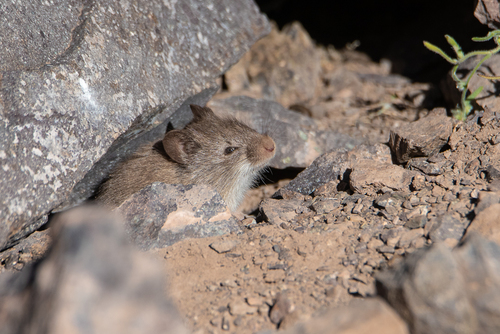
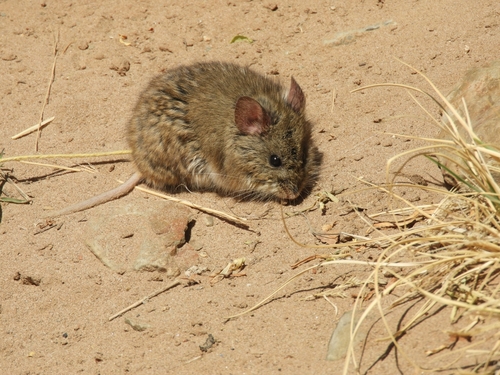
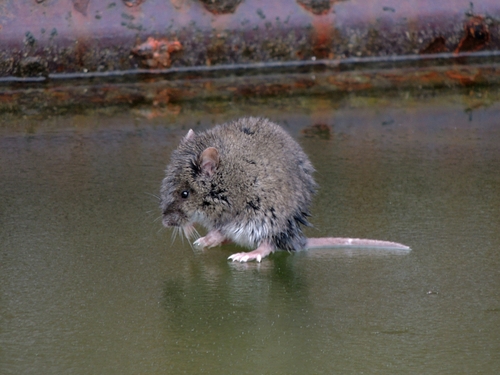
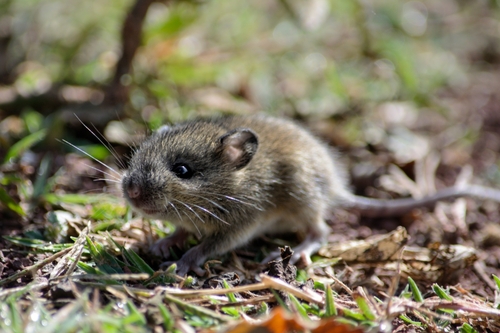
Dorsal fur is dull grayish-brown to olivaceous brown, with individual hairs showing a dark base and buffy or grayish tip, giving a grizzled appearance. The venter is distinctly gray (the key characteristic referenced in the common name), lacking the whitish or buff tones seen in some congeners. The tail is bicolored — darker above and paler below — and moderately haired. Eyes and ears are medium-sized and the snout is bluntly pointed.
Size
Head-body length approximately 85–115 mm; tail length 65–90 mm (roughly 75–85% of head-body length). Hind foot length 19–23 mm. A typical mid-sized member of the genus Akodon.
Weight
Adults typically weigh between 18 and 38 g. Males may average slightly heavier than females, but size overlap is substantial.
Distinctive features
The consistently gray (rather than white or cream) belly reliably separates A. simulator from several sympatric Akodon species such as Akodon dolores and Akodon caenosus, which tend toward paler venters. Cranial morphology, particularly the shape of the interorbital region and zygomatic arches, also differs subtly from close relatives and is often necessary for definitive identification.
Differences between males and females
Sexual dimorphism is minimal. Males may be marginally larger on average but overlap extensively with females in all external measurements. No differences in coloration are reported.
Behaviour and diet of the Gray-bellied Grass Mouse
Predominantly solitary outside of breeding interactions, which is typical for Akodon grass mice. Home ranges of adjacent individuals may overlap slightly. No evidence of complex social hierarchies; interactions between adults are generally brief and agonistic.
When it is active
Primarily nocturnal and crepuscular, with peak activity occurring in the first few hours after sunset and before sunrise. Some limited diurnal activity has been noted during cooler periods. Shelter is taken in burrows or dense vegetation during daylight hours.
Diet
Omnivorous, consuming a mixture of grass seeds, green plant material, fungi, and invertebrates (insects, larvae, spiders). The proportional diet shifts seasonally — more seeds and dry plant matter in the dry season, more invertebrates and fresh vegetation in the wet season. This dietary flexibility is characteristic of the genus.
How it feeds and hunts
Forages primarily on the ground through dense grass and leaf litter, using its vibrissae (whiskers) to detect seeds and invertebrates. Insects and larvae are captured opportunistically rather than through active pursuit. Food items may be carried short distances before consumption.
Communication
Communication is primarily olfactory, with scent marking via urine and specialized glands used to define home ranges and signal reproductive status. Ultrasonic vocalizations are likely used in mother–pup interactions, as demonstrated in related Akodon species. Threat postures and tooth chattering serve as agonistic signals between individuals.
Interactions with other species
Natural predators include owls (especially barn owls, Tyto alba, and spectacled owls), small carnivorous mammals such as weasels and small foxes, and snakes. It competes for resources with other small rodents in the community, including Calomys and Phyllotis species. As a seed consumer, it may influence local plant community dynamics.
Role in its ecosystem
Akodon simulator functions as an important mid-level consumer in its ecosystem, linking primary producers (grasses, forbs) and invertebrate communities to higher predators. Through caching or losing seeds, it may act as a minor seed disperser. It is also a potential reservoir host for hantaviruses and other zoonotic pathogens, as documented for many Akodon species in South America.
Reproduction and lifecycle
Breeding occurs mainly from late winter through early autumn (August–March in the Southern Hemisphere), with multiple litters possible per year in favorable conditions. Gestation lasts approximately 20–23 days. Litter size typically ranges from 2 to 6 young, with an average near 3–4.
Raising the young
Altricial young are born hairless and with eyes closed. The female provides all parental care, nursing offspring in a grass-lined nest within a burrow or beneath dense vegetation. Weaning occurs at approximately 14–21 days, after which juveniles rapidly become independent. Males play no known role in raising offspring.
Maturity and lifespan
Sexual maturity is reached rapidly, likely within 2–3 months of birth, consistent with other Akodon species. Wild lifespan is typically less than 1 year due to high predation and mortality rates, though some individuals may survive 1.5–2 years. Captive longevity may extend to 3 years under optimal conditions.
Taxonomy and naming of the Gray-bellied Grass Mouse
Classification
Mammalia > Rodentia > Cricetidae (subfamily Sigmodontinae) > Akodon > Akodon simulator
Subspecies
Two subspecies have been tentatively recognized — Akodon simulator simulator (nominate, from Tucumán and Salta, Argentina) and Akodon simulator tucumanensis — though their validity requires further morphological and molecular confirmation.
Scientific synonyms
Originally described by Oldfield Thomas in 1916. Occasionally referenced under the broader Akodon varius species group in older literature; no widely accepted junior synonyms are currently recognized.
What research says
Recent studies
Phylogeographic studies using mitochondrial and nuclear markers have been used to clarify relationships within the Akodon varius species group, within which A. simulator is placed. Recent taxonomic revisions of the genus (e.g., by Jayat, Ortiz, and colleagues, 2010s) have helped stabilize its recognition as a distinct species rather than a subspecies or synonym. Hantavirus surveillance studies in northwestern Argentina have included trapping surveys where A. simulator has been captured, prompting interest in its potential as a reservoir.
Genome and DNA
The karyotype of Akodon simulator has been reported as 2n = 40, FN = 40, which is consistent with several Akodon species in the varius group. The genus Akodon is notable for frequent chromosomal polymorphism and the occurrence of sex-chromosome variants (XY females) in some species, though this has not been specifically confirmed for A. simulator.
Compared with similar species
Akodon simulator is most closely related to Akodon caenosus (Tucumán grass mouse) and Akodon varius (variable grass mouse), with which it shares habitat in parts of its range. It is distinguished from A. caenosus by its larger size and grayer venter, and from A. varius by consistent pelage coloration and cranial differences. Compared to the widely studied Akodon azarae of the pampas, A. simulator occupies drier, more montane habitats and appears to have a more restricted distribution.
The Gray-bellied Grass Mouse and people
The species name 'simulator' was chosen by Thomas (1916) because the animal so closely resembles its congeners that it 'simulates' — or mimics — other Akodon species, making it a classic cryptic species. Despite being a tiny rodent weighing less than a AA battery, it can produce multiple litters per season, potentially tripling its population size in a single favorable year. Barn owls hunting near Andean villages inadvertently serve as important survey tools for researchers studying A. simulator, as owl pellet analysis has revealed the species' presence in areas where live-trapping efforts missed it.
Where and how to see it
The best chance to encounter this species is at night in grasslands and scrub edges in the lower Yungas foothills of Tucumán and Salta provinces, Argentina, during the austral spring and summer. Sherman live traps baited with peanut butter, oats, and vanilla essence, placed along runways at the base of grass tufts or rocky outcrops, are the standard capture method. Parque Nacional Calilegua in Jujuy and the Yungas transition zones near San Javier (Tucumán) are accessible areas with suitable habitat.
Risks to humans
No direct danger to humans from bites or venom under normal circumstances. As a potential small-mammal reservoir in the broader Akodon community, there is a theoretical risk of hantavirus exposure for researchers handling individuals without protective equipment (gloves, mask). Standard biosafety precautions are recommended during any live-trapping work.
Human uses
No known direct human uses including food, trade, or traditional medicine. The species has been used as a study subject in small-mammal community ecology and phylogeographic research in South America. It may occasionally be captured incidentally in rodent control campaigns in agricultural areas.
Myths and legends
No specific myths, legends, or cultural symbolism are associated with Akodon simulator. Like most small Andean rodents, it is largely unnoticed in regional folk traditions, though small mice and rats as a general category feature in Andean cosmology as minor spirits or signs of changing weather in some indigenous communities.
Countries where the Gray-bellied Grass Mouse is recorded
The 4 countries named in the range description of its IUCN Red List assessment.
Questions about the Gray-bellied Grass Mouse
Where does the Gray-bellied Grass Mouse live?
The Gray-bellied Grass Mouse is recorded in Argentina, Bolivia, Chile and Paraguay across South America. These countries come from the range description of its IUCN Red List assessment, and they are what place the species on the interactive map.
Is the Gray-bellied Grass Mouse endangered?
The IUCN Red List assesses the Gray-bellied Grass Mouse as Least Concern. The species is widespread and abundant enough not to qualify for any threatened category. It does not mean the species is safe forever, only that nothing in the current data raises an alarm.
How many are left in the wild?
No reliable global population estimate exists. This figure comes from the species assessment on the IUCN Red List; population estimates for wild mammals are ranges, not counts, and are revised at each assessment.
What habitat does the Gray-bellied Grass Mouse live in?
Primary habitats include dry monte scrubland, transitional thorn-scrub, rocky grasslands, and the edges of Yungas subtropical montane forests.
What is the scientific name of the Gray-bellied Grass Mouse?
The Gray-bellied Grass Mouse is Akodon simulator, in the family Cricetidae, order Rodentia.
Other species in the genus Akodon

Other species in the family Cricetidae
Sources
Conservation status, range description and population estimate come from the IUCN Red List assessment for Akodon simulator. Countries are derived from that range description, not from a mapped country list. Last refreshed on .
The distribution map is drawn from the IUCN Red List spatial data compiled in 2008. IUCN (International Union for Conservation of Nature)