
Bolivian Grass Mouse
Akodon boliviensis
Red List assessment
Least Concernon the IUCN Red List
- EXExtinct
- EWExtinct in the Wild
- CRCritically Endangered
- ENEndangered
- VUVulnerable
- NTNear Threatened
- LCLeast Concern
The Bolivian Grass Mouse is recorded in 3 countries across South America. The IUCN Red List assesses the Bolivian Grass Mouse as Least Concern. No precise global population estimate is available.
- Family
- Cricetidae
- Order
- Rodentia
- Genus
- Akodon
- Countries recorded
- 3
- Continents
- South America
- Red List category
- Least Concern
- Data updated
- August 9, 2026
What is the Bolivian Grass Mouse?
The Bolivian Grass Mouse is a small, ground-dwelling sigmodontine rodent endemic to the high Andean puna and altiplano of Bolivia and adjacent regions. It inhabits open grasslands and shrubby areas at high elevation, often associated with bunchgrasses and rocky outcrops. As a member of the speciose Akodon genus—one of the most diverse rodent genera in South America—it plays an important ecological role in high-altitude food webs. It is notable for thriving in cold, oxygen-poor environments above 3,000 meters.
Where does the Bolivian Grass Mouse live?
Andean highlands of Bolivia, with range extensions into adjacent southern Peru and possibly northwestern Argentina
Distributed mainly across the Bolivian altiplano and adjacent Andean slopes, including the departments of La Paz, Oruro, and Potosí. Its range extends into the Peruvian puna near Lake Titicaca and may marginally reach northwestern Argentina.
Altitude and depth
Typically found between 3,000 and 4,800 meters above sea level, with core populations centered around 3,500–4,200 m in the altiplano and puna zones.
Seasonal movements
No long-distance migrations are known. Activity and reproduction may peak during the austral summer wet season (November–March), when food resources are more abundant, but the species remains active year-round without hibernation.
Habitat of the Bolivian Grass Mouse
Primarily occupies puna grasslands (pajonal), altiplano shrublands, and humid montane grasslands. Also found in transitional zones between high Andean grasslands and shrub communities, often near rocky outcrops, stream margins, and disturbed agricultural borders.
Adaptations to its environment
Possesses a dense, insulating fur coat adapted to cold Andean nights. Physiological adaptations to hypoxia at high altitude, such as increased blood oxygen-carrying capacity, are likely as in other high-altitude sigmodontines. Its compact body shape reduces heat loss.
Conservation status and numbers
Least Concern (LC) on the IUCN Red List. The species has a reasonably wide distribution across the Bolivian altiplano, appears to be locally common, and faces no currently identified major threats sufficient to warrant a higher threat category. Population trends are considered stable.
Estimated population
No precise global population estimate is available. The species is considered locally common across its range, with a presumed stable population trend based on habitat availability and IUCN LC assessment.
What threatens the Bolivian Grass Mouse?
Potential threats include overgrazing of puna grasslands by livestock (cattle, sheep, llamas, alpacas), conversion of native grassland to agriculture, and long-term habitat degradation. Climate change poses a future risk through alteration of high-altitude ecosystem dynamics.
Diseases and parasites
May harbor hantaviruses, as other Akodon species are known reservoir hosts. Internal parasites including helminths (cestodes, nematodes) and ectoparasites (fleas, mites, ticks) have been documented in the genus. Specific parasitological studies for this species are limited.
What is being done to protect it?
The species benefits passively from protected areas within its range, such as the Reserva Nacional de Fauna Andina Eduardo Avaroa and areas within the TDPS system around Lake Titicaca. No species-specific conservation program is known.
Recommended actions
Monitoring of population trends in the context of climate change and land-use change is advised. Sustainable grazing management in puna grasslands would benefit the species. Further taxonomic and ecological research is needed to refine the species' distribution and habitat requirements.
What the Bolivian Grass Mouse looks like
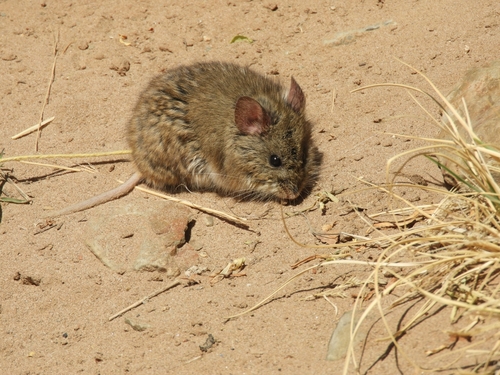
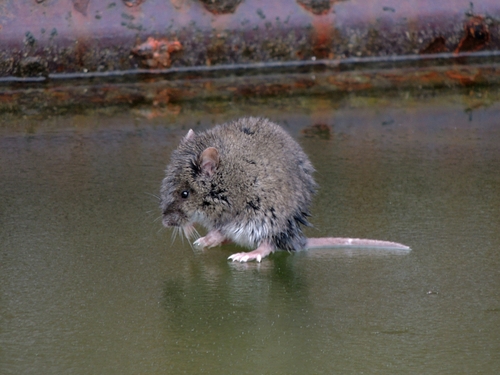
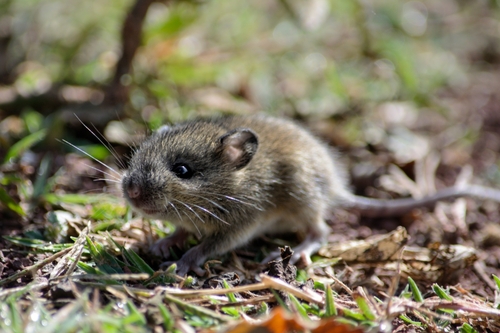
Dorsal fur is brownish-gray to dark brown, with individual hairs often showing a tricolored pattern. The ventral surface is paler grayish-white or buff. The tail is moderately haired and bicolored (darker above, paler below). Ears are moderately sized and rounded. Eyes are small and dark.
Size
Head-body length approximately 80–120 mm; tail length 60–90 mm (shorter than or equal to body length). Hind foot length typically 18–23 mm.
Weight
Typically between 15 and 35 grams; no pronounced sexual size dimorphism reported, though males may average marginally larger.
Distinctive features
Distinguished from sympatric Akodon species by a combination of cranial and dental morphology, including the configuration of the molars and rostral shape. Compared to Akodon cursor or Akodon azarae, it is adapted to higher elevations and shows subtler differences in fur coloration and skull measurements.
Differences between males and females
Sexual dimorphism is minimal. Males may be slightly larger on average than females, but the difference is not conspicuous in the field. Both sexes share similar coloration and body proportions.
Behaviour and diet of the Bolivian Grass Mouse
Generally considered solitary or semi-solitary, as is typical for most Akodon species. Individuals maintain small home ranges within grassland patches. Temporary aggregations may occur during breeding season.
When it is active
Primarily nocturnal and crepuscular, with peak activity in the hours after sunset and before sunrise. Some diurnal activity may occur on overcast days. Active year-round.
Diet
Omnivorous, feeding primarily on seeds, green plant material, roots, and invertebrates (insects, larvae, worms). The diet shifts seasonally depending on availability, with more invertebrate consumption during the wet season and greater reliance on seeds and roots in the dry season.
How it feeds and hunts
Forages opportunistically on the ground, exploring leaf litter, grass tussocks, and soil surfaces for food items. Invertebrate prey is captured by pouncing or digging. No specialized hunting technique is documented.
Communication
Uses ultrasonic vocalizations for intraspecific communication, particularly during mating encounters. Scent marking via urine and glandular secretions is used to delineate territories and signal reproductive status. Tactile and postural signals are used in close-range interactions.
Interactions with other species
Predated upon by Andean foxes (Lycalopex culpaeus), raptors (e.g., Geranoaetus melanoleucus, Bubo virginianus), and snakes. Competes with other small rodents of the altiplano such as Phyllotis xanthopygus and Calomys species. May serve as an intermediate host for parasites shared with sympatric rodents.
Role in its ecosystem
Functions as an important prey base for mid-level predators in the puna ecosystem. As a seed consumer and invertebrate predator, it contributes to seed dispersal and soil invertebrate regulation. Its burrowing and nesting activities may also influence soil structure.
Reproduction and lifecycle
Breeding appears to peak in the austral wet season (November–April). Gestation period is approximately 20–23 days, typical for the genus. Litter sizes range from 2 to 6 pups, with females capable of multiple litters per year under favorable conditions.
Raising the young
Young are altricial at birth. The mother provides most parental care, nursing and protecting the pups within a grass-lined nest. Pups are weaned at approximately 14–21 days. Males do not typically participate in direct parental care.
Maturity and lifespan
Sexual maturity is reached at approximately 30–60 days of age in the wild, consistent with other Akodon species. Lifespan in the wild is typically 1–2 years; captive individuals may survive up to 3 years.
Taxonomy and naming of the Bolivian Grass Mouse
Classification
Mammalia > Rodentia > Cricetidae > Akodon > Akodon boliviensis
Subspecies
No widely recognized subspecies are currently accepted; the species has historically been subject to taxonomic revision but is now treated as monotypic.
Scientific synonyms
Mus boliviensis Meyen, 1833; Habrothrix boliviensis; historically lumped or confused with other Akodon species from the altiplano complex.
What research says
Recent studies
Phylogeographic studies of Andean Akodon have clarified the relationships and range boundaries of A. boliviensis relative to other altiplano species. Ongoing rodent community surveys in Bolivia have helped refine its distributional limits and ecological associations.
Genome and DNA
The genus Akodon is notable for its extraordinary karyotypic variation, with diploid numbers ranging from 2n=10 to 2n=44 across species. The karyotype of Akodon boliviensis specifically has been reported with 2n=40, though further genomic characterization is limited.
Compared with similar species
Akodon boliviensis is closely related to other high-Andean Akodon such as Akodon albiventer and Akodon subfuscus, all sharing similar puna habitats. It differs from lowland species like Akodon cursor in its high-altitude adaptations and smaller body size. The genus as a whole is one of the most speciose rodent genera in the Neotropics.
The Bolivian Grass Mouse and people
1) The genus Akodon contains over 40 recognized species, making it one of the most species-rich mammal genera in the entire Western Hemisphere. 2) Some Akodon species are remarkable for having sex chromosome systems where females (XX) and XY females coexist with normal XY males—one of the most unusual reproductive anomalies in mammals. 3) Despite living at extreme altitudes where nighttime temperatures can drop well below freezing, Akodon boliviensis remains active year-round without any form of torpor.
Where and how to see it
Best observed at night using a red-light headlamp in open puna grasslands around 3,500–4,200 m altitude, particularly near Lake Titicaca's Bolivian shores and the La Paz altiplano. The wet season (November–March) offers higher activity. Live-trapping surveys in grass tussocks and rocky margins are used by researchers.
Risks to humans
Low direct risk to humans; the bite of a small rodent can cause minor injury. As a potential hantavirus reservoir (as are related Akodon species), caution is advised when handling wild individuals. Standard rodent-handling hygiene protocols should be followed.
Human uses
Not used directly for food, medicine, or trade. Occasionally collected as museum specimens for taxonomic and biodiversity research. Serves as a model organism in Andean small mammal ecological studies.
Myths and legends
Small rodents in Andean cultures are occasionally associated with fertility of the earth and agricultural abundance in Aymara and Quechua traditions, though no specific myth or legend is uniquely attributed to this species.
Countries where the Bolivian Grass Mouse is recorded
The 3 countries named in the range description of its IUCN Red List assessment.
Questions about the Bolivian Grass Mouse
Where does the Bolivian Grass Mouse live?
The Bolivian Grass Mouse is recorded in Argentina, Bolivia and Peru across South America. These countries come from the range description of its IUCN Red List assessment, and they are what place the species on the interactive map.
Is the Bolivian Grass Mouse endangered?
The IUCN Red List assesses the Bolivian Grass Mouse as Least Concern. The species is widespread and abundant enough not to qualify for any threatened category. It does not mean the species is safe forever, only that nothing in the current data raises an alarm.
How many are left in the wild?
No precise global population estimate is available. This figure comes from the species assessment on the IUCN Red List; population estimates for wild mammals are ranges, not counts, and are revised at each assessment.
What habitat does the Bolivian Grass Mouse live in?
Primarily occupies puna grasslands (pajonal), altiplano shrublands, and humid montane grasslands.
What is the scientific name of the Bolivian Grass Mouse?
The Bolivian Grass Mouse is Akodon boliviensis, in the family Cricetidae, order Rodentia.
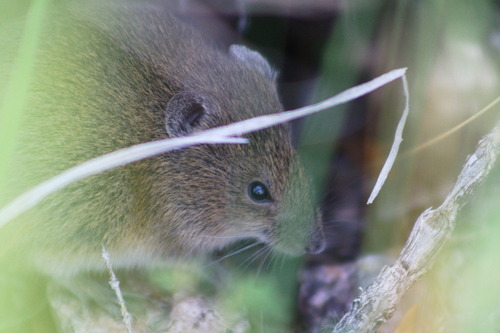
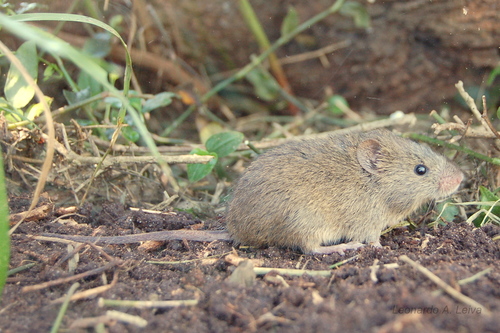
Other species in the genus Akodon

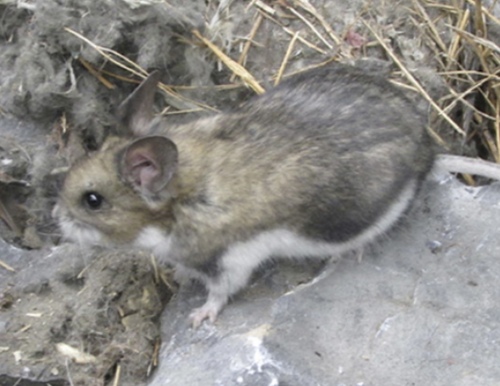
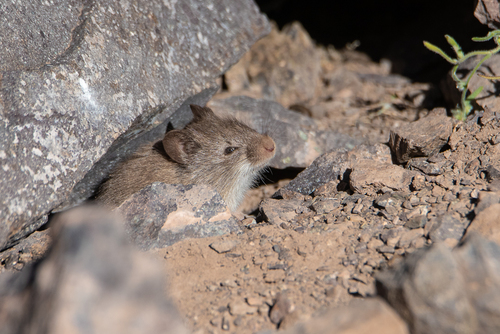
Other species in the family Cricetidae
Sources
Conservation status, range description and population estimate come from the IUCN Red List assessment for Akodon boliviensis. Countries are derived from that range description, not from a mapped country list. Last refreshed on .
The distribution map is drawn from the IUCN Red List spatial data compiled in 2008. IUCN (International Union for Conservation of Nature)