
Colombian Grass Mouse
Akodon affinis
Red List assessment
Least Concernon the IUCN Red List
- EXExtinct
- EWExtinct in the Wild
- CRCritically Endangered
- ENEndangered
- VUVulnerable
- NTNear Threatened
- LCLeast Concern
The Colombian Grass Mouse is recorded in one country, Colombia across South America. The IUCN Red List assesses the Colombian Grass Mouse as Least Concern. No precise global population estimate exists for this species.
- Family
- Cricetidae
- Order
- Rodentia
- Genus
- Akodon
- Countries recorded
- 1
- Continents
- South America
- Red List category
- Least Concern
- Data updated
- August 9, 2026
What is the Colombian Grass Mouse?
Akodon affinis is a small sigmodontine rodent endemic to the Andean highlands of Colombia. It is a member of the highly diverse genus Akodon, commonly known as grass mice, which is one of the most species-rich genera of South American rodents. The species inhabits montane grasslands and scrub forest edges at high elevations, playing a key ecological role as a seed consumer and prey item. It is remarkable as a range-restricted Andean endemic adapted to the cool, humid puna and páramo environments of northern South America.
Where does the Colombian Grass Mouse live?
Endemic to Colombia, primarily in the western and central Andes mountain ranges, including departments such as Antioquia, Caldas, and Risaralda.
Restricted to Colombia in South America, with records concentrated in the western and central Cordilleras of the Andes. Known localities include the departments of Antioquia, Caldas, Risaralda, and adjacent areas. The species is considered a Colombian endemic with a relatively limited geographic range.
Altitude and depth
Typically found between approximately 2,000 and 4,000 meters above sea level, with peak occurrence in the upper montane and páramo zones of the Colombian Andes.
Seasonal movements
No long-distance seasonal migrations are known for this species. Activity patterns may shift slightly with wet and dry seasons in the Colombian Andes, but the species is considered year-round resident within its range.
Habitat of the Colombian Grass Mouse
The Colombian Grass Mouse primarily occupies montane grasslands (páramo and subpáramo), shrubby ecotones, and the edges of Andean cloud forests. It favors areas with dense grassy ground cover that provides shelter and foraging opportunities. Agricultural margins and secondary vegetation within its altitudinal range may also be used.
Adaptations to its environment
Like other high-Andean rodents, Akodon affinis likely has dense, insulating fur to cope with cold temperatures at altitude. Its relatively robust body shape helps minimize heat loss. It is adapted to foraging efficiently among dense grass tussocks and may have physiological adaptations for functioning at lower oxygen partial pressures found at high elevations.
Conservation status and numbers
Listed as Least Concern (LC) by the IUCN Red List. The species is assessed as having a sufficiently wide distribution and stable enough population within Colombia that it does not currently meet the threshold for a threatened category, though it remains vulnerable to Andean habitat degradation.
Estimated population
No precise global population estimate exists for this species. The population trend is presumed stable given its LC status, though localized declines may occur in areas of intense agricultural pressure.
What threatens the Colombian Grass Mouse?
The primary threats include habitat loss and degradation due to agricultural expansion (particularly cattle ranching and potato farming) in the Colombian Andes, burning of páramo grasslands, and potential impacts of climate change causing upward compression of suitable high-altitude habitat. Urbanization in Andean valleys also contributes to habitat fragmentation.
Diseases and parasites
As with other Akodon species, it may harbor ectoparasites (fleas, mites, ticks) and endoparasites (nematodes, cestodes). Some Akodon species serve as reservoir hosts for hantaviruses and other zoonotic pathogens, though specific data for A. affinis are lacking.
What is being done to protect it?
The species may benefit from protected areas within its range in Colombia, such as natural reserves and national parks protecting Andean ecosystems (e.g., areas within the Cordillera Occidental). Colombian environmental legislation provides general protections for native wildlife. No species-specific conservation program is known.
Recommended actions
Priority actions include detailed population surveys to better characterize distribution and abundance, protection and restoration of páramo habitats in Colombia, enforcement of existing land-use regulations in protected Andean zones, and integration of this species into broader Andean small mammal monitoring programs.
What the Colombian Grass Mouse looks like
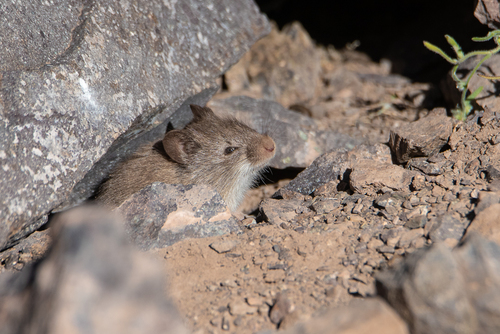
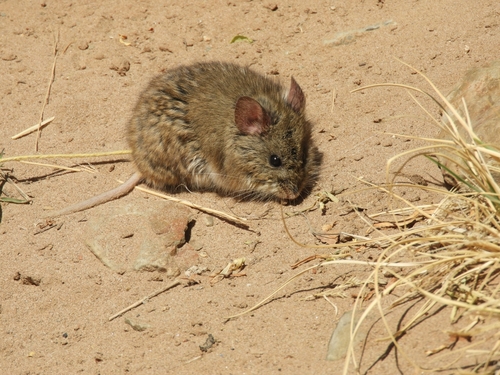
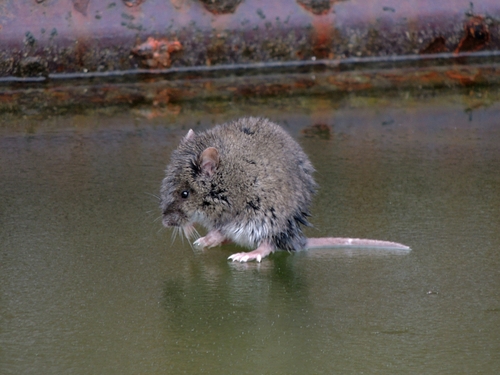
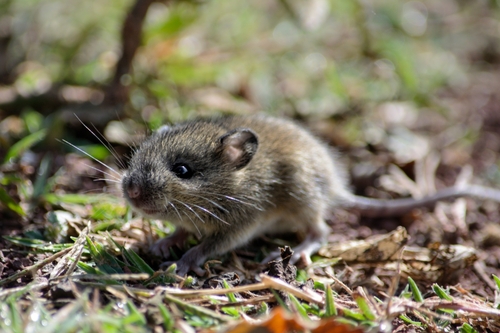
Akodon affinis has soft, dense brownish or dark olive-brown fur on the dorsal surface, with a paler grayish or buffy-white ventral side. The tail is sparsely haired and bicolored, darker above and lighter below. The eyes are small and dark, the ears are rounded and short, and the overall body form is robust and compact.
Size
Body length (head to body) approximately 80–115 mm; tail length approximately 60–90 mm, typically shorter than the body. Hind foot length roughly 18–22 mm.
Weight
Typically between 15 and 35 grams; males and females are of similar size though slight sexual variation in mass may occur.
Distinctive features
Distinguished from other Akodon species in the region by the combination of its relatively dark dorsal coloration, specific cranial and dental morphology (including molar cusp patterns), and its restricted Colombian Andean distribution. Molecular genetic data are often necessary for definitive identification from closely related congeners such as Akodon bogotensis.
Differences between males and females
Sexual dimorphism is minimal in this species, as is typical for Akodon. Males and females are broadly similar in external appearance and size, though males may marginally exceed females in body mass.
Behaviour and diet of the Colombian Grass Mouse
Likely solitary or loosely social, as is typical for Akodon grass mice. Individuals may tolerate overlapping home ranges, particularly at high population densities, but sustained social groupings are not reported.
When it is active
Primarily nocturnal to crepuscular, with peak activity during the night and around dawn and dusk. Daytime activity may occur in protected dense vegetation. Like most Akodon, it remains active year-round without hibernation.
Diet
Omnivorous, feeding on seeds, plant material (stems, roots, leaves), fungi, and invertebrates such as insects and earthworms. Seeds and green vegetation are likely dietary staples, supplemented opportunistically by arthropods.
How it feeds and hunts
Forages by moving through dense grass and leaf litter, sniffing out and excavating seeds, plant material, and invertebrates. It uses its vibrissae to navigate and detect food items in low-light conditions.
Communication
Communication likely involves ultrasonic vocalizations used in mate attraction and mother-offspring contact, as well as scent marking via urine and glandular secretions to establish territories or signal reproductive status. Body postures and tactile signals may also play a role in close-range interactions.
Interactions with other species
Predated upon by Andean raptors (e.g., Buteo species), small carnivorous mammals (e.g., weasels, small foxes), and snakes. It likely competes with other small rodents sharing the same high-altitude grassland habitat. As a seed consumer and prey species, it forms an important link in Andean food webs.
Role in its ecosystem
Akodon affinis serves as an important prey base for higher trophic levels in Andean ecosystems and contributes to seed dispersal and soil turnover through its burrowing and foraging activities. It is a mid-level consumer connecting primary producers and predators in páramo food webs.
Reproduction and lifecycle
Reproductive biology is not well documented for this specific species. Based on congeners, breeding likely occurs year-round or during favorable seasons, with gestation of approximately 21–23 days and litter sizes of 2–6 young per birth.
Raising the young
Maternal care is the primary parental investment, as is typical for sigmodontine rodents. The mother nurses and protects the altricial young in a grass-lined nest. Young are weaned at approximately 2–3 weeks and reach independence relatively quickly.
Maturity and lifespan
Sexual maturity is likely reached at 2–3 months of age, as is typical for Akodon. Lifespan in the wild is probably 1–2 years; captive individuals of related species can live up to 3 years.
Taxonomy and naming of the Colombian Grass Mouse
Classification
Mammalia > Rodentia > Cricetidae > Akodon > Akodon affinis
Scientific synonyms
Originally described as Akodon affinis J.A. Allen, 1912. No widely recognized synonyms beyond the original description.
What research says
Recent studies
Phylogenetic studies on the genus Akodon using mitochondrial and nuclear DNA have helped clarify species boundaries within the Colombian Andes, and A. affinis has been included in broader sigmodontine biogeographic analyses examining the Andean radiation of small mammals. Taxonomic revisions of Andean Akodon remain ongoing.
Genome and DNA
Chromosome number has not been definitively confirmed for A. affinis in published literature. Related Akodon species typically have diploid counts of 2n=38–44, but specific karyotypic data for this species require verification.
Compared with similar species
Akodon affinis is most closely related to other Andean Akodon species such as Akodon bogotensis (the Bogotá Grass Mouse) and Akodon caucensis (the Cauca Grass Mouse), all of which share overlapping or adjacent ranges in the Colombian and Ecuadorian Andes. These species are distinguished primarily through skull morphology, pelage details, and molecular markers.
The Colombian Grass Mouse and people
The genus Akodon is among the most species-rich mammal genera in the world, with over 40 recognized species. Despite being a small, inconspicuous rodent, Akodon affinis lives at altitudes where conditions rival those of Arctic tundra in terms of cold and wind exposure. Some Akodon species are known to have female individuals with an XXY sex chromosome configuration that phenotypically resembles males, making the genetics of this genus a fascinating research subject.
Where and how to see it
The best opportunities to observe Akodon affinis are in the high-altitude páramo grasslands of Colombia's western and central Andes at dusk or during nighttime using headlamps. Areas within Antioquia and Caldas departments near protected zones offer accessible habitat. Sherman live traps placed along grass tussocks and near rocky outcrops are the standard method used by researchers to detect this cryptic species.
Risks to humans
No notable direct risk to humans. As a potential reservoir for hantaviruses or other rodent-borne pathogens (as seen in related Akodon species), handling wild individuals without protective equipment is inadvisable.
Countries where the Colombian Grass Mouse is recorded
The 1 countries named in the range description of its IUCN Red List assessment.
Questions about the Colombian Grass Mouse
Where does the Colombian Grass Mouse live?
The Colombian Grass Mouse is recorded in Colombia across South America. These countries come from the range description of its IUCN Red List assessment, and they are what place the species on the interactive map.
Is the Colombian Grass Mouse endangered?
The IUCN Red List assesses the Colombian Grass Mouse as Least Concern. The species is widespread and abundant enough not to qualify for any threatened category. It does not mean the species is safe forever, only that nothing in the current data raises an alarm.
How many are left in the wild?
No precise global population estimate exists for this species. This figure comes from the species assessment on the IUCN Red List; population estimates for wild mammals are ranges, not counts, and are revised at each assessment.
What habitat does the Colombian Grass Mouse live in?
The Colombian Grass Mouse primarily occupies montane grasslands (páramo and subpáramo), shrubby ecotones, and the edges of Andean cloud forests.
What is the scientific name of the Colombian Grass Mouse?
The Colombian Grass Mouse is Akodon affinis, in the family Cricetidae, order Rodentia.
Other species in the genus Akodon

Other species in the family Cricetidae
Sources
Conservation status, range description and population estimate come from the IUCN Red List assessment for Akodon affinis. Countries are derived from that range description, not from a mapped country list. Last refreshed on .
The distribution map is drawn from the IUCN Red List spatial data compiled in 2008. IUCN (International Union for Conservation of Nature)