
Chocolate Wattled Bat
Chalinolobus morio
Red List assessment
Least Concernon the IUCN Red List
- EXExtinct
- EWExtinct in the Wild
- CRCritically Endangered
- ENEndangered
- VUVulnerable
- NTNear Threatened
- LCLeast Concern
The Chocolate Wattled Bat is recorded in 2 countries across Europe and Oceania. The IUCN Red List assesses the Chocolate Wattled Bat as Least Concern. No precise global population estimate exists, but the species is considered abundant and common across its range with a stable population trend.
- Family
- Vespertilionidae
- Order
- Chiroptera
- Genus
- Chalinolobus
- Countries recorded
- 2
- Continents
- Europe and Oceania
- Red List category
- Least Concern
- Data updated
- August 9, 2026
What is the Chocolate Wattled Bat?
The Chocolate Wattled Bat is a small insectivorous microbat native to southern Australia, named for its distinctive dark chocolate-brown fur and fleshy wattles at the corners of its mouth. It is one of the most common and widespread bats in temperate Australia, found in a variety of forested and woodland habitats. This species is notable for its ability to enter torpor during cold periods, helping it survive in cooler climates than many other Australian bats.
Where does the Chocolate Wattled Bat live?
Southern Australia, including Western Australia, South Australia, Victoria, New South Wales, and Tasmania
Widely distributed across southern Australia, from southwestern Western Australia through South Australia, Victoria, New South Wales, and into southeastern Queensland, as well as Tasmania. It is one of the most southerly-ranging Australian bat species.
Altitude and depth
Sea level to approximately 1500m, though most commonly found in lowland and mid-elevation forested regions
Seasonal movements
Exhibits seasonal torpor during cooler months (autumn to winter) to conserve energy, becoming less active or entering hibernation-like states in colder regions such as Tasmania and alpine areas.
Habitat of the Chocolate Wattled Bat
Found in eucalypt forests, woodlands, coastal heathland, and riparian vegetation; also occurs in agricultural areas and urban parks with sufficient tree cover for roosting. Prefers habitats with abundant tree hollows for roosting and nearby water sources and open areas for foraging.
Adaptations to its environment
Capable of entering torpor to survive cold temperatures and food scarcity, an important adaptation for surviving in the cooler parts of its range. Its dense fur provides insulation, and echolocation allows it to navigate and hunt effectively in cluttered forest environments at night.
Conservation status and numbers
Listed as Least Concern by the IUCN due to its wide distribution, large population, and tolerance of a variety of habitats including modified landscapes. Population appears stable overall despite localized habitat loss.
Estimated population
No precise global population estimate exists, but the species is considered abundant and common across its range with a stable population trend.
What threatens the Chocolate Wattled Bat?
Habitat loss from land clearing for agriculture and urban development, loss of roosting hollows due to removal of old-growth trees, and potential impacts from climate change altering insect prey availability.
Diseases and parasites
Susceptible to various ectoparasites such as bat mites and fleas; like other Australian bats, may carry lyssaviruses (e.g., Australian Bat Lyssavirus), posing a low but notable zoonotic risk.
What is being done to protect it?
Protected under various Australian state and federal wildlife legislation; benefits indirectly from forest conservation reserves and protected areas across southern Australia. Some revegetation and hollow-bearing tree retention programs support roosting habitat.
Recommended actions
Continued protection of mature trees with hollows for roosting, maintenance of forest connectivity, and monitoring of populations in urbanizing areas to ensure habitat retention keeps pace with development.
What the Chocolate Wattled Bat looks like
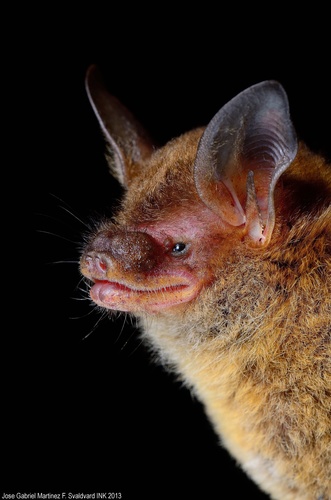
Small bat with dark chocolate-brown to blackish fur on the back, slightly paler underparts, and blackish wing membranes. It has small fleshy wattles or lobes at the corners of the mouth, giving rise to its common name, and relatively short, rounded ears.
Size
Body length approximately 4-5 cm, with a wingspan of around 23-26 cm; forearm length typically 33-38mm
Weight
Approximately 5-10 grams, with females sometimes slightly heavier than males
Distinctive features
Distinguished from similar Chalinolobus species by its uniform dark chocolate-brown coloration and the presence of wattles, as well as its smaller size compared to the Gould's Wattled Bat (Chalinolobus gouldii).
Differences between males and females
Minimal sexual dimorphism; females may be marginally larger than males, but overall size and coloration are similar between sexes
Behaviour and diet of the Chocolate Wattled Bat
Roosts in colonies ranging from a few individuals to several hundred, often in tree hollows, sometimes mixing with other bat species. Social structure within roosts is not strongly hierarchical.
When it is active
Strictly nocturnal, emerging after dusk to forage and returning to roost before dawn.
Diet
Insectivorous, feeding primarily on small flying insects such as moths, beetles, and other nocturnal insects caught in flight.
How it feeds and hunts
Uses echolocation to detect and capture prey in flight, typically foraging in open spaces along forest edges, over water, and in clearings below the tree canopy.
Communication
Communicates through echolocation calls for navigation and hunting, as well as social vocalizations within roosts for contact and coordination among colony members.
Interactions with other species
Predated upon by owls and other nocturnal birds of prey, as well as introduced predators such as cats; may share roosting hollows with other microbat species and competes with them for insect prey and roost sites.
Role in its ecosystem
Plays an important ecological role as a predator of nocturnal flying insects, helping to regulate insect populations in forest and woodland ecosystems.
Reproduction and lifecycle
Mating occurs in autumn, with females storing sperm over winter and delayed fertilization leading to births in spring or early summer; typically gives birth to a single pup, occasionally twins.
Raising the young
Females form maternity colonies where they give birth and raise young communally; pups are nursed and cared for until they are able to fly and forage independently, usually within 4-6 weeks.
Maturity and lifespan
Reaches sexual maturity at around 1 year of age; lifespan in the wild can reach up to 5-10 years, with some individuals recorded living longer.
Taxonomy and naming of the Chocolate Wattled Bat
Classification
Class Mammalia > Order Chiroptera > Family Vespertilionidae > Genus Chalinolobus > Species Chalinolobus morio
Scientific synonyms
Nycticejus morio, Chalinolobus morio morio
What research says
Recent studies
Recent studies have focused on the species' use of tree hollows and artificial roosting structures, as well as its resilience to habitat fragmentation in agricultural landscapes.
Compared with similar species
Similar to the Gould's Wattled Bat (Chalinolobus gouldii) but smaller and darker in coloration; both species share the characteristic facial wattles that distinguish the genus Chalinolobus from other vespertilionid bats.
The Chocolate Wattled Bat and people
Despite its name suggesting a sweet chocolate treat, the Chocolate Wattled Bat is named purely for its fur color, not any dietary preference. It can enter torpor even during summer nights if temperatures drop suddenly, showcasing remarkable physiological flexibility.
Where and how to see it
Best observed at dusk near forest edges, waterways, or woodland clearings in southern Australia during warmer months when bats are most active; bat detectors can help identify their echolocation calls.
Risks to humans
Low risk to humans; like other Australian bats, it may carry Australian Bat Lyssavirus, so direct handling should be avoided and only trained professionals should manage bat contact.
Countries where the Chocolate Wattled Bat is recorded
The 2 countries named in the range description of its IUCN Red List assessment.
Questions about the Chocolate Wattled Bat
Where does the Chocolate Wattled Bat live?
The Chocolate Wattled Bat is recorded in Australia and United Kingdom across Europe and Oceania. These countries come from the range description of its IUCN Red List assessment, and they are what place the species on the interactive map.
Is the Chocolate Wattled Bat endangered?
The IUCN Red List assesses the Chocolate Wattled Bat as Least Concern. The species is widespread and abundant enough not to qualify for any threatened category. It does not mean the species is safe forever, only that nothing in the current data raises an alarm.
How many are left in the wild?
No precise global population estimate exists, but the species is considered abundant and common across its range with a stable population trend. This figure comes from the species assessment on the IUCN Red List; population estimates for wild mammals are ranges, not counts, and are revised at each assessment.
What habitat does the Chocolate Wattled Bat live in?
Found in eucalypt forests, woodlands, coastal heathland, and riparian vegetation; also occurs in agricultural areas and urban parks with sufficient tree cover for roosting.
What is the scientific name of the Chocolate Wattled Bat?
The Chocolate Wattled Bat is Chalinolobus morio, in the family Vespertilionidae, order Chiroptera.
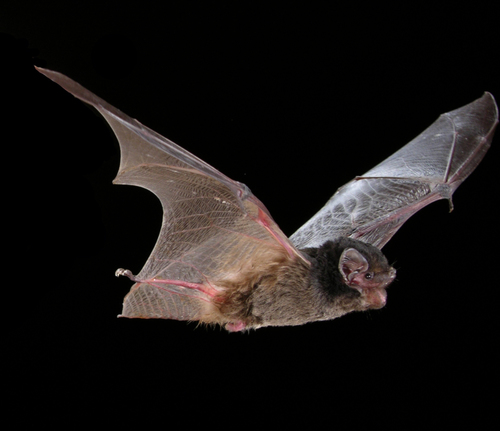
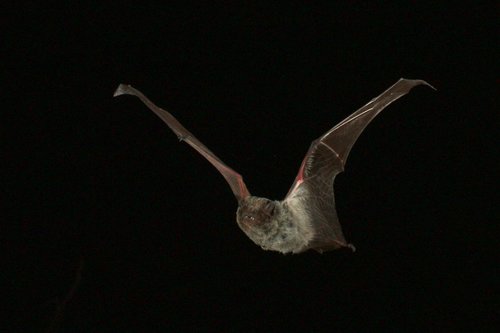
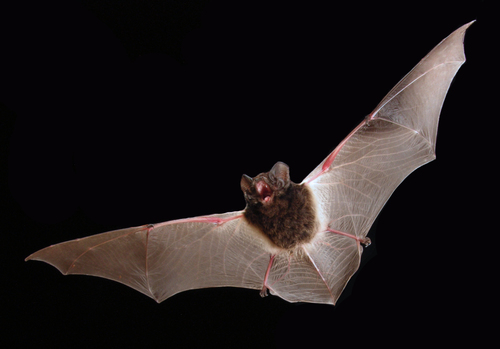
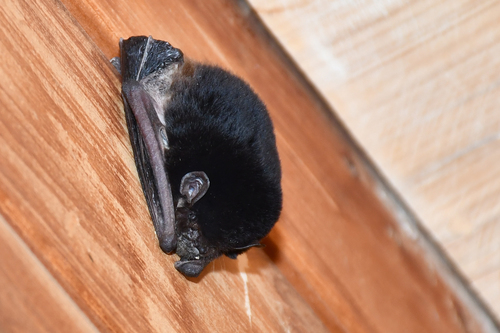
Other species in the genus Chalinolobus
Other species in the family Vespertilionidae
Species that share its range

Sources
Conservation status, range description and population estimate come from the IUCN Red List assessment for Chalinolobus morio. Countries are derived from that range description, not from a mapped country list. Last refreshed on .
The distribution map is drawn from the IUCN Red List spatial data compiled in 2008. IUCN (International Union for Conservation of Nature)