
Gould's Wattled Bat
Chalinolobus gouldii
Red List assessment
Least Concernon the IUCN Red List
- EXExtinct
- EWExtinct in the Wild
- CRCritically Endangered
- ENEndangered
- VUVulnerable
- NTNear Threatened
- LCLeast Concern
The Gould's Wattled Bat is recorded in 3 countries across Asia and Oceania. The IUCN Red List assesses the Gould's Wattled Bat as Least Concern. No precise global population estimate exists, but the species is considered abundant and common throughout its range with a presumed stable population trend.
- Family
- Vespertilionidae
- Order
- Chiroptera
- Genus
- Chalinolobus
- Countries recorded
- 3
- Continents
- Asia and Oceania
- Red List category
- Least Concern
- Data updated
- August 9, 2026
What is the Gould's Wattled Bat?
Gould's Wattled Bat is one of Australia's most widespread and common microbat species, found across nearly the entire continent including Tasmania. It is a medium-sized vespertilionid bat named for the fleshy 'wattle' lobes on its lower lip. Highly adaptable, it thrives in urban, agricultural, and natural habitats, making it a familiar bat to Australians and a valuable insect predator.
Where does the Gould's Wattled Bat live?
Australia (mainland and Tasmania), including Papua New Guinea
Found throughout mainland Australia, Tasmania, and parts of southern New Guinea. It is one of the most widely distributed bat species on the continent, absent only from the most extreme desert interiors.
Altitude and depth
Sea level to approximately 1500m elevation, though most commonly found in lowland and mid-elevation habitats.
Seasonal movements
Exhibits seasonal torpor during cooler months, especially in southern populations, reducing metabolic activity in winter. Breeding is highly seasonal with a defined mating period in autumn and births concentrated in spring/early summer.
Habitat of the Gould's Wattled Bat
Occupies an extremely broad range of habitats including eucalypt forests, woodlands, grasslands, arid scrublands, coastal heath, and urban/suburban environments. Roosts in tree hollows, under bark, in caves, mines, and man-made structures such as roofs and bridges.
Adaptations to its environment
Capable of entering torpor to survive cold periods and food scarcity, conserving energy during unfavorable conditions. Its broad wings and echolocation allow flexible foraging in cluttered and open environments alike, and its tolerance of diverse roost types (natural and artificial) supports its wide distribution.
Conservation status and numbers
Listed as Least Concern by the IUCN due to its wide distribution, large population, presumed large overall population size, and tolerance of modified habitats including urban areas.
Estimated population
No precise global population estimate exists, but the species is considered abundant and common throughout its range with a presumed stable population trend.
What threatens the Gould's Wattled Bat?
Loss of roosting hollows due to land clearing and removal of old-growth trees is a localized concern. Pesticide use reducing insect prey availability and disturbance at roost sites (including in buildings) also pose minor threats.
Diseases and parasites
Can host various ectoparasites such as bat mites and fleas, as well as endoparasites. Like other Australian bats, it can potentially carry lyssaviruses (e.g., Australian bat lyssavirus), though documented cases are rare.
What is being done to protect it?
Protected under various Australian state wildlife legislation as a native species; benefits indirectly from habitat protection in national parks and reserves. No species-specific conservation programs are required given its stable status.
Recommended actions
Continued retention of hollow-bearing trees in urban and agricultural landscapes to preserve roosting sites. Public education to reduce unnecessary destruction of bats found in buildings and promotion of bat-friendly urban planning.
What the Gould's Wattled Bat looks like
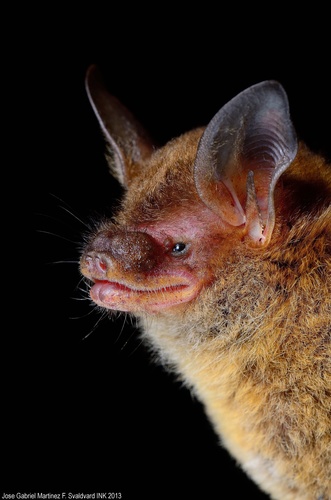
Fur is generally dark brown to blackish-brown on the back, with paler brown to grayish underparts. The face features the characteristic fleshy 'wattle' lobes at the corners of the mouth, and the ears are short and rounded.
Size
Body length approximately 5-6.5 cm, with a wingspan of roughly 25-30 cm and forearm length of 39-47mm.
Weight
Typically weighs between 8-18 grams, with some seasonal variation related to fat reserves before winter torpor.
Distinctive features
Distinguished from similar Chalinolobus species by its combination of dark dorsal fur, pale wattle lobes, and specific skull and dental characteristics. Its wide distribution and habitat flexibility also set it apart ecologically from more range-restricted relatives.
Differences between males and females
Minimal sexual dimorphism; males and females are similar in size and coloration, though females may be marginally larger on average.
Behaviour and diet of the Gould's Wattled Bat
Roosts in colonies ranging from a few individuals to several hundred, often segregated by sex outside of breeding season. Maternity colonies form in spring/summer with females gathering to raise young communally.
When it is active
Strictly nocturnal, emerging shortly after sunset to forage and returning to roost before dawn. Activity levels decrease significantly during cold winter periods due to torpor.
Diet
Insectivorous, feeding on a wide variety of flying insects including moths, beetles, mosquitoes, and other small arthropods. Diet composition varies seasonally based on insect availability.
How it feeds and hunts
Uses echolocation to detect and capture prey in flight, typically hunting in open or semi-open areas above canopy or along habitat edges. Employs agile, maneuverable flight to pursue and catch insects mid-air (aerial hawking).
Communication
Communicates primarily through echolocation calls used for both navigation and prey detection, as well as social calls for colony cohesion. Body language and physical contact within roost clusters also play a role in social interaction.
Interactions with other species
Natural predators include owls, some raptors, and introduced predators such as cats near urban roosts. Competes with other insectivorous bat species for food resources and roost sites, though its habitat flexibility reduces direct competition pressure.
Role in its ecosystem
Plays an important ecological role as a nocturnal insect predator, helping regulate populations of moths, beetles, and other pest insects. Contributes to ecosystem pest control services in both natural and agricultural landscapes.
Reproduction and lifecycle
Mating occurs in autumn (March-May), but females store sperm and delayed fertilization/implantation occurs, with births typically in November-December (spring). Litter size is usually one, occasionally two pups.
Raising the young
Females form maternity colonies to give birth and raise young communally, with pups being altricial and dependent on maternal care. Young are weaned and become flight-capable within 6-8 weeks after birth.
Maturity and lifespan
Sexual maturity is typically reached by one year of age. Lifespan in the wild can reach up to 8-10 years, with some individuals living longer under favorable conditions.
Taxonomy and naming of the Gould's Wattled Bat
Classification
Class Mammalia > Order Chiroptera > Family Vespertilionidae > Genus Chalinolobus > Species Chalinolobus gouldii
Scientific synonyms
Nyctophilus gouldii; Chalinolobus (formerly placed under Glauconycteris in older literature)
What research says
Recent studies
Recent research has focused on the species' use of urban roosts and its role in urban ecosystem pest control services. Studies have also examined echolocation call variation across its wide geographic range for species identification purposes.
Compared with similar species
Similar to other Chalinolobus species such as the Chocolate Wattled Bat (Chalinolobus morio), but Gould's Wattled Bat is generally larger with more grayish-brown underparts. It is more widespread and habitat-tolerant than most congeners, contributing to its ubiquity across Australia.
The Gould's Wattled Bat and people
Gould's Wattled Bat is one of the few Australian bat species commonly found roosting in urban roof spaces and buildings. Despite weighing less than a slice of bread, an individual can consume hundreds of insects in a single night. Its unusual lip 'wattles' give it a distinctive appearance among Australian microbats.
Where and how to see it
Best observed at dusk near water sources, forest edges, or urban parks where bats emerge to forage. Bat detectors (ultrasonic recorders) are commonly used by enthusiasts to detect and identify their echolocation calls, as visual identification in flight can be difficult.
Risks to humans
Low risk to humans; direct contact should be avoided due to small potential for rabies-like lyssavirus transmission through bites, though documented cases are extremely rare. Bats should not be handled without proper training and vaccination.
Countries where the Gould's Wattled Bat is recorded
The 3 countries named in the range description of its IUCN Red List assessment.
Questions about the Gould's Wattled Bat
Where does the Gould's Wattled Bat live?
The Gould's Wattled Bat is recorded in Australia, Indonesia and Papua New Guinea across Asia and Oceania. These countries come from the range description of its IUCN Red List assessment, and they are what place the species on the interactive map.
Is the Gould's Wattled Bat endangered?
The IUCN Red List assesses the Gould's Wattled Bat as Least Concern. The species is widespread and abundant enough not to qualify for any threatened category. It does not mean the species is safe forever, only that nothing in the current data raises an alarm.
How many are left in the wild?
No precise global population estimate exists, but the species is considered abundant and common throughout its range with a presumed stable population trend. This figure comes from the species assessment on the IUCN Red List; population estimates for wild mammals are ranges, not counts, and are revised at each assessment.
What habitat does the Gould's Wattled Bat live in?
Occupies an extremely broad range of habitats including eucalypt forests, woodlands, grasslands, arid scrublands, coastal heath, and urban/suburban environments.
What is the scientific name of the Gould's Wattled Bat?
The Gould's Wattled Bat is Chalinolobus gouldii, in the family Vespertilionidae, order Chiroptera.
Other species in the genus Chalinolobus
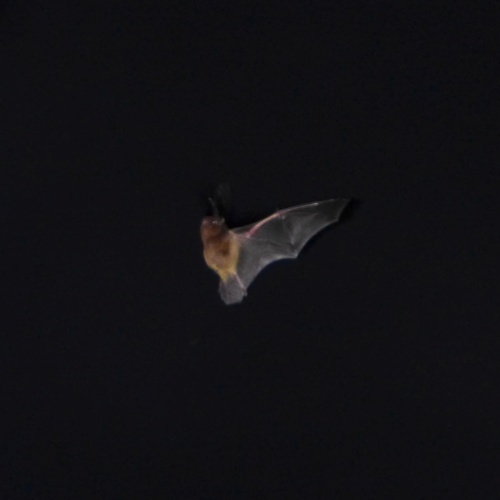
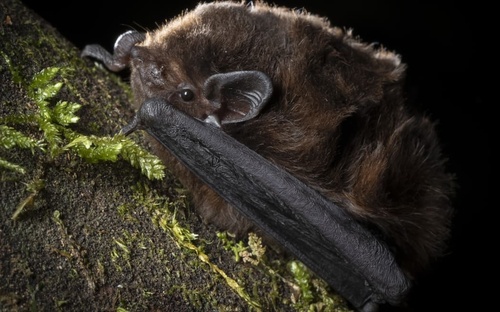
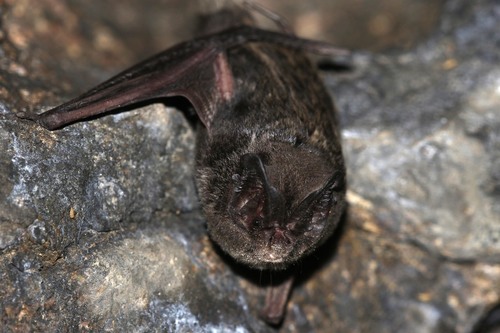
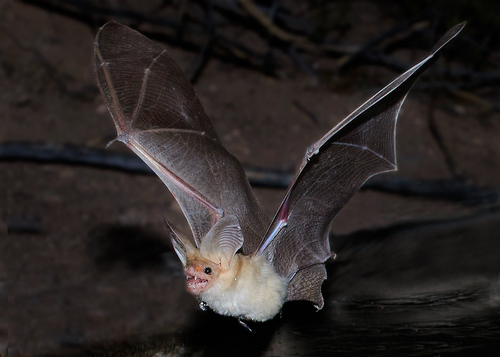
Other species in the family Vespertilionidae
Species that share its range

Sources
Conservation status, range description and population estimate come from the IUCN Red List assessment for Chalinolobus gouldii. Countries are derived from that range description, not from a mapped country list. Last refreshed on .
The distribution map is drawn from the IUCN Red List spatial data compiled in 2008. IUCN (International Union for Conservation of Nature)