
Barbastelle Bat
Barbastella barbastellus
Red List assessment
Near Threatenedon the IUCN Red List
- EXExtinct
- EWExtinct in the Wild
- CRCritically Endangered
- ENEndangered
- VUVulnerable
- NTNear Threatened
- LCLeast Concern
The Barbastelle Bat is recorded in 5 countries across Europe. The IUCN Red List assesses the Barbastelle Bat as Near Threatened. Population size is not precisely known but is considered to be declining in many parts of its range, particularly in intensively managed agricultural and forestry landscapes; some strongholds remain in Eastern Europe.
- Family
- Vespertilionidae
- Order
- Chiroptera
- Genus
- Barbastella
- Countries recorded
- 5
- Continents
- Europe
- Red List category
- Near Threatened
- Data updated
- August 9, 2026
What is the Barbastelle Bat?
The Barbastelle is a medium-small European bat notable for its distinctive pug-like face and broad, joined ears. It roosts in forests and old buildings across temperate Europe and is considered a flagship species for old-growth woodland conservation. It is remarkable for its unique, quiet echolocation calls that help it evade detection by moth prey with hearing adapted to bat sonar.
Where does the Barbastelle Bat live?
Europe, from the UK and Iberia to the Caucasus, including Lithuania where the given coordinates are located
Found throughout most of Europe from the British Isles and Iberian Peninsula in the west to the Caucasus and parts of the Near East in the east, including Lithuania, Poland, France, Germany, and the Mediterranean countries.
Altitude and depth
Typically found from sea level up to about 1,500-2,000 meters in mountainous regions of central and southern Europe.
Seasonal movements
Hibernates in winter (roughly October to March/April) in caves, tunnels, cellars, and tree hollows; migrates locally between summer forest roosts and winter hibernacula, though migrations are generally short-distance.
Habitat of the Barbastelle Bat
Primarily associated with mature deciduous and mixed forests with abundant dead wood, but also uses hedgerows, orchards, and riparian woodland; roosts under loose bark, in tree cavities, and occasionally in buildings.
Adaptations to its environment
Possesses low-intensity, narrowband echolocation calls that allow it to approach eared moths undetected, a key adaptation for hunting tympanate prey. Its dense fur and ability to enter torpor help it survive cold periods, and flexible roosting habits allow use of both natural and anthropogenic structures.
Conservation status and numbers
Classified as Near Threatened by the IUCN due to ongoing habitat loss and population declines across parts of its range, though it remains locally common in some well-forested regions. It is also listed on Annex II of the EU Habitats Directive, requiring special area protections.
Estimated population
Population size is not precisely known but is considered to be declining in many parts of its range, particularly in intensively managed agricultural and forestry landscapes; some strongholds remain in Eastern Europe.
What threatens the Barbastelle Bat?
Loss and fragmentation of mature forest habitat, removal of dead wood and old trees used for roosting, agricultural intensification and pesticide use reducing moth prey, and disturbance of hibernation and roost sites.
Diseases and parasites
Susceptible to ectoparasites such as bat flies and mites, and like many European bats, may carry certain lyssaviruses (rabies-related), though documented cases in this species are rare.
What is being done to protect it?
Protected under the EU Habitats Directive (Annex II and IV) and the Eurobats Agreement; conservation actions include designation of Special Areas of Conservation, retention of veteran trees and deadwood in managed forests, and roost/hibernacula protection programs in several countries.
Recommended actions
Prioritize retention and creation of deadwood and veteran trees in managed forests, protect and monitor known hibernacula and maternity roosts, reduce pesticide use to maintain moth prey populations, and expand forest connectivity between roosting and foraging areas.
What the Barbastelle Bat looks like
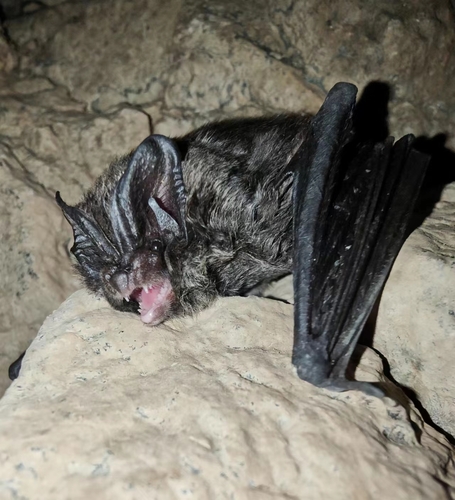
Distinctive blackish-brown to dark grey fur, a flattened pug-like face, and broad ears that are joined at the base across the forehead, giving it a unique silhouette among European bats. The wings and tail membrane are dark, and the fur often has a slightly frosted appearance due to pale-tipped hairs.
Size
Head-body length approximately 45-58 mm, with a wingspan of about 245-290 mm.
Weight
Typically weighs between 6-13 grams, with slight seasonal variation due to fat reserves before hibernation.
Distinctive features
The combination of a flat, pug-like snout and ears fused at the base distinguishes it clearly from other Vespertilionid bats in Europe, none of which share this exact ear structure.
Differences between males and females
Sexual dimorphism is minimal, with females being slightly larger than males on average, a common pattern among many bat species.
Behaviour and diet of the Barbastelle Bat
Forms small to moderate maternity colonies of typically 10-100 individuals in summer, often switching between multiple roost trees within a local area; males tend to roost more solitarily or in small groups outside the breeding season.
When it is active
Strictly nocturnal, emerging relatively late after dusk to forage, with activity peaks in the first few hours after sunset and before dawn.
Diet
Insectivorous, with a diet dominated by moths (Lepidoptera), especially small and medium-sized eared moths, supplemented occasionally by other soft-bodied insects.
How it feeds and hunts
Uses quiet, low-amplitude echolocation calls that reduce detection by moths' ultrasonic hearing, allowing stealthy aerial hawking and gleaning of prey from foliage in cluttered forest environments.
Communication
Communicates primarily through echolocation calls for navigation and hunting, along with social calls used for roost-mate recognition and mother-pup contact within colonies.
Interactions with other species
Preyed upon occasionally by owls and other nocturnal predators; competes with other insectivorous bat species for moth prey, though its unique low-intensity calls give it a niche advantage in hunting eared moths.
Role in its ecosystem
Plays an important ecological role as a natural regulator of nocturnal insect populations, particularly moths, contributing to pest control services in forest and agricultural ecosystems.
Reproduction and lifecycle
Mating occurs in autumn with delayed fertilization, and after hibernation females give birth to typically one (occasionally two) pup in June or July following an active gestation period of about 6-8 weeks post-fertilization.
Raising the young
Females raise pups in maternity colonies, nursing them for about 4-6 weeks until they are capable of independent flight and foraging; males do not participate in offspring care.
Maturity and lifespan
Reaches sexual maturity at around 1-2 years of age; lifespan in the wild can reach up to 20-23 years, making it relatively long-lived for its small body size.
Taxonomy and naming of the Barbastelle Bat
Classification
Class Mammalia > Order Chiroptera > Family Vespertilionidae > Genus Barbastella > Species Barbastella barbastellus
Subspecies
Barbastella barbastellus barbastellus (most of Europe) and Barbastella barbastellus guanchae (Canary Islands, sometimes treated as a separate species)
Scientific synonyms
Vespertilio barbastellus (original name given by Schreber in 1774)
What research says
Recent studies
Recent research has focused on its unique low-amplitude echolocation as an evolutionary counter-adaptation to moth hearing, as well as landscape genetics studies examining population connectivity across fragmented European forests.
Genome and DNA
The species has a diploid chromosome number of 2n=32, typical for many vespertilionid bats, though detailed genomic studies remain limited.
Compared with similar species
Compared to other Vespertilionid bats like the brown long-eared bat, the Barbastelle has shorter, differently shaped ears joined at the base and a much flatter facial profile, along with quieter echolocation calls suited to stealth hunting.
The Barbastelle Bat and people
The Barbastelle's whisper-quiet echolocation calls are so faint that scientists nickname it a 'stealth bat' for its ability to sneak up on moths with sensitive hearing. Its pug-like face and fused ears make it one of the most visually distinctive bats in Europe.
Where and how to see it
Best observed at dusk near mature woodland edges or river corridors in rural Europe during summer months, using bat detectors tuned to its characteristic quiet, low-frequency calls; hibernation sites in caves or tunnels can also be surveyed with appropriate permits in winter.
Risks to humans
No notable risk to humans; like all bats, direct handling should be avoided due to a very small potential risk of rabies-related virus transmission.
Human uses
Not used commercially, but valued for pest control services in agricultural and forest ecosystems, and serves as an indicator species for forest habitat quality in conservation monitoring programs.
Myths and legends
Like many bats, it has historically been associated with folklore surrounding witches and darkness in European rural traditions, though no myths are specific to this species alone.
Countries where the Barbastelle Bat is recorded
The 5 countries named in the range description of its IUCN Red List assessment.
Questions about the Barbastelle Bat
Where does the Barbastelle Bat live?
The Barbastelle Bat is recorded in France, Germany, Lithuania, Poland and United Kingdom across Europe. These countries come from the range description of its IUCN Red List assessment, and they are what place the species on the interactive map.
Is the Barbastelle Bat endangered?
The IUCN Red List assesses the Barbastelle Bat as Near Threatened. The species does not qualify as threatened today, but it is close to the thresholds and likely to cross them soon. It is the category that most often changes at the next assessment.
How many are left in the wild?
Population size is not precisely known but is considered to be declining in many parts of its range, particularly in intensively managed agricultural and forestry landscapes; some strongholds remain in Eastern Europe. This figure comes from the species assessment on the IUCN Red List; population estimates for wild mammals are ranges, not counts, and are revised at each assessment.
What habitat does the Barbastelle Bat live in?
Primarily associated with mature deciduous and mixed forests with abundant dead wood, but also uses hedgerows, orchards, and riparian woodland; roosts under loose bark, in tree cavities, and occasionally in buildings.
What is the scientific name of the Barbastelle Bat?
The Barbastelle Bat is Barbastella barbastellus, in the family Vespertilionidae, order Chiroptera.
Other species in the genus Barbastella
Other species in the family Vespertilionidae
Species that share its range

Sources
Conservation status, range description and population estimate come from the IUCN Red List assessment for Barbastella barbastellus. Countries are derived from that range description, not from a mapped country list. Last refreshed on .
The distribution map is drawn from the IUCN Red List spatial data compiled in 2016. IUCN (International Union for Conservation of Nature)