
New Caledonia Wattled Bat
Chalinolobus neocaledonicus
Red List assessment
Endangeredon the IUCN Red List
- EXExtinct
- EWExtinct in the Wild
- CRCritically Endangered
- ENEndangered
- VUVulnerable
- NTNear Threatened
- LCLeast Concern
The New Caledonia Wattled Bat is recorded in one country, New Caledonia across Oceania. The IUCN Red List assesses the New Caledonia Wattled Bat as Endangered. Exact population size is unknown but believed to be small and declining due to ongoing habitat loss; considered rare in survey records across its range.
- Family
- Vespertilionidae
- Order
- Chiroptera
- Genus
- Chalinolobus
- Countries recorded
- 1
- Continents
- Oceania
- Red List category
- Endangered
- Data updated
- August 9, 2026
What is the New Caledonia Wattled Bat?
The New Caledonia Wattled Bat is a small vespertilionid bat endemic to New Caledonia, distinguished by fleshy wattles or lobes on the lower lip that give the genus its name. It is a poorly studied insectivorous bat restricted to a small island archipelago, making it vulnerable to habitat changes. Its endemic status and limited range make it a conservation priority for Pacific island bat fauna.
Where does the New Caledonia Wattled Bat live?
New Caledonia (French overseas territory), South Pacific
Endemic to New Caledonia, a French territory in the southwest Pacific Ocean, including the main island (Grande Terre) and possibly nearby islets. It has a very restricted range compared to mainland relatives.
Altitude and depth
Generally found at low to mid elevations, roughly 0-800m, though precise altitudinal limits are not well documented.
Seasonal movements
No long-distance migration is known; the species likely shows some seasonal activity variation tied to insect abundance and the tropical wet/dry season cycle of New Caledonia.
Habitat of the New Caledonia Wattled Bat
Found in tropical and subtropical forests, including humid rainforest edges, dry sclerophyll forest, and areas near caves or rock crevices used for roosting. It appears to favor forested habitats with access to water sources and abundant insect prey.
Adaptations to its environment
Possesses echolocation for nocturnal insect hunting and wattled lip lobes possibly aiding in food handling or roost microhabitat use. Small body size and flight agility allow foraging in cluttered forest environments typical of island ecosystems.
Conservation status and numbers
Classified as Endangered (EN) by the IUCN due to its restricted range, small and likely declining population, and ongoing habitat degradation across New Caledonia. The species' endemism to a single island group increases its vulnerability to localized threats.
Estimated population
Exact population size is unknown but believed to be small and declining due to ongoing habitat loss; considered rare in survey records across its range.
What threatens the New Caledonia Wattled Bat?
Main threats include deforestation and habitat degradation from mining activities, agricultural expansion, invasive species (such as rats and feral cats preying on bats), and roost disturbance. Climate change and cyclone frequency may further threaten remaining populations.
Diseases and parasites
Specific diseases or parasites are not well documented for this species, though bats in general can host mites, ticks, and various viruses.
What is being done to protect it?
Some protection is afforded through New Caledonia's protected areas and forest reserves, and the species benefits indirectly from broader biodiversity conservation initiatives on the island. Specific targeted conservation programs for this bat are limited.
Recommended actions
Priority actions include systematic population surveys, roost site protection, mitigation of mining-related habitat loss, and control of invasive predators. Increased research funding and habitat connectivity restoration are also recommended.
What the New Caledonia Wattled Bat looks like
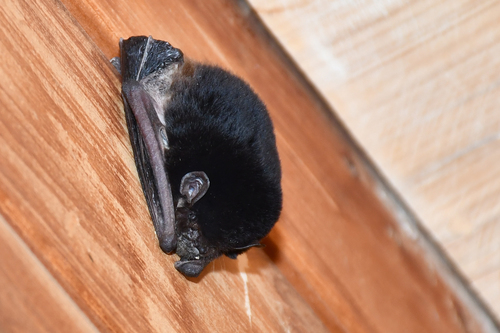
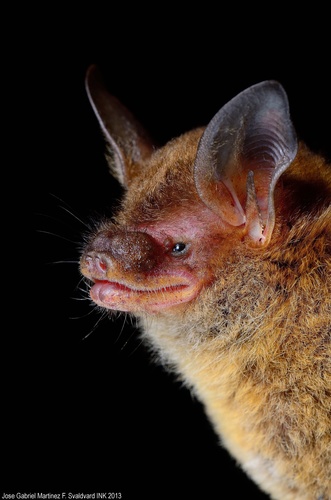
Small bat with dark brown to blackish fur, membranous wings, and characteristic fleshy wattles or lobes on the lower lip and chin area. The ears are relatively short and rounded, typical of the genus.
Size
Forearm length approximately 35-40mm; body length roughly 5-7cm excluding tail, with a wingspan estimated around 20-25cm, typical of small vespertilionid bats.
Weight
Approximately 5-10 grams, consistent with other small Chalinolobus species.
Distinctive features
Distinguished from related Chalinolobus species by subtle differences in wattle shape, skull morphology, and its restricted endemic range to New Caledonia, setting it apart from the more widespread Australian Chalinolobus gouldii.
Behaviour and diet of the New Caledonia Wattled Bat
Likely roosts in small colonies or solitary/pairs in tree hollows, caves, or crevices, similar to related Chalinolobus species, though detailed social structure data is lacking for this specific species.
When it is active
Nocturnal, emerging at dusk to forage for flying insects and returning to roosts before dawn.
Diet
Insectivorous, feeding on small flying insects such as moths, beetles, and other nocturnal arthropods caught in flight.
How it feeds and hunts
Uses echolocation to detect and capture insects while flying through forest understory and edges, likely employing aerial hawking behavior typical of vespertilionid bats.
Communication
Communicates primarily through echolocation calls for navigation and prey detection, along with social vocalizations within roosts for contact and possibly mating behavior.
Interactions with other species
Potential predators include introduced cats, rats, and birds of prey; competes with other insectivorous bats and possibly birds for aerial insect prey within its habitat.
Role in its ecosystem
Plays a role as an insectivorous predator helping regulate nocturnal insect populations within New Caledonian forest ecosystems, contributing to ecosystem balance.
Reproduction and lifecycle
Breeding biology is not well documented, but likely follows a pattern similar to related species with a single annual breeding season, gestation of a few months, and typically one pup per litter.
Raising the young
Presumed sole maternal care, with females nursing and carrying or roosting with pups until they are capable of independent flight, as is typical for small vespertilionid bats.
Maturity and lifespan
Sexual maturity is likely reached within the first year, with lifespan estimated at several years in the wild, though exact figures for this species are not well studied; related bats can live 5-10 years.
Taxonomy and naming of the New Caledonia Wattled Bat
Classification
Class Mammalia > Order Chiroptera > Family Vespertilionidae > Genus Chalinolobus > Species Chalinolobus neocaledonicus
Scientific synonyms
Previously sometimes considered a subspecies or synonym of Chalinolobus gouldii; taxonomic status has been debated in older literature.
What research says
Recent studies
Recent taxonomic and conservation assessments have reaffirmed its status as a distinct endemic species, but comprehensive ecological studies remain scarce, highlighting a need for further field research.
Compared with similar species
Similar to the Australian Chalinolobus gouldii but smaller and geographically isolated on New Caledonia; distinguished by subtle morphological and genetic differences reflecting its island endemism.
The New Caledonia Wattled Bat and people
This bat's genus name 'Chalinolobus' means 'bridled lobe,' referring to its distinctive lip wattles. It is one of the few native mammal species endemic to New Caledonia, an island known for its unique flora and fauna.
Where and how to see it
Best observed at dusk near forest edges or water sources in New Caledonia's remaining native forests; bat detectors can help identify echolocation calls since visual sightings are difficult due to its small size and nocturnal habits.
Risks to humans
No notable risk to humans; like most bats, it should not be handled due to general precautions against zoonotic disease transmission.
Countries where the New Caledonia Wattled Bat is recorded
The 1 countries named in the range description of its IUCN Red List assessment.
Questions about the New Caledonia Wattled Bat
Where does the New Caledonia Wattled Bat live?
The New Caledonia Wattled Bat is recorded in New Caledonia across Oceania. These countries come from the range description of its IUCN Red List assessment, and they are what place the species on the interactive map.
Is the New Caledonia Wattled Bat endangered?
Yes. The IUCN Red List assesses the New Caledonia Wattled Bat as Endangered, one of the three threatened categories. The species faces a very high risk of extinction in the wild — a step below Critically Endangered, but still on a trajectory that ends badly without intervention.
How many are left in the wild?
Exact population size is unknown but believed to be small and declining due to ongoing habitat loss; considered rare in survey records across its range. This figure comes from the species assessment on the IUCN Red List; population estimates for wild mammals are ranges, not counts, and are revised at each assessment.
What habitat does the New Caledonia Wattled Bat live in?
Found in tropical and subtropical forests, including humid rainforest edges, dry sclerophyll forest, and areas near caves or rock crevices used for roosting.
What is the scientific name of the New Caledonia Wattled Bat?
The New Caledonia Wattled Bat is Chalinolobus neocaledonicus, in the family Vespertilionidae, order Chiroptera.
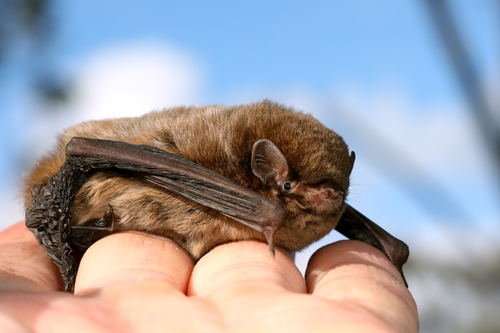
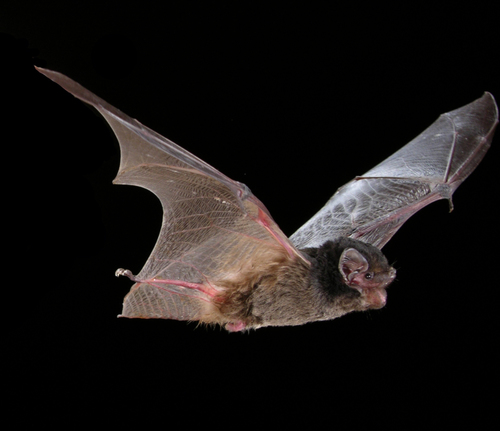
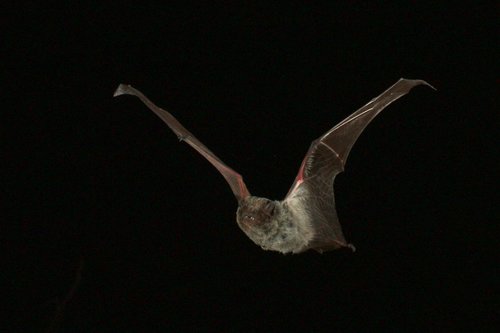
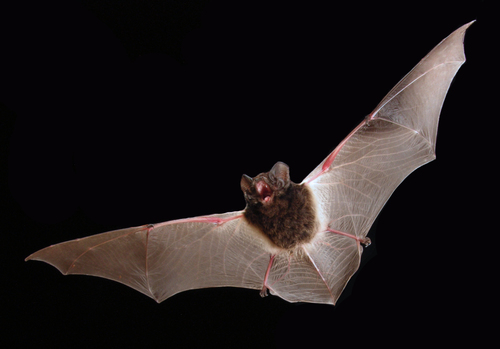
Other species in the genus Chalinolobus
Other species in the family Vespertilionidae
Sources
Conservation status, range description and population estimate come from the IUCN Red List assessment for Chalinolobus neocaledonicus. Countries are derived from that range description, not from a mapped country list. Last refreshed on .
The distribution map is drawn from the IUCN Red List spatial data compiled in 2020. IUCN (International Union for Conservation of Nature)