
Crested Porcupine
Hystrix cristata
Red List assessment
Least Concernon the IUCN Red List
- EXExtinct
- EWExtinct in the Wild
- CRCritically Endangered
- ENEndangered
- VUVulnerable
- NTNear Threatened
- LCLeast Concern
The Crested Porcupine is recorded in 9 countries across Africa and Europe. The IUCN Red List assesses the Crested Porcupine as Least Concern. No precise global population estimate exists, but the species is considered common and widespread across much of its range, with an overall stable population trend
- Family
- Hystricidae
- Order
- Rodentia
- Genus
- Hystrix
- Countries recorded
- 9
- Continents
- Africa and Europe
- Red List category
- Least Concern
- Data updated
- August 9, 2026
What is the Crested Porcupine?
The Crested Porcupine is the largest rodent in Africa and one of the largest in the world, easily recognized by its impressive crest of long bristles running along its back and its formidable array of black-and-white banded quills. It inhabits a wide range of habitats across northern and sub-Saharan Africa, and has also established a naturalized population in Italy since Roman times. This nocturnal, burrow-dwelling rodent is remarkable for its passive but highly effective defense mechanism, which can seriously injure or kill predators.
Where does the Crested Porcupine live?
North and sub-Saharan Africa, primarily Italy (introduced), Morocco, Algeria, Tunisia, Libya, and countries across West, Central and East Africa such as Senegal, Tanzania, and Kenya
Widely distributed across North Africa (Morocco, Algeria, Tunisia, Libya, Egypt) and much of sub-Saharan Africa from Senegal to Tanzania and south to parts of Central Africa; also naturalized in Italy since antiquity, likely introduced by Romans. Absent from the Sahara's most extreme desert zones and dense equatorial rainforest cores.
Altitude and depth
Occurs from sea level up to approximately 3000 meters in some mountainous regions of East Africa
Seasonal movements
No true hibernation or long-distance migration; activity may be reduced during extreme cold in northern range edges (e.g., Italy) but the species remains active year-round, sheltering in burrows during harsh weather
Habitat of the Crested Porcupine
Found in a wide variety of habitats including savanna, grassland, rocky hillsides, forest edges, cultivated land, and semi-desert regions, provided there is sufficient cover and soil suitable for burrowing. Avoids extremely arid deserts and dense rainforest interiors, favoring transitional zones and areas near water sources.
Adaptations to its environment
Possesses long, sharp, barbed quills used defensively against predators, along with a rattling tail apparatus that produces warning sounds. Its strong digging claws allow construction of extensive burrow systems for shelter and predator avoidance, and its robust digestive system enables it to process fibrous plant material.
Conservation status and numbers
Listed as Least Concern by IUCN due to its wide distribution, adaptability to various habitats including agricultural land, and generally stable population trends across most of its range, despite localized declines from hunting and habitat conversion.
Estimated population
No precise global population estimate exists, but the species is considered common and widespread across much of its range, with an overall stable population trend
What threatens the Crested Porcupine?
Main threats include hunting for bushmeat and traditional medicine, persecution as an agricultural pest due to crop-raiding behavior, and habitat loss from land conversion in some regions. Road mortality is also a localized concern near populated areas.
Diseases and parasites
Susceptible to various ectoparasites such as ticks and fleas, and can carry diseases like anthrax in some regions, though specific studies on porcupine-specific pathogens remain limited
What is being done to protect it?
Protected under national wildlife laws in several African countries and included in some protected areas and national parks across its range; in Italy it receives protection under national and EU wildlife regulations. No dedicated large-scale conservation programs exist due to its Least Concern status.
Recommended actions
Recommended actions include monitoring population trends in areas of high hunting pressure, promoting human-wildlife conflict mitigation strategies for farmers, and maintaining habitat connectivity in fragmented agricultural landscapes.
What the Crested Porcupine looks like
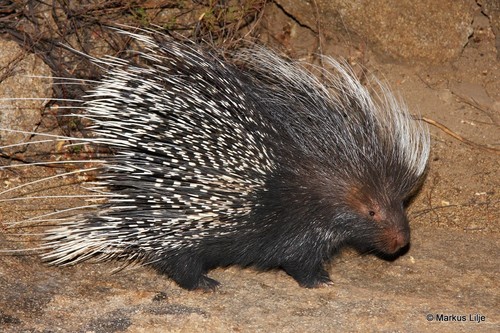
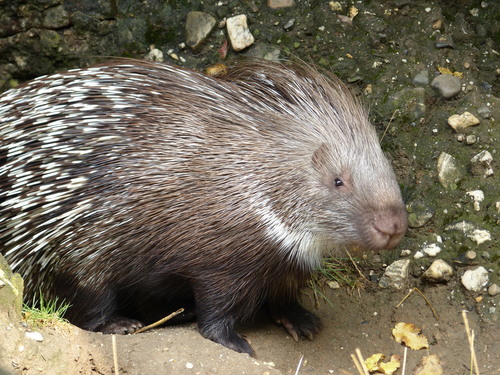
Covered in long black-and-white banded quills interspersed with coarse black and white bristles, with a prominent erectile crest of long bristles running from the head down the back. The underparts and legs are covered in shorter dark brown or blackish fur, and the tail bears specialized hollow quills that rattle when shaken.
Size
Body length typically ranges from 60 to 93 cm, with an additional tail of 8 to 17 cm; shoulder height is approximately 25 to 30 cm
Weight
Adults typically weigh between 10 and 27 kg, with males and females showing minimal size difference
Distinctive features
Distinguished from other porcupine species by its prominent dorsal crest of long bristles, larger overall size, and the distinctive rattling quills on its short tail used for warning displays.
Behaviour and diet of the Crested Porcupine
Generally lives in small family groups or monogamous pairs, occupying shared burrow systems with offspring from multiple litters; can be territorial and will defend burrow systems against intruders
When it is active
Strictly nocturnal, emerging from burrows after dusk to forage and returning before dawn; spends daylight hours resting in underground burrows or rock crevices
Diet
Primarily herbivorous, feeding on roots, tubers, bulbs, bark, fallen fruit, and cultivated crops such as potatoes and melons; occasionally gnaws bones and antlers to obtain minerals and sharpen incisors
Communication
Communicates through quill rattling as a warning signal, foot stamping, grunting and growling vocalizations, and scent marking of territory using specialized glands
Interactions with other species
Preyed upon occasionally by large carnivores such as lions, leopards, and hyenas, though its quills deter most predators; competes with other burrowing herbivores for food resources and sometimes shares burrow systems with other species like aardvarks
Role in its ecosystem
Plays a role in seed dispersal and soil aeration through its burrowing activity, and its foraging can influence local plant community structure by selectively feeding on roots and tubers
Reproduction and lifecycle
Breeding can occur year-round in favorable conditions, though births often peak in certain seasons depending on region; gestation lasts approximately 90 to 112 days, with litters typically consisting of 1 to 4 offspring that are weaned after about 13 weeks
Raising the young
Both parents may participate in raising the young within the shared burrow, with offspring remaining with the family group for an extended period before dispersing; young are born relatively well-developed with soft quills that harden within days
Maturity and lifespan
Reaches sexual maturity around 1.5 to 2 years of age; lifespan in the wild is typically 12 to 15 years, while captive individuals have been known to live up to 20 years
Taxonomy and naming of the Crested Porcupine
Classification
Class: Mammalia > Order: Rodentia > Family: Hystricidae > Genus: Hystrix > Species: Hystrix cristata
Subspecies
No universally recognized subspecies; some historical variants described but current taxonomy treats Hystrix cristata as monotypic, though populations across Africa show some regional variation in size and quill coloration.
Scientific synonyms
Hystrix cristata var. senegalica; historically some populations were classified under Hystrix galeata before being synonymized with H. cristata
What research says
Recent studies
Recent research has focused on the population genetics of the naturalized Italian population, suggesting ancient introduction possibly by Romans, as well as studies on its ecological impact as a burrowing ecosystem engineer
Genome and DNA
Diploid chromosome number reported as 2n=66; genetic studies remain relatively limited compared to other rodent species
Compared with similar species
Similar to the Indian Crested Porcupine (Hystrix indica) but generally larger with a more pronounced dorsal crest; distinguished from African brush-tailed porcupines (Atherurus) by its much larger size and lack of a tufted tail
The Crested Porcupine and people
Despite popular myth, porcupines cannot shoot their quills; they simply detach easily upon contact. The rattling sound produced by hollow tail quills serves as an effective warning before any physical confrontation, and this species has lived in Italy since at least Roman times, likely introduced deliberately as a food source.
Where and how to see it
Best observed at night using red-filtered flashlights or thermal imaging near known burrow entrances in savanna or rural agricultural areas; national parks in East Africa and rural regions of central Italy offer good observation opportunities during evening hours
Risks to humans
Generally poses no direct threat to humans unless cornered or threatened, in which case it may charge backward, driving quills into an attacker, which can cause painful puncture wounds or infections
Human uses
Hunted across parts of Africa for bushmeat and traditional medicine, with quills sometimes used decoratively or in traditional rituals; occasionally kept in captivity in zoos and wildlife parks for educational display
Myths and legends
In various African folklore traditions, the porcupine is often depicted as a clever or cunning creature due to its effective defense mechanisms; in some cultures its quills are used as protective talismans or ceremonial objects
Countries where the Crested Porcupine is recorded
The 9 countries named in the range description of its IUCN Red List assessment.
Questions about the Crested Porcupine
Where does the Crested Porcupine live?
The Crested Porcupine is recorded in Algeria, Egypt, Italy, Kenya and Libya, among 9 countries in total across Africa and Europe. These countries come from the range description of its IUCN Red List assessment, and they are what place the species on the interactive map.
Is the Crested Porcupine endangered?
The IUCN Red List assesses the Crested Porcupine as Least Concern. The species is widespread and abundant enough not to qualify for any threatened category. It does not mean the species is safe forever, only that nothing in the current data raises an alarm.
How many are left in the wild?
No precise global population estimate exists, but the species is considered common and widespread across much of its range, with an overall stable population trend This figure comes from the species assessment on the IUCN Red List; population estimates for wild mammals are ranges, not counts, and are revised at each assessment.
What habitat does the Crested Porcupine live in?
Found in a wide variety of habitats including savanna, grassland, rocky hillsides, forest edges, cultivated land, and semi-desert regions, provided there is sufficient cover and soil suitable for burrowing.
What is the scientific name of the Crested Porcupine?
The Crested Porcupine is Hystrix cristata, in the family Hystricidae, order Rodentia.
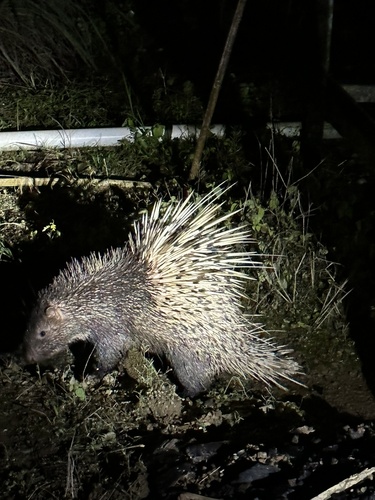
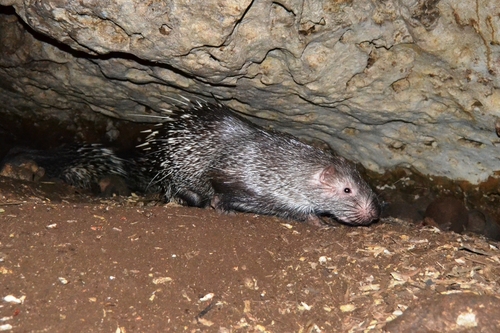
Other species in the genus Hystrix
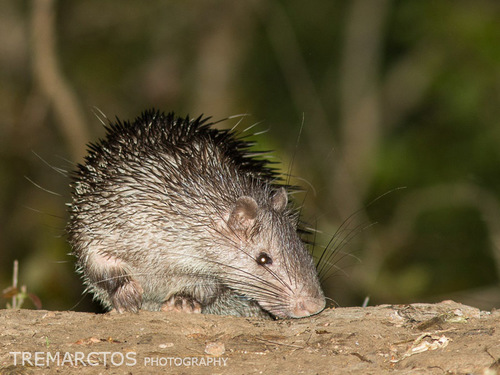
Other species in the family Hystricidae

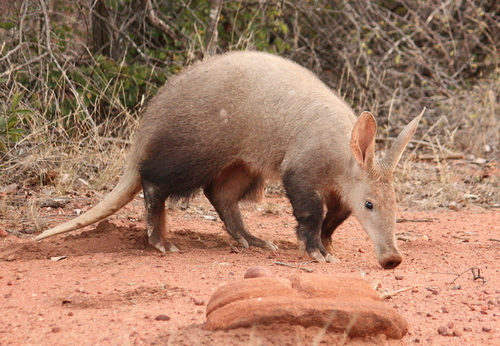
Species that share its range
Sources
Conservation status, range description and population estimate come from the IUCN Red List assessment for Hystrix cristata. Countries are derived from that range description, not from a mapped country list. Last refreshed on .
The distribution map is drawn from the IUCN Red List spatial data compiled in 2014. IUCN (International Union for Conservation of Nature)