
West Indian Manatee
Trichechus manatus
Red List assessment
Vulnerableon the IUCN Red List
- EXExtinct
- EWExtinct in the Wild
- CRCritically Endangered
- ENEndangered
- VUVulnerable
- NTNear Threatened
- LCLeast Concern
The West Indian Manatee is recorded in 8 countries across North America and South America. The IUCN Red List assesses the West Indian Manatee as Vulnerable. Approximately 13,000 individuals globally, with the Florida subspecies representing around 8,000-10,000 individuals and populations showing mixed trends across different countries.
- Family
- Trichechidae
- Order
- Sirenia
- Genus
- Trichechus
- Countries recorded
- 8
- Continents
- North America and South America
- Red List category
- Vulnerable
- Data updated
- August 9, 2026
What is the West Indian Manatee?
The West Indian Manatee is a large, gentle aquatic mammal known for its slow movements and herbivorous diet, inhabiting warm coastal waters, estuaries, and rivers of the Americas. It is remarkable for its close evolutionary relationship to elephants and its role as a keystone species in seagrass ecosystems. Often called a 'sea cow,' it has captivated human imagination for centuries, historically inspiring mermaid legends. Despite its size, it is entirely peaceful and poses no threat to humans.
Where does the West Indian Manatee live?
Florida (USA), Caribbean islands, Gulf of Mexico, and northern coasts of South America including Brazil, Venezuela, and Colombia
Found along the southeastern United States (primarily Florida), throughout the Caribbean Sea including islands such as Cuba, Puerto Rico, and Jamaica, along the Gulf of Mexico coast, and southward along the coasts of Mexico, Central America, and northern South America to Brazil.
Altitude and depth
0-10 meters, generally in shallow waters; occasionally found slightly deeper in open coastal areas.
Seasonal movements
In temperate parts of their range like Florida, manatees migrate seasonally to warm-water refuges such as natural springs or power plant outflows during winter to avoid cold stress.
Habitat of the West Indian Manatee
Shallow coastal waters, estuaries, rivers, and springs with warm temperatures and abundant aquatic vegetation. They favor slow-moving or calm waters with access to freshwater for drinking and seagrass beds for feeding.
Adaptations to its environment
Their large, paddle-like tail and flexible flippers allow efficient movement in shallow waters, while a thick layer of blubber-like fat provides some insulation, though limited compared to other marine mammals. Their slow metabolism and warm-water dependency reflect adaptation to tropical and subtropical aquatic environments.
Conservation status and numbers
Listed as Vulnerable by the IUCN due to ongoing habitat loss, boat strikes, and pollution affecting population stability, despite localized recovery efforts. Population trends vary by region, with Florida showing recovery while other areas face decline.
Estimated population
Approximately 13,000 individuals globally, with the Florida subspecies representing around 8,000-10,000 individuals and populations showing mixed trends across different countries.
What threatens the West Indian Manatee?
Boat strikes, habitat degradation from coastal development, pollution, loss of seagrass beds, entanglement in fishing gear, and cold stress events due to loss of warm-water refuges.
Diseases and parasites
Susceptible to cold stress syndrome, papillomavirus, and various parasites; harmful algal blooms (red tide) can cause fatal neurotoxic poisoning.
What is being done to protect it?
Protected under the U.S. Endangered Species Act and Marine Mammal Protection Act, with designated manatee protection zones, speed limits for boats, and rehabilitation programs. Various Caribbean and Latin American countries have also implemented protective legislation and habitat conservation initiatives.
Recommended actions
Strengthen enforcement of boat speed regulations, protect and restore seagrass habitats, secure warm-water refuges threatened by power plant closures, and expand cross-border conservation cooperation throughout the Caribbean and South America.
What the West Indian Manatee looks like
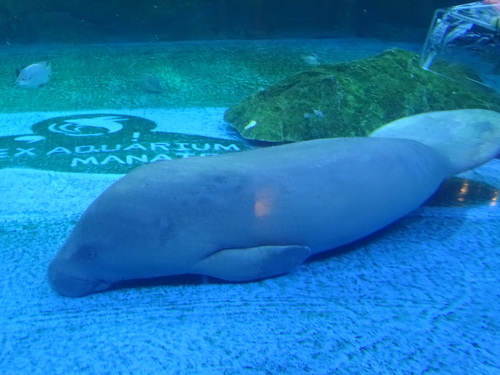
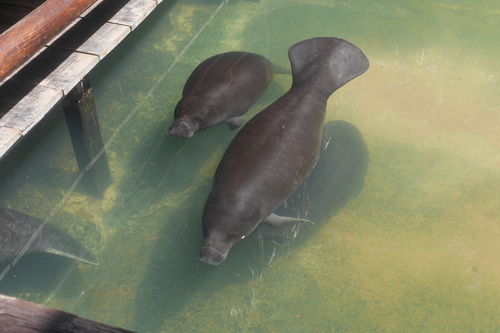
Manatees have a rounded, robust body, wrinkled gray-brown skin, a paddle-shaped tail, and two forelimbs with nails. Their face features a whiskered, prehensile upper lip used for grasping vegetation.
Size
Adults typically measure 2.5 to 4.5 meters in length.
Weight
Adults generally weigh between 400 and 590 kg, with some large individuals exceeding 1,500 kg.
Distinctive features
Distinguished from the Amazonian manatee by its larger size, coastal/marine habitat use, and presence of nails on flippers; distinguished from dugongs by its rounded paddle tail rather than a fluked tail.
Differences between males and females
Minimal sexual dimorphism; males and females are similar in size, though females may grow slightly larger on average.
Behaviour and diet of the West Indian Manatee
Generally solitary or found in small, loose groups, though larger aggregations occur in warm-water refuges during winter. Social bonds are weak except between mothers and calves.
When it is active
Primarily crepuscular and diurnal, alternating between periods of feeding and resting throughout the day and night.
Diet
Herbivorous, feeding on a wide variety of submerged, floating, and emergent aquatic vegetation including seagrasses, mangrove leaves, and freshwater plants.
Communication
Manatees communicate through a range of vocalizations such as chirps and squeaks, especially between mothers and calves, along with touch and body positioning.
Interactions with other species
Manatees have few natural predators due to their size, though young calves may occasionally be vulnerable to large sharks or crocodilians. They often share habitat with fish species that feed on algae growing on their skin.
Role in its ecosystem
As grazers of seagrass beds, manatees help maintain healthy seagrass ecosystems by promoting new growth through their feeding activity, playing an important role in coastal marine ecology.
Reproduction and lifecycle
Breeding can occur year-round, with a gestation period of about 12-14 months and typically a single calf born per pregnancy. Calves are weaned after 1-2 years but may stay close to their mothers during this period.
Raising the young
Mothers provide extensive care, nursing and guiding calves for one to two years, teaching them feeding areas and migratory routes.
Maturity and lifespan
Sexual maturity is typically reached between 3-5 years old; lifespan in the wild can reach up to 40-60 years under favorable conditions.
Taxonomy and naming of the West Indian Manatee
Classification
Class Mammalia > Order Sirenia > Family Trichechidae > Genus Trichechus > Species Trichechus manatus
Subspecies
Trichechus manatus latirostris (Florida manatee, found in Florida and southeastern USA) and Trichechus manatus manatus (Antillean manatee, found throughout the Caribbean, Gulf of Mexico, and northern South America).
Scientific synonyms
Manatus americanus, Trichechus latirostris (older classifications sometimes treated Florida manatee as a separate species).
What research says
Recent studies
Recent studies focus on the impacts of climate change on warm-water refuge availability and the effects of seagrass habitat loss due to nutrient pollution in Florida waters.
Genome and DNA
The manatee genome has been sequenced, revealing insights into adaptations for aquatic life and slow metabolic rate; diploid chromosome number is 2n=48.
Compared with similar species
Similar in general body form to the Amazonian manatee and dugong but larger and more tolerant of brackish and marine waters than the freshwater-restricted Amazonian species.
The West Indian Manatee and people
Manatees are believed to have inspired ancient mermaid legends among sailors; despite their bulk, they can float, dive, and maneuver with surprising grace; their closest living relatives are elephants rather than other marine mammals.
Where and how to see it
Best observed in Florida's warm-water springs and rivers such as Crystal River during winter months when manatees gather in large numbers seeking warmth.
Risks to humans
No notable risk; manatees are non-aggressive and pose no threat to humans.
Human uses
Historically hunted for meat, oil, and hides in some regions; today primarily valued for ecotourism, particularly manatee-watching activities in Florida and the Caribbean.
Myths and legends
Historical sailors, including explorers like Christopher Columbus, reportedly mistook manatees for mermaids due to their humanlike movements in water.
Countries where the West Indian Manatee is recorded
The 8 countries named in the range description of its IUCN Red List assessment.
Questions about the West Indian Manatee
Where does the West Indian Manatee live?
The West Indian Manatee is recorded in Brazil, Colombia, Cuba, Jamaica and Mexico, among 8 countries in total across North America and South America. These countries come from the range description of its IUCN Red List assessment, and they are what place the species on the interactive map.
Is the West Indian Manatee endangered?
Yes. The IUCN Red List assesses the West Indian Manatee as Vulnerable, one of the three threatened categories. The species faces a high risk of extinction in the wild. It is the first of the three threatened categories: numbers are falling, the range is shrinking, or the population is small enough that a single bad event could do lasting damage.
How many are left in the wild?
Approximately 13,000 individuals globally, with the Florida subspecies representing around 8,000-10,000 individuals and populations showing mixed trends across different countries. This figure comes from the species assessment on the IUCN Red List; population estimates for wild mammals are ranges, not counts, and are revised at each assessment.
What habitat does the West Indian Manatee live in?
Shallow coastal waters, estuaries, rivers, and springs with warm temperatures and abundant aquatic vegetation.
What is the scientific name of the West Indian Manatee?
The West Indian Manatee is Trichechus manatus, in the family Trichechidae, order Sirenia.
Other species in the genus Trichechus
Species that share its range
Sources
Conservation status, range description and population estimate come from the IUCN Red List assessment for Trichechus manatus. Countries are derived from that range description, not from a mapped country list. Last refreshed on .
The distribution map is drawn from the IUCN Red List spatial data compiled in 2024. IUCN (International Union for Conservation of Nature)