
Mona Monkey
Cercopithecus mona
Red List assessment
Near Threatenedon the IUCN Red List
- EXExtinct
- EWExtinct in the Wild
- CRCritically Endangered
- ENEndangered
- VUVulnerable
- NTNear Threatened
- LCLeast Concern
The Mona Monkey is recorded in 6 countries across Africa and North America. The IUCN Red List assesses the Mona Monkey as Near Threatened. No precise global population figure exists, but the species is considered common in suitable habitat within its native range; native populations are believed to be declining slowly, while the introduced Grenada population is stable to increasing.
- Family
- Cercopithecidae
- Order
- Primates
- Genus
- Cercopithecus
- Countries recorded
- 6
- Continents
- Africa and North America
- Red List category
- Near Threatened
- Data updated
- August 9, 2026
What is the Mona Monkey?
The Mona Monkey is a medium-sized, brightly colored Old World monkey native to the forests of West Africa, notable for its striking coat pattern and adaptability to disturbed habitats. It has also been successfully introduced to the Caribbean island of Grenada, where it now thrives in a feral population descended from animals brought during the colonial era. Highly social and vocal, it lives in cohesive multi-male or single-male groups and is a key seed disperser in its forest ecosystem.
Where does the Mona Monkey live?
Native to West and Central Africa (Ghana, Togo, Benin, Nigeria, Cameroon); also introduced to the Caribbean island of Grenada and São Tomé.
Native range spans coastal West Africa from Ghana through Togo, Benin, and Nigeria to Cameroon; introduced populations occur on São Tomé island and on Grenada in the Lesser Antilles, likely arriving via the transatlantic slave trade centuries ago.
Altitude and depth
Generally found from sea level up to about 1,500 meters, though most populations occur below 1,000 meters in lowland and lower montane forest.
Seasonal movements
No true hibernation or long-distance migration; activity and ranging patterns shift seasonally with fruit availability during wet and dry seasons.
Habitat of the Mona Monkey
Primarily inhabits primary and secondary tropical rainforest, gallery forest, and forest-savanna mosaics; also found in mangroves, plantations, and secondary growth near human settlements. In Grenada it occupies dry forest, rainforest, and agricultural edge habitats.
Adaptations to its environment
Its flexible omnivorous diet and tolerance of habitat disturbance allow it to persist in fragmented and secondary forests as well as agricultural mosaics. Strong limbs and a long tail aid agile arboreal locomotion, while cheek pouches allow rapid food storage during foraging bouts in risky, open areas.
Conservation status and numbers
Classified as Near Threatened by the IUCN due to ongoing habitat loss and hunting pressure in parts of its native range, though it remains relatively common and adaptable compared to many other forest primates.
Estimated population
No precise global population figure exists, but the species is considered common in suitable habitat within its native range; native populations are believed to be declining slowly, while the introduced Grenada population is stable to increasing.
What threatens the Mona Monkey?
Main threats include deforestation and habitat fragmentation for agriculture and logging, bushmeat hunting, and capture for the pet trade in parts of West Africa.
Diseases and parasites
Susceptible to various intestinal parasites and can carry simian viruses; interactions with humans and other primates raise concerns about zoonotic disease transmission.
What is being done to protect it?
Protected in several national parks and forest reserves across its West African range (e.g., in Ghana and Nigeria); listed on CITES Appendix II regulating international trade; the Grenada population is monitored informally as a tourist attraction and naturalized species.
Recommended actions
Priority actions include strengthening enforcement against illegal hunting and pet trade, protecting remaining forest habitat corridors, and conducting updated population surveys across its native range.
What the Mona Monkey looks like
The Mona Monkey has a reddish-brown to olive back, white underparts, and a distinctive black-and-white facial pattern with a pale forehead band and dark cheek stripes. The tail is long, dark, and often held arched over the back while moving.
Size
Head-body length ranges from about 40 to 60 cm, with a tail typically longer than the body, around 55-75 cm.
Weight
Adult males weigh approximately 4-5.5 kg, while females are smaller, weighing around 3-4 kg.
Distinctive features
It is distinguished from close relatives like the Campbell's monkey by its brighter coloring, more contrasting facial mask, and white patches on the rump and thighs that flash during movement.
Differences between males and females
Males are noticeably larger and heavier than females and possess more prominent canine teeth, though coloration is similar between sexes.
Behaviour and diet of the Mona Monkey
Mona Monkeys live in social groups of 5 to 35 individuals, typically organized around one or a few adult males with multiple females and their offspring; groups sometimes merge temporarily with other monkey species for foraging.
When it is active
Diurnal, with peak activity in the early morning and late afternoon; they rest and socialize during the hottest midday hours.
Diet
Omnivorous, feeding mainly on fruits, seeds, leaves, flowers, and invertebrates such as insects; they will also raid crops like maize, cocoa, and bananas near human settlements.
How it feeds and hunts
Not a hunter in the predatory sense; forages opportunistically through the canopy and understory, using cheek pouches to quickly gather food, especially when raiding exposed crop areas.
Communication
Communicates through a range of vocalizations including loud calls for group cohesion and alarm, as well as facial expressions, tail postures, and scent marking to convey social and territorial information.
Interactions with other species
Natural predators include large raptors, snakes, and forest carnivores such as leopards where present; Mona Monkeys often form polyspecific associations with other guenons for enhanced predator detection while foraging.
Role in its ecosystem
Plays an important ecological role as a seed disperser for many forest fruiting trees, contributing to forest regeneration and plant diversity.
Reproduction and lifecycle
Breeding is not strictly seasonal, though births may peak with fruit abundance; gestation lasts about 5-6 months, and females typically give birth to a single infant.
Raising the young
Mothers provide the primary care, nursing and carrying infants for several months, with weaning occurring around 6-12 months; other group females sometimes engage in allomothering behavior.
Maturity and lifespan
Sexual maturity is typically reached around 4-5 years in females and slightly later in males; lifespan in the wild is around 15-20 years, extending to over 25 years in captivity.
Taxonomy and naming of the Mona Monkey
Classification
Class Mammalia > Order Primates > Family Cercopithecidae > Genus Cercopithecus > Species Cercopithecus mona
Subspecies
No widely recognized subspecies; some authors consider populations in different parts of West/Central Africa as showing clinal variation rather than distinct subspecies.
Scientific synonyms
Simia mona (Schreber, 1774); occasionally placed in the Cercopithecus mona species group alongside C. campbelli and C. lowei.
What research says
Recent studies
Recent research has focused on the genetics and origins of the introduced Grenada population, confirming its West African ancestry and examining its ecological impact on the island's native fauna.
Genome and DNA
The Mona Monkey has a diploid chromosome number of 2n=72, consistent with many Cercopithecus species, though detailed genomic studies remain limited.
Compared with similar species
Compared to the closely related Campbell's Monkey (Cercopithecus campbelli), the Mona Monkey has brighter, more contrasting coloration and a wider native range; it is generally more adaptable to disturbed habitats than many other forest guenons.
The Mona Monkey and people
Mona Monkeys were transported to the Caribbean centuries ago, likely by enslaved Africans or slave ships, establishing a thriving population in Grenada far from their native range. They are known for their acrobatic leaps between trees and their loud, distinctive alarm calls that can be heard echoing through the forest.
Where and how to see it
Best observed in early morning or late afternoon in West African forest reserves such as Ghana's Kakum National Park, or more easily in Grenada's forested interior where the introduced population is habituated to human presence.
Risks to humans
Generally poses no serious risk to humans, though they may raid crops and can bite if cornered or handled; as with all primates, there is a small risk of zoonotic disease transmission through close contact.
Human uses
Occasionally hunted for bushmeat in parts of West Africa and sometimes kept as pets; in Grenada, the population has become a notable tourist attraction supporting local ecotourism.
Myths and legends
In parts of West Africa, monkeys including the Mona are sometimes featured in local folklore as clever tricksters, though no widespread specific myth is solely attributed to this species.
Countries where the Mona Monkey is recorded
The 6 countries named in the range description of its IUCN Red List assessment.
Questions about the Mona Monkey
Where does the Mona Monkey live?
The Mona Monkey is recorded in Benin, Cameroon, Ghana, Grenada and Nigeria, among 6 countries in total across Africa and North America. These countries come from the range description of its IUCN Red List assessment, and they are what place the species on the interactive map.
Is the Mona Monkey endangered?
The IUCN Red List assesses the Mona Monkey as Near Threatened. The species does not qualify as threatened today, but it is close to the thresholds and likely to cross them soon. It is the category that most often changes at the next assessment.
How many are left in the wild?
No precise global population figure exists, but the species is considered common in suitable habitat within its native range; native populations are believed to be declining slowly, while the introduced Grenada population is stable to increasing. This figure comes from the species assessment on the IUCN Red List; population estimates for wild mammals are ranges, not counts, and are revised at each assessment.
What habitat does the Mona Monkey live in?
Primarily inhabits primary and secondary tropical rainforest, gallery forest, and forest-savanna mosaics; also found in mangroves, plantations, and secondary growth near human settlements.
What is the scientific name of the Mona Monkey?
The Mona Monkey is Cercopithecus mona, in the family Cercopithecidae, order Primates.
Other species in the genus Cercopithecus
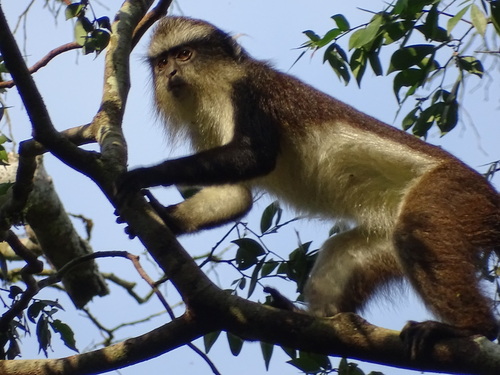
Other species in the family Cercopithecidae
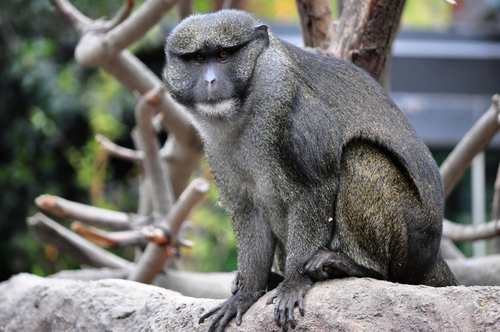
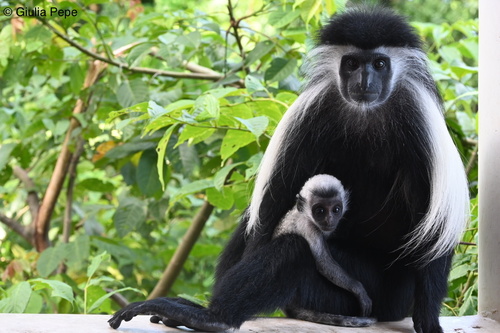
Sources
Conservation status, range description and population estimate come from the IUCN Red List assessment for Cercopithecus mona. Countries are derived from that range description, not from a mapped country list. Last refreshed on .
The distribution map is drawn from the IUCN Red List spatial data compiled in 2018. IUCN (International Union for Conservation of Nature)