
Rhesus Monkey
Macaca mulatta
Red List assessment
Least Concernon the IUCN Red List
- EXExtinct
- EWExtinct in the Wild
- CRCritically Endangered
- ENEndangered
- VUVulnerable
- NTNear Threatened
- LCLeast Concern
The Rhesus Monkey is recorded in 13 countries across Asia and North America. The IUCN Red List assesses the Rhesus Monkey as Least Concern. Global population is likely in the millions, with stable or increasing trends in many areas due to adaptability, though some regional populations are declining due to habitat pressures.
- Family
- Cercopithecidae
- Order
- Primates
- Genus
- Macaca
- Countries recorded
- 13
- Continents
- Asia and North America
- Red List category
- Least Concern
- Data updated
- August 9, 2026
What is the Rhesus Monkey?
The rhesus monkey is one of the most widely distributed and best-studied primate species, ranging across a vast area of Asia from Afghanistan to China. It is a medium-sized macaque highly adaptable to diverse habitats including forests, grasslands, and urban environments. Renowned for its role in biomedical research, it has contributed enormously to human medicine, including the discovery of the Rh blood factor. Its intelligence, social complexity, and ecological flexibility make it a remarkable model species for studying primate behavior.
Where does the Rhesus Monkey live?
South, Central and Southeast Asia, primarily India, Pakistan, Nepal, Bangladesh, Myanmar, Thailand, and southern China
Widely distributed from Afghanistan and Pakistan through northern India, Nepal, Bhutan, Bangladesh, Myanmar, Thailand, Laos, Vietnam, and into southern and central China. Also introduced populations exist in Florida (USA) and Puerto Rico.
Altitude and depth
Sea level up to approximately 2500-3000 meters in the Himalayan foothills
Seasonal movements
No true hibernation or migration, but breeding is seasonal in most populations, typically occurring in autumn/winter with births concentrated in spring.
Habitat of the Rhesus Monkey
Highly adaptable, inhabiting tropical and subtropical forests, dry deciduous woodlands, grasslands, mountainous regions, and human-modified landscapes including cities, temples, and agricultural areas. Often found near water sources and human settlements where food is accessible.
Adaptations to its environment
Highly adaptable digestive system allows consumption of a broad range of foods; cheek pouches enable food storage for later consumption. Thick fur provides insulation in cooler climates, and strong social structures aid in resource competition and predator avoidance.
Conservation status and numbers
Listed as Least Concern (LC) by IUCN due to its wide distribution, large population size, and adaptability to human-altered environments. However, some regional populations face localized declines due to habitat loss and human conflict.
Estimated population
Global population is likely in the millions, with stable or increasing trends in many areas due to adaptability, though some regional populations are declining due to habitat pressures.
What threatens the Rhesus Monkey?
Habitat destruction from deforestation and urbanization, hunting for traditional medicine and bushmeat in some regions, capture for biomedical research trade, and human-wildlife conflict due to crop raiding.
Diseases and parasites
Susceptible to various parasites including intestinal worms and ectoparasites; can carry diseases transmissible to humans such as Herpes B virus and tuberculosis, making close contact with humans a health concern.
What is being done to protect it?
Protected under CITES Appendix II regulating international trade; various national wildlife protection laws in range countries; some populations managed in protected reserves and sanctuaries, particularly in India and China.
Recommended actions
Improved habitat protection and connectivity, regulation of the biomedical trade to ensure sustainability, mitigation of human-monkey conflict through community education, and monitoring of regional population trends.
What the Rhesus Monkey looks like
Robust body covered in brown to grey-brown fur, with a lighter underside and a distinctive pink to red face and rump that becomes more vivid during breeding season. The tail is medium-length and non-prehensile.
Size
Body length (head and body) ranges from 47-53 cm in males and 47-53 cm in females, with males generally slightly larger; tail length adds 20-30 cm.
Weight
Males typically weigh 5.3-10.9 kg, while females weigh 3.4-10.9 kg on average, with males generally heavier.
Distinctive features
Distinguished from other macaques by its shorter tail relative to body length, characteristic red facial and rump skin, and golden-brown dorsal fur. Its wide geographic range and habitat flexibility also set it apart from more range-restricted macaque species.
Differences between males and females
Males are generally larger and heavier than females, with more pronounced canine teeth used in social displays and dominance interactions.
Behaviour and diet of the Rhesus Monkey
Highly social, living in complex multi-male, multi-female troops ranging from 20 to over 200 individuals. Society is organized around matrilineal dominance hierarchies, with females remaining in their natal troop for life while males typically disperse at maturity.
When it is active
Diurnal, active during daylight hours with peak activity in early morning and late afternoon, resting during the hottest part of the day.
Diet
Omnivorous, feeding on a wide variety of fruits, seeds, leaves, roots, insects, and occasionally small vertebrates; readily exploits human food sources including crops and garbage in urban areas.
How it feeds and hunts
Not a hunter in the traditional sense; forages opportunistically, using cheek pouches to store food quickly, and employs manipulation skills to extract food from difficult sources such as insect larvae from bark.
Communication
Uses a rich repertoire of vocalizations (screams, grunts, coos), facial expressions, body postures, and grooming behaviors to communicate social status, alarm, and affiliative bonds within the troop.
Interactions with other species
Natural predators include leopards, tigers, pythons, and birds of prey; competes with other primate and mammal species for food resources; often coexists closely with humans, sometimes leading to conflict over food and space.
Role in its ecosystem
Plays a role as a seed disperser through fruit consumption, contributing to forest regeneration; also serves as prey for larger carnivores, forming a link in local food webs.
Reproduction and lifecycle
Breeding season typically occurs in autumn, with a gestation period of about 164 days (roughly 5.5 months), usually resulting in a single offspring; twins are rare.
Raising the young
Mothers provide extensive care including nursing, grooming, and protection for approximately 1 year, with juveniles becoming independent around 3-4 years of age while remaining socially integrated in the troop.
Maturity and lifespan
Females reach sexual maturity around 3-4 years, males slightly later around 4-6 years; average lifespan is 15-25 years in the wild, with captive individuals living up to 30-40 years.
Taxonomy and naming of the Rhesus Monkey
Classification
Class: Mammalia > Order: Primates > Family: Cercopithecidae > Genus: Macaca > Species: Macaca mulatta
Subspecies
Several recognized subspecies including M. m. mulatta (northern India, Nepal, Bangladesh), M. m. villosa (Kashmir), M. m. mcmahoni (Pakistan), M. m. vestita (China), M. m. lasiotis (southwestern China, Myanmar), and M. m. brevicaudus (southern China).
Scientific synonyms
Simia mulatta (Zimmermann, 1780); Macaca rhesus (older usage)
What research says
Recent studies
Recent research has focused on rhesus monkeys as models for studying aging, neurodegenerative diseases, immune response, and vaccine development, including significant contributions to COVID-19 vaccine research.
Genome and DNA
Rhesus monkeys have 42 chromosomes; their genome has been fully sequenced and is extensively used in comparative genomics due to close genetic similarity to humans (~93% genome similarity).
Compared with similar species
Similar in size and ecology to the Japanese macaque (Macaca fuscata) and long-tailed macaque (Macaca fascicularis), but distinguished by its shorter tail, wider distribution, and more pronounced red facial skin coloration.
The Rhesus Monkey and people
The Rh blood group system is named after the Rhesus monkey due to research conducted on its blood in the 1940s. Rhesus monkeys were among the first animals sent into space by the United States in the 1940s and 1950s. They are considered sacred in Hindu culture and are commonly found in temple complexes across India.
Where and how to see it
Best observed in protected reserves, temple complexes, and urban areas in India and Nepal, particularly in early morning or late afternoon when they are most active; caution is advised due to their bold behavior around humans and food.
Risks to humans
Can pose risks through aggressive behavior, bites, and disease transmission (including Herpes B virus), particularly in areas of frequent human-monkey interaction such as temples and urban settings.
Human uses
Extensively used in biomedical and pharmaceutical research due to genetic and physiological similarity to humans; also culturally significant in religious practices, and sometimes kept as performing animals in some regions.
Myths and legends
In Hindu mythology, monkeys are revered due to their association with the deity Hanuman, and rhesus monkeys are often protected and fed near temples as a result of this cultural reverence.
Countries where the Rhesus Monkey is recorded
The 13 countries named in the range description of its IUCN Red List assessment.
Questions about the Rhesus Monkey
Where does the Rhesus Monkey live?
The Rhesus Monkey is recorded in Afghanistan, Bangladesh, Bhutan, China and India, among 13 countries in total across Asia and North America. These countries come from the range description of its IUCN Red List assessment, and they are what place the species on the interactive map.
Is the Rhesus Monkey endangered?
The IUCN Red List assesses the Rhesus Monkey as Least Concern. The species is widespread and abundant enough not to qualify for any threatened category. It does not mean the species is safe forever, only that nothing in the current data raises an alarm.
How many are left in the wild?
Global population is likely in the millions, with stable or increasing trends in many areas due to adaptability, though some regional populations are declining due to habitat pressures. This figure comes from the species assessment on the IUCN Red List; population estimates for wild mammals are ranges, not counts, and are revised at each assessment.
What habitat does the Rhesus Monkey live in?
Highly adaptable, inhabiting tropical and subtropical forests, dry deciduous woodlands, grasslands, mountainous regions, and human-modified landscapes including cities, temples, and agricultural areas.
What is the scientific name of the Rhesus Monkey?
The Rhesus Monkey is Macaca mulatta, in the family Cercopithecidae, order Primates.
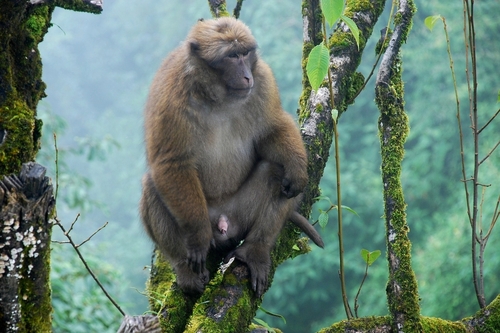
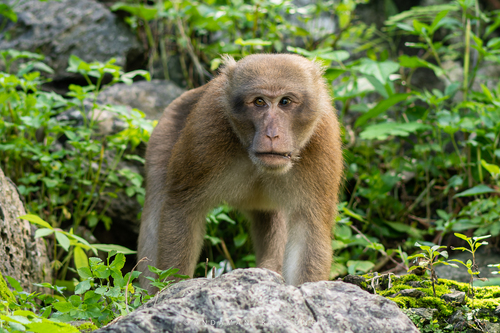
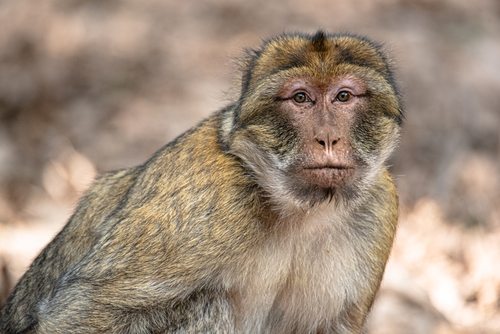
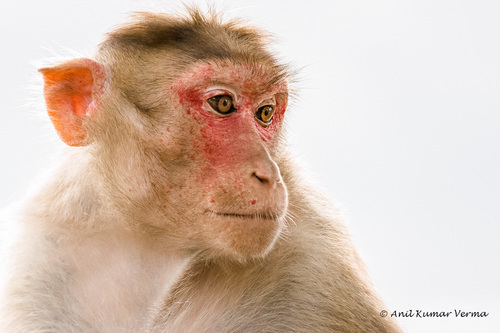
Other species in the genus Macaca

Other species in the family Cercopithecidae
Sources
Conservation status, range description and population estimate come from the IUCN Red List assessment for Macaca mulatta. Countries are derived from that range description, not from a mapped country list. Last refreshed on .
The distribution map is drawn from the IUCN Red List spatial data compiled in 2020. IUCN (International Union for Conservation of Nature)