
White-footed Vole
Arborimus albipes
Red List assessment
Least Concernon the IUCN Red List
- EXExtinct
- EWExtinct in the Wild
- CRCritically Endangered
- ENEndangered
- VUVulnerable
- NTNear Threatened
- LCLeast Concern
The White-footed Vole is recorded in one country, United States across North America. The IUCN Red List assesses the White-footed Vole as Least Concern. No reliable global population estimate exists.
- Family
- Cricetidae
- Order
- Rodentia
- Genus
- Arborimus
- Countries recorded
- 1
- Continents
- North America
- Red List category
- Least Concern
- Data updated
- August 9, 2026
What is the White-footed Vole?
The White-footed Vole is a small, secretive semi-arboreal rodent endemic to the Pacific Northwest of North America. It is strongly associated with riparian corridors dominated by red alder (Alnus rubra) and other streamside vegetation in moist, lowland to mid-elevation forests of western Oregon. Named for its distinctively pale, whitish feet, it occupies a unique ecological niche among North American voles by relying heavily on riparian leaf and bark material. It is rarely observed in the wild, making it one of the lesser-studied members of the Arvicolinae subfamily.
Where does the White-footed Vole live?
Western Oregon (USA), primarily west of the Cascade Range; small populations may extend into extreme northwestern California
Restricted to western Oregon, USA, ranging from the Columbia River south to the California border, largely within the Coast Range and the western foothills of the Cascades. Its occurrence in extreme northwestern California (Del Norte or Humboldt counties) has been suggested but not firmly confirmed. The species does not occur east of the Cascades.
Altitude and depth
Typically found from near sea level up to approximately 900–1,000 m elevation, with highest densities in low-elevation riparian valleys.
Seasonal movements
No long-distance migrations or true hibernation. Activity may be reduced during the coldest winter months but the species remains active year-round. Breeding is likely concentrated in spring through autumn when food resources are most abundant.
Habitat of the White-footed Vole
Primarily riparian corridors within temperate rainforests and coastal forests, particularly alder (Alnus rubra), willow (Salix spp.), and mixed hardwood-conifer streamside zones. It favors moist, densely vegetated streambanks with abundant leaf litter and downed woody debris. It avoids dry upland habitats and open areas.
Adaptations to its environment
The white-footed vole has semi-arboreal tendencies, capable of climbing shrubs and low branches to access leaves and bark. Its streamside lifestyle makes it a capable swimmer. Dense, soft dorsal fur provides insulation in the cool, wet Pacific coastal climate. Like other Arborimus, it may construct small nests in root tangles or low vegetation near water.
Conservation status and numbers
Least Concern (LC) on the IUCN Red List. The species has a restricted range but is not currently considered to be declining at a rate warranting a threatened category. Habitat specificity to riparian areas, however, makes it locally vulnerable to land-use changes.
Estimated population
No reliable global population estimate exists. Population trend is assumed stable, though local populations can be patchy and low-density. It is rarely captured in standard small mammal trapping surveys, suggesting naturally low abundances.
What threatens the White-footed Vole?
Primary threats include riparian habitat loss due to logging, stream channelization, agricultural encroachment, and urban development. Reduction of old-growth and mature riparian forest reduces alder-dominated corridors essential to the species. Climate change-driven alterations to Pacific Northwest hydrology and streamflow regimes may further degrade its habitat.
Diseases and parasites
Specific parasites for Arborimus albipes are poorly documented, but it is likely host to common arvicolid ectoparasites such as fleas (Siphonaptera), mites, and lice, as well as endoparasites including helminths. Like other North American voles, it may serve as a reservoir for hantaviruses and other zoonotic pathogens, though this has not been specifically confirmed for this species.
What is being done to protect it?
The species benefits indirectly from Oregon's Riparian Management Areas under the Northwest Forest Plan and state regulations protecting streamside buffers. It is listed as a Species of Concern by the Oregon Department of Fish and Wildlife. No dedicated captive breeding or recovery program exists.
Recommended actions
Priority actions include long-term population monitoring using live-trapping and camera arrays in known riparian habitats, protection and restoration of alder-dominated streamside corridors, refinement of its distribution limits (particularly near the California border), and assessment of genetic diversity across its fragmented populations.
What the White-footed Vole looks like
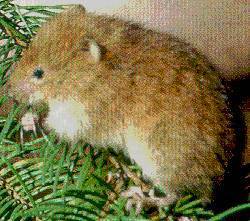
Dorsal fur is warm reddish-brown to dark brown; ventral fur is grayish-white to pale buff. The feet are distinctively white or pale whitish, contrasting clearly with the darker upper body. The tail is bicolored—darker above and paler below—and moderately long relative to body size. Eyes are small and ears are relatively short and rounded.
Size
Total body length 135–175 mm; head-body length approximately 85–105 mm; tail length 48–68 mm. A small to medium-sized vole relative to other arvicolines.
Weight
Typically 20–35 g; no pronounced size dimorphism between sexes has been documented.
Distinctive features
The white feet are the most diagnostic field characteristic, setting it apart from the sympatric red tree vole (Arborimus longicaudus), which has buff or dark feet and a more strictly arboreal, conifer-associated lifestyle. The white-footed vole also has a shorter, less tufted tail and a more terrestrial-riparian ecology than its congeners.
Differences between males and females
Sexual dimorphism is minimal; males and females are similar in size and coloration. Slight size differences may exist, with males occasionally being marginally larger, but this is not pronounced.
Behaviour and diet of the White-footed Vole
Solitary and territorial, as is typical for most voles. Individuals occupy individual home ranges centered on streamside vegetation. Social interactions are likely limited to mating encounters.
When it is active
Primarily nocturnal and crepuscular. Like many small rodents, it may also show brief activity peaks during daylight hours, particularly in overcast Pacific Northwest conditions. Activity occurs throughout the year.
Diet
Strictly herbivorous. Diet consists primarily of leaves, petioles, bark, and cambium of riparian trees and shrubs—especially red alder (Alnus rubra), willows (Salix spp.), and possibly vine maple (Acer circinatum). It may also consume some grasses, forbs, and mosses available along streambanks.
How it feeds and hunts
Not applicable; strictly herbivorous. Forages on the ground and by climbing low into shrubs and alder saplings to clip and consume leaves and green bark. Food may be cached locally during periods of abundance.
Communication
Communication likely involves ultrasonic vocalizations (common in Arvicolinae), scent marking via urine and flank glands to delineate territories and signal reproductive status. Body posture and tactile interactions may occur during mating. Specific vocalizations of this species have not been well characterized.
Interactions with other species
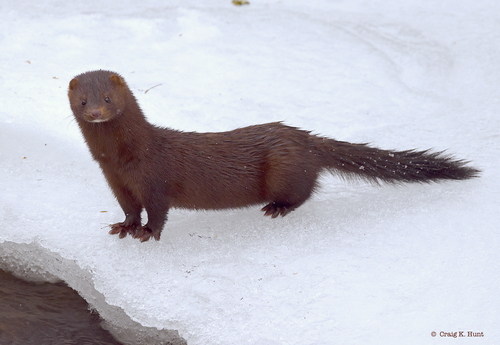
Predators include owls (especially Barn Owl Tyto alba and Northern Spotted Owl Strix occidentalis), American mink (Neovison vison), weasels (Mustela spp.), and various raptors. It may compete for riparian habitat with other small mammals such as the Pacific jumping mouse (Zapus trinotatus) and Townsend's vole (Microtus townsendii). It plays a role as prey supporting local predator communities.
Role in its ecosystem
The white-footed vole functions as a primary herbivore and prey species within Pacific Northwest riparian ecosystems. By browsing on alder and willow, it may influence local vegetation dynamics. As a prey item, it contributes to energy transfer to mesopredator and raptor trophic levels. It may also contribute to soil turnover through burrowing activity.
Reproduction and lifecycle
Breeding season is thought to extend from late winter or early spring through late autumn. Gestation period is approximately 21 days (estimated by analogy with related voles). Litter size is typically 2–4 young. Multiple litters per year are probable.
Raising the young
As in most arvicolines, the female is the primary caregiver, nursing and protecting altricial young in a grass-lined nest near or at ground level in dense riparian vegetation. Young are weaned at approximately 3 weeks of age and reach independence shortly thereafter. Males play little to no role in parental care.
Maturity and lifespan
Sexual maturity is likely reached at 4–6 weeks of age, as is typical for small arvicolines. Lifespan in the wild is estimated at 1–2 years; captive lifespan data are not available for this species.
Taxonomy and naming of the White-footed Vole
Classification
Mammalia > Rodentia > Cricetidae (Arvicolinae) > Arborimus > Arborimus albipes
Subspecies
No recognized subspecies. The species is treated as monotypic.
Scientific synonyms
Phenacomys albipes Merriam, 1901 (original description); formerly placed in genus Phenacomys before reclassification into Arborimus.
What research says
Recent studies
Phylogenomic studies of the subfamily Arvicolinae have helped clarify the evolutionary relationships of Arborimus albipes within the tribe Arborimi. Surveys using detection dogs and remote camera trapping have attempted to better map its distribution and confirm its presence near the Oregon–California border. Its cryptic, riparian-associated behavior continues to make ecological research challenging.
Genome and DNA
Detailed genomic data for Arborimus albipes are limited. Molecular phylogenetic studies (e.g., using cytochrome b and other mitochondrial markers) have confirmed the genus Arborimus as distinct from Phenacomys, with albipes as the most basal member of the genus. Chromosome number has not been definitively published for this species.
Compared with similar species
Arborimus albipes is the most terrestrial and riparian member of its genus. It differs markedly from the red tree vole (A. longicaudus) and Sonoma tree vole (A. pomo), which are highly arboreal, nest in Douglas-fir or other conifers high above the ground, and rely almost exclusively on conifer needles for food. The white-footed vole thus represents a distinct ecological strategy within Arborimus, more akin to typical riparian voles of the genus Microtus in its ground-level habits.
The White-footed Vole and people
Despite being called a 'vole,' the white-footed vole is part of the genus Arborimus ('tree mouse'), yet it is the least arboreal of the three species in that group—an irony in its classification. It is so rarely caught in traps that wildlife biologists sometimes describe it as a 'ghost of the riparian forest.' Its strong dependence on a single plant—red alder—makes it a highly specialized mammal, unusual among generalist voles.
Where and how to see it
The best chance of observing or detecting this species is through live-trapping surveys in dense, low-elevation alder-dominated riparian corridors of western Oregon, particularly in the Coast Range during spring or summer evenings. Sites along major river systems such as the Siuslaw, Alsea, or Wilson River drainages offer suitable habitat. Night surveys with headlamps near streamsides may occasionally reveal the species, though it remains highly elusive.
Risks to humans
No notable risk to humans. Like all wild small mammals, it may bite if handled. As a possible (unconfirmed) rodent reservoir of hantavirus, standard precautions should be taken when handling trapped individuals.
Human uses
No known direct uses by humans—no farming, hunting, medicinal, or commercial trade value. It serves as an indicator species for the health of riparian ecosystems in the Pacific Northwest and is used in ecological research on forest management impacts.
Myths and legends
No known myths, legends, or cultural symbolism are specifically associated with the White-footed Vole among Indigenous peoples or in popular culture.
Countries where the White-footed Vole is recorded
The 1 countries named in the range description of its IUCN Red List assessment.
Questions about the White-footed Vole
Where does the White-footed Vole live?
The White-footed Vole is recorded in United States across North America. These countries come from the range description of its IUCN Red List assessment, and they are what place the species on the interactive map.
Is the White-footed Vole endangered?
The IUCN Red List assesses the White-footed Vole as Least Concern. The species is widespread and abundant enough not to qualify for any threatened category. It does not mean the species is safe forever, only that nothing in the current data raises an alarm.
How many are left in the wild?
No reliable global population estimate exists. This figure comes from the species assessment on the IUCN Red List; population estimates for wild mammals are ranges, not counts, and are revised at each assessment.
What habitat does the White-footed Vole live in?
Primarily riparian corridors within temperate rainforests and coastal forests, particularly alder (Alnus rubra), willow (Salix spp.), and mixed hardwood-conifer streamside zones.
What is the scientific name of the White-footed Vole?
The White-footed Vole is Arborimus albipes, in the family Cricetidae, order Rodentia.
Other species in the genus Arborimus
Other species in the family Cricetidae
Species that share its range
Sources
Conservation status, range description and population estimate come from the IUCN Red List assessment for Arborimus albipes. Countries are derived from that range description, not from a mapped country list. Last refreshed on .
The distribution map is drawn from the IUCN Red List spatial data compiled in 2024. IUCN (International Union for Conservation of Nature)