
Western Gray Kangaroo
Macropus fuliginosus
Red List assessment
Least Concernon the IUCN Red List
- EXExtinct
- EWExtinct in the Wild
- CRCritically Endangered
- ENEndangered
- VUVulnerable
- NTNear Threatened
- LCLeast Concern
The Western Gray Kangaroo is recorded in 2 countries across Europe and Oceania. The IUCN Red List assesses the Western Gray Kangaroo as Least Concern. Population estimated in the millions, with numbers considered stable to increasing in many regions, particularly in agricultural landscapes with supplemental water and pasture
- Family
- Macropodidae
- Order
- Diprotodontia
- Genus
- Macropus
- Countries recorded
- 2
- Continents
- Europe and Oceania
- Red List category
- Least Concern
- Data updated
- August 9, 2026
What is the Western Gray Kangaroo?
The Western Gray Kangaroo is a large marsupial native to southern Australia, easily recognized by its dark brownish-grey fur and distinctive musky odor, earning it the nickname 'stinker'. It inhabits open woodlands, mallee scrub, and grasslands across southern Australia. As one of the largest kangaroo species, it plays a key ecological role as a grazer, shaping vegetation structure in its habitat. It is a common and widespread species, often observed in mobs grazing at dawn and dusk.
Where does the Western Gray Kangaroo live?
Southern Australia, including South Australia, Victoria, New South Wales, and southern Western Australia
Found across southern Australia from western Victoria and southern New South Wales through South Australia to south-western Western Australia, including Kangaroo Island. Distribution generally follows the temperate southern coastal and inland regions of the continent.
Altitude and depth
Sea level to approximately 1000 meters, typically found in lowland and coastal plains rather than high mountainous terrain
Seasonal movements
No true migration or hibernation; breeding can occur year-round but often peaks in summer months when food resources are favorable
Habitat of the Western Gray Kangaroo
Prefers open forests, woodlands, mallee scrub, and grassy plains with access to shade and shelter. Also found in coastal heathlands and semi-arid regions with some tree cover for daytime resting.
Adaptations to its environment
Powerful hind legs allow efficient hopping locomotion for covering large distances while conserving energy in arid environments. Specialized kidneys and ability to reduce water loss enable survival in dry conditions, while a multi-chambered stomach allows fermentation of tough, fibrous vegetation.
Conservation status and numbers
Listed as Least Concern by IUCN due to a large, stable, and widespread population across its range. Populations are secure and in some agricultural areas are considered overabundant, requiring management culls.
Estimated population
Population estimated in the millions, with numbers considered stable to increasing in many regions, particularly in agricultural landscapes with supplemental water and pasture
What threatens the Western Gray Kangaroo?
Habitat loss from agricultural expansion, vehicle collisions on roads, and periodic culling programs due to conflicts with farmers over crop and pasture competition. Drought can also cause localized population stress.
Diseases and parasites
Susceptible to lumpy jaw disease, toxoplasmosis, and various internal and external parasites including ticks and nematodes
What is being done to protect it?
Protected under Australian wildlife legislation with regulated harvest quotas for population control; national parks and reserves across southern Australia provide protected habitat. Kangaroo Island populations receive special conservation attention due to genetic distinctiveness.
Recommended actions
Continued monitoring of population trends in relation to land-use change, maintaining wildlife corridors to reduce road mortality, and balanced management programs that consider both agricultural interests and ecological sustainability.
What the Western Gray Kangaroo looks like
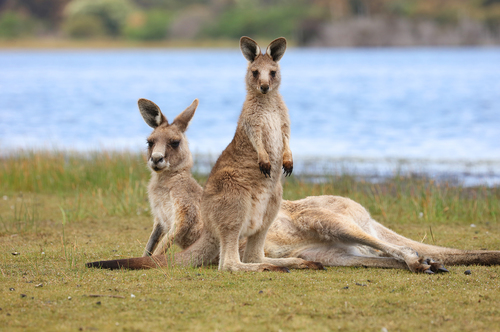
Fur is a smoky grey to dark brown, sometimes described as chocolate-brown, with a paler underside. The face, ears, and limbs may show darker shading, and the species has a robust, muscular build typical of large kangaroos.
Size
Body length 85-140 cm with a tail of 75-100 cm, standing height when upright can reach 1.2-1.8 meters for males
Weight
Males 28-72 kg, females significantly smaller at 15-32 kg
Distinctive features
Distinguished from the Eastern Grey Kangaroo by its darker, more brownish coloration and distinctive strong musky odor. It also has a more square-shaped muzzle and coarser fur texture compared to its eastern relative.
Differences between males and females
Pronounced sexual dimorphism with males being substantially larger and more muscular than females, particularly in the forearms and chest, used in dominance displays and combat
Behaviour and diet of the Western Gray Kangaroo
Lives in loose social groups called mobs, typically consisting of 2-10 individuals but can be larger near abundant food sources. Dominance hierarchies exist among males, established through boxing matches for breeding access.
When it is active
Primarily crepuscular and nocturnal, resting in shade during the heat of the day and becoming active for grazing in early morning and evening
Diet
Herbivorous grazer feeding mainly on grasses, but also consumes shrubs, forbs, and occasionally agricultural crops. Diet composition shifts seasonally based on availability of green vegetation.
Communication
Communicates through vocalizations such as clicks and coughs, foot-thumping to signal alarm, and body postures including ear positioning and tail movements. Scent marking also plays a role in social and reproductive communication.
Interactions with other species
Natural predators include dingoes and historically thylacines, with eagles occasionally preying on joeys. Competes with livestock for grazing resources in shared agricultural landscapes.
Role in its ecosystem
Functions as an important grazer that helps shape grassland and woodland understory vegetation structure, influencing plant community composition and providing a food source for apex predators.
Reproduction and lifecycle
Breeding can occur year-round with a peak in summer; gestation lasts about 30-31 days, after which a single joey is born and continues development in the mother's pouch for approximately 8-9 months
Raising the young
Mothers provide extended care, with joeys remaining in the pouch for months and continuing to suckle at foot for several more months after leaving the pouch permanently. Males provide no direct parental care.
Maturity and lifespan
Females reach sexual maturity around 2-3 years, males slightly later; lifespan in the wild averages 10-15 years, with captive individuals sometimes living up to 20 years
Taxonomy and naming of the Western Gray Kangaroo
Classification
Class Mammalia > Order Diprotodontia > Family Macropodidae > Genus Macropus > Species Macropus fuliginosus
Subspecies
Macropus fuliginosus fuliginosus (Kangaroo Island, South Australia) and Macropus fuliginosus melanops (mainland southern Australia)
Scientific synonyms
Macropus melanops; formerly sometimes classified under genus Notamacropus
What research says
Recent studies
Recent research has focused on population genetics distinguishing Kangaroo Island populations, as well as studies on hybridization zones with Eastern Grey Kangaroos where their ranges overlap
Genome and DNA
Diploid chromosome number of 2n=16 for males and 2n=17 for females due to sex chromosome differences; genome studies contribute to broader marsupial comparative genomics research
Compared with similar species
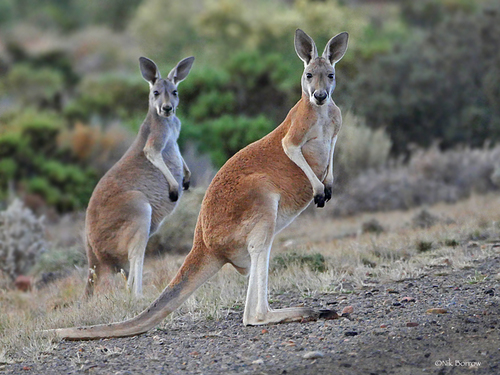
Closely resembles the Eastern Grey Kangaroo but is generally darker in color, has a stronger odor, and prefers slightly different habitat with more woodland cover. Smaller and less robust than the Red Kangaroo, which favors arid interior regions.
The Western Gray Kangaroo and people
Western Grey Kangaroos are sometimes called 'stinkers' due to their strong musky smell, especially in males. They can hop at speeds exceeding 55 km/h and can travel great distances using minimal energy due to their unique tendon-spring hopping mechanism.
Where and how to see it
Best observed at dawn or dusk in national parks and reserves across South Australia and Victoria, such as Flinders Chase National Park on Kangaroo Island, where they are commonly seen grazing in open areas.
Risks to humans
Generally low risk, though large males can become aggressive if provoked or cornered, capable of delivering powerful kicks; vehicle collisions pose more risk to humans than direct kangaroo aggression
Human uses
Commercially harvested for meat and leather in regulated culling programs; also a popular subject for ecotourism and wildlife photography across southern Australia
Myths and legends
Kangaroos hold significant cultural importance in Aboriginal Australian mythology and Dreamtime stories, often symbolizing strength, fertility, and connection to the land
Countries where the Western Gray Kangaroo is recorded
The 2 countries named in the range description of its IUCN Red List assessment.
Questions about the Western Gray Kangaroo
Where does the Western Gray Kangaroo live?
The Western Gray Kangaroo is recorded in Australia and United Kingdom across Europe and Oceania. These countries come from the range description of its IUCN Red List assessment, and they are what place the species on the interactive map.
Is the Western Gray Kangaroo endangered?
The IUCN Red List assesses the Western Gray Kangaroo as Least Concern. The species is widespread and abundant enough not to qualify for any threatened category. It does not mean the species is safe forever, only that nothing in the current data raises an alarm.
How many are left in the wild?
Population estimated in the millions, with numbers considered stable to increasing in many regions, particularly in agricultural landscapes with supplemental water and pasture This figure comes from the species assessment on the IUCN Red List; population estimates for wild mammals are ranges, not counts, and are revised at each assessment.
What habitat does the Western Gray Kangaroo live in?
Prefers open forests, woodlands, mallee scrub, and grassy plains with access to shade and shelter.
What is the scientific name of the Western Gray Kangaroo?
The Western Gray Kangaroo is Macropus fuliginosus, in the family Macropodidae, order Diprotodontia.
Other species in the genus Macropus
Other species in the family Macropodidae
Species that share its range

Sources
Conservation status, range description and population estimate come from the IUCN Red List assessment for Macropus fuliginosus. Countries are derived from that range description, not from a mapped country list. Last refreshed on .
The distribution map is drawn from the IUCN Red List spatial data compiled in 2008. IUCN (International Union for Conservation of Nature)