
Red Kangaroo
Osphranter rufus
Red List assessment
Least Concernon the IUCN Red List
- EXExtinct
- EWExtinct in the Wild
- CRCritically Endangered
- ENEndangered
- VUVulnerable
- NTNear Threatened
- LCLeast Concern
The Red Kangaroo is recorded in 2 countries across Europe and Oceania. The IUCN Red List assesses the Red Kangaroo as Least Concern. Population estimated in the millions (varies from 4-10+ million depending on rainfall cycles), generally stable to fluctuating rather than declining.
- Family
- Macropodidae
- Order
- Diprotodontia
- Genus
- Osphranter
- Countries recorded
- 2
- Continents
- Europe and Oceania
- Red List category
- Least Concern
- Data updated
- August 9, 2026
What is the Red Kangaroo?
The Red Kangaroo is the largest living marsupial and the largest terrestrial mammal native to Australia. It inhabits the arid and semi-arid interior of the continent, thriving in open plains, deserts, and grasslands. Remarkable for its powerful hind-leg locomotion via hopping, it can reach speeds up to 70 km/h. It is an iconic symbol of Australian wildlife and features prominently in the country's national emblem.
Where does the Red Kangaroo live?
Central and inland Australia, spanning arid and semi-arid regions across most states except coastal fringes
Found throughout mainland Australia's interior, including Western Australia, Northern Territory, Queensland, South Australia, and New South Wales; largely absent from coastal and heavily forested regions.
Altitude and depth
Sea level to approximately 1000m, typically found in low-lying arid plains.
Seasonal movements
No true hibernation or migration, but breeding and activity patterns shift with rainfall; can enter reproductive diapause during drought conditions (embryonic diapause).
Habitat of the Red Kangaroo
Open grasslands, arid scrublands, deserts, and semi-arid plains with sparse tree cover; avoids dense forests and coastal wet regions.
Adaptations to its environment
Highly efficient water conservation through concentrated urine and dry feces; nocturnal/crepuscular activity to avoid heat; powerful hind legs and tail for energy-efficient hopping over long distances in search of food and water.
Conservation status and numbers
Least Concern (LC) according to IUCN; the species is abundant and widespread, benefiting from pastoral land use with artificial water sources, though populations fluctuate significantly with rainfall and drought cycles.
Estimated population
Population estimated in the millions (varies from 4-10+ million depending on rainfall cycles), generally stable to fluctuating rather than declining.
What threatens the Red Kangaroo?
Drought and habitat degradation, competition with livestock for grazing resources, vehicle collisions, and periodic culling programs to manage population density in agricultural areas.
Diseases and parasites
Susceptible to lumpy jaw disease, various internal and external parasites including ticks and worms, and occasionally toxoplasmosis; generally robust with few population-threatening diseases.
What is being done to protect it?
Managed through sustainable harvesting quotas and monitoring programs by Australian state governments; protected under national wildlife legislation with regulated commercial culling to balance ecological and agricultural needs.
Recommended actions
Continued population monitoring linked to climate and rainfall data, sustainable management of grazing lands shared with livestock, and mitigation of vehicle strike risks through road signage in high-density areas.
What the Red Kangaroo looks like
Reddish-brown fur in males (giving the species its name), while females often have blue-grey fur, though color can vary regionally; short fur, long pointed ears, powerful hind legs, and a thick muscular tail used for balance and as a fifth limb.
Size
Males: body length 1.3-1.6m with tail adding 90-110cm; females smaller, body length around 85cm-1.1m.
Weight
Males: 55-90kg (up to 200kg in physical condition in captivity); females: 18-40kg, significantly smaller than males.
Distinctive features
Distinguished from other large kangaroos by sexual dichromatism (red males, grey-blue females), larger size, and preference for arid inland habitats compared to the Eastern and Western Grey Kangaroos.
Differences between males and females
Pronounced: males are substantially larger and heavier than females, often reddish in color with more muscular build, while females are smaller and often blue-grey; males also have larger forearms used in fighting.
Behaviour and diet of the Red Kangaroo
Live in loose social groups called 'mobs' typically of 2-10 individuals, though larger aggregations can form near water sources; dominance hierarchies exist among males, established through boxing contests.
When it is active
Primarily crepuscular and nocturnal, resting in shade during the heat of the day and becoming active during cooler dawn, dusk, and night hours.
Diet
Herbivorous, primarily grazing on grasses and forbs; diet shifts opportunistically based on availability of green vegetation following rainfall.
Communication
Communicates through vocalizations (clicks, hisses, coughs), body posture, foot-thumping to warn of danger, and scent marking; males use boxing and physical displays to establish dominance.
Interactions with other species
Few natural predators remain besides dingoes and historically Thylacines; humans and introduced predators like feral dogs pose occasional threats to joeys; competes with livestock for grazing resources.
Role in its ecosystem
Plays a role as a primary grazer in arid ecosystems, influencing vegetation structure and nutrient cycling; serves as prey for dingoes, particularly targeting young or weak individuals.
Reproduction and lifecycle
Breeding occurs year-round with peaks influenced by rainfall; gestation lasts about 33 days, producing a single joey that continues developing in the pouch for around 8 months; females can experience embryonic diapause during unfavorable conditions.
Raising the young
Mothers provide extended care, nursing joeys in the pouch for 8 months and allowing them to return to the pouch for supplemental nursing until about 12 months; joeys remain dependent on mother's milk with adjusting composition as they grow.
Maturity and lifespan
Sexual maturity reached around 2 years in females and 2-3 years in males; lifespan averages 6-8 years in the wild, up to 20+ years in captivity.
Taxonomy and naming of the Red Kangaroo
Classification
Mammalia > Diprotodontia > Macropodidae > Osphranter > Osphranter rufus
Scientific synonyms
Macropus rufus (previous genus placement); Osphranter rufus reflects recent taxonomic revision splitting Macropus
What research says
Recent studies
Recent genomic studies have used the Red Kangaroo to investigate marsupial-specific immune genes and reproductive biology, including embryonic diapause mechanisms relevant to reproductive science.
Genome and DNA
Diploid chromosome number of 20 (2n=20); genome studies have contributed to understanding marsupial evolution and X-chromosome inactivation patterns unique to marsupials.
Compared with similar species
Larger and more specialized for arid environments than the Eastern Grey Kangaroo and Western Grey Kangaroo, with more pronounced sexual dichromatism; shares the hopping locomotion and pouch reproduction typical of all macropods.
The Red Kangaroo and people
Red Kangaroos can leap distances of up to 8-9 meters in a single bound and jump nearly 3 meters high; they rarely need to drink water directly, obtaining most moisture from vegetation; joeys are born the size of a jellybean, blind and hairless.
Where and how to see it
Best observed in outback reserves such as Sturt National Park or Flinders Ranges during early morning or late afternoon when kangaroos are most active and temperatures are cooler.
Risks to humans
Generally low risk to humans, though large males can be dangerous if cornered or provoked, capable of delivering powerful kicks; vehicle collisions pose more risk to humans than direct attacks.
Human uses
Commercially harvested for meat and leather under regulated quotas in Australia; also significant in ecotourism and wildlife documentaries showcasing Australian fauna.
Myths and legends
Kangaroos hold significant cultural symbolism in Aboriginal Australian mythology, often featured in Dreamtime stories as ancestral beings; the Red Kangaroo is also a national symbol, appearing on Australia's coat of arms.
Countries where the Red Kangaroo is recorded
The 2 countries named in the range description of its IUCN Red List assessment.
Questions about the Red Kangaroo
Where does the Red Kangaroo live?
The Red Kangaroo is recorded in Australia and United Kingdom across Europe and Oceania. These countries come from the range description of its IUCN Red List assessment, and they are what place the species on the interactive map.
Is the Red Kangaroo endangered?
The IUCN Red List assesses the Red Kangaroo as Least Concern. The species is widespread and abundant enough not to qualify for any threatened category. It does not mean the species is safe forever, only that nothing in the current data raises an alarm.
How many are left in the wild?
Population estimated in the millions (varies from 4-10+ million depending on rainfall cycles), generally stable to fluctuating rather than declining. This figure comes from the species assessment on the IUCN Red List; population estimates for wild mammals are ranges, not counts, and are revised at each assessment.
What habitat does the Red Kangaroo live in?
Open grasslands, arid scrublands, deserts, and semi-arid plains with sparse tree cover; avoids dense forests and coastal wet regions.
What is the scientific name of the Red Kangaroo?
The Red Kangaroo is Osphranter rufus, in the family Macropodidae, order Diprotodontia.
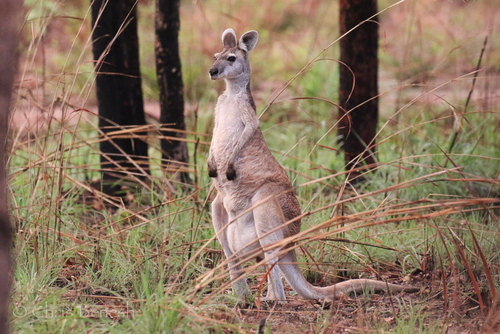
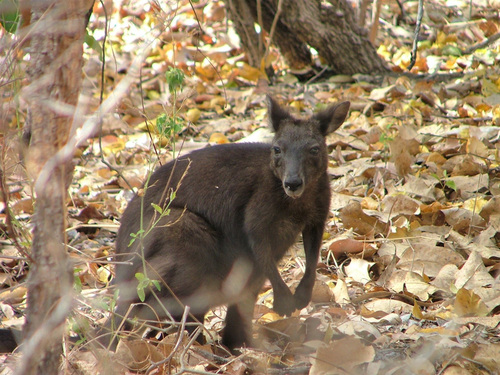
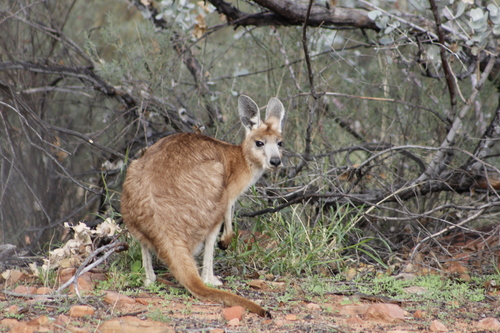
Other species in the genus Osphranter
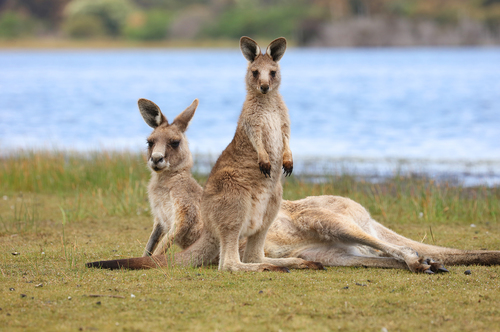
Other species in the family Macropodidae
Species that share its range

Sources
Conservation status, range description and population estimate come from the IUCN Red List assessment for Osphranter rufus. Countries are derived from that range description, not from a mapped country list. Last refreshed on .
The distribution map is drawn from the IUCN Red List spatial data compiled in 2008. IUCN (International Union for Conservation of Nature)