
Eastern Grey Kangaroo
Macropus giganteus
Red List assessment
Least Concernon the IUCN Red List
- EXExtinct
- EWExtinct in the Wild
- CRCritically Endangered
- ENEndangered
- VUVulnerable
- NTNear Threatened
- LCLeast Concern
The Eastern Grey Kangaroo is recorded in 2 countries across Europe and Oceania. The IUCN Red List assesses the Eastern Grey Kangaroo as Least Concern. Estimated in the several millions, with population trends generally stable or increasing in many parts of its range.
- Family
- Macropodidae
- Order
- Diprotodontia
- Genus
- Macropus
- Countries recorded
- 2
- Continents
- Europe and Oceania
- Red List category
- Least Concern
- Data updated
- August 9, 2026
What is the Eastern Grey Kangaroo?
The Eastern Grey Kangaroo is one of the largest and most abundant marsupials in Australia, inhabiting forests, woodlands, and grasslands along the eastern seaboard. It is remarkable for its powerful hind legs adapted for bounding locomotion and its highly social grouping behavior called 'mobs'. As a keystone herbivore, it plays a major role in shaping vegetation structure across its range.
Where does the Eastern Grey Kangaroo live?
Eastern Australia, including Queensland, New South Wales, Victoria, and Tasmania
Widespread across eastern and southeastern Australia, from Cape York Peninsula in Queensland through New South Wales and Victoria to Tasmania and South Australia.
Altitude and depth
Sea level to around 1300 meters in elevation, including some alpine regions of southeastern Australia.
Seasonal movements
No true migration or hibernation; however, breeding and grouping behavior can shift seasonally with food and water availability, particularly during droughts.
Habitat of the Eastern Grey Kangaroo
Found in eucalypt forests, woodlands, grasslands, and coastal heath, often at forest edges where grazing pasture meets tree cover for shelter.
Adaptations to its environment
Powerful hind legs and a strong tail enable energy-efficient hopping over long distances at high speed. Specialized kidneys allow it to conserve water, and its grazing habits and dental adaptations suit tough, fibrous grasses.
Conservation status and numbers
Listed as Least Concern by the IUCN due to its wide distribution, large population size, and stable to increasing trend in most regions.
Estimated population
Estimated in the several millions, with population trends generally stable or increasing in many parts of its range.
What threatens the Eastern Grey Kangaroo?
Threats include vehicle collisions, habitat fragmentation from agriculture and urban development, and periodic culling programs to manage population density.
Diseases and parasites
Susceptible to parasites such as ticks and intestinal worms, as well as diseases like toxoplasmosis and lumpy jaw in stressed or captive populations.
What is being done to protect it?
Protected under Australian wildlife legislation with regulated harvest quotas; found within numerous national parks and reserves across eastern Australia.
Recommended actions
Continued habitat connectivity planning, wildlife crossing structures to reduce roadkill, and sustainable population management balancing agricultural interests and conservation.
What the Eastern Grey Kangaroo looks like
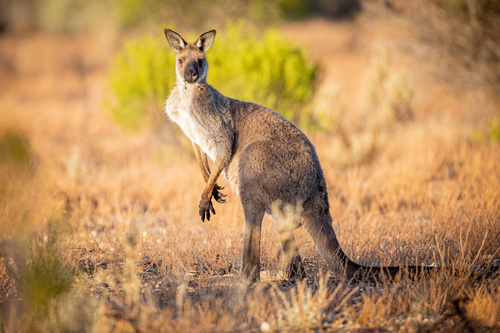
Fur is generally soft and grey-brown, sometimes with a silvery sheen, paler on the underside. It has large ears, a long muscular tail, and powerful hind limbs contrasted with smaller forelimbs.
Size
Body length of 0.85-1.4 meters, with males reaching up to 2 meters including a tail of 60-110 cm.
Weight
Males typically weigh 55-85 kg, sometimes up to 95 kg, while females are considerably smaller at 17-40 kg.
Distinctive features
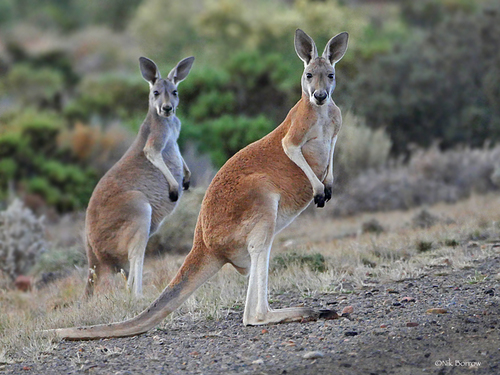
Distinguished from the Red Kangaroo by its grey coloration, denser fur, and preference for forested habitats rather than arid open plains.
Differences between males and females
Males are substantially larger and more muscular than females, especially in the shoulders and forearms, and develop a more robust build with age.
Behaviour and diet of the Eastern Grey Kangaroo
Highly social, living in loose groups called 'mobs' that can range from a few individuals to over 50, with a dominance hierarchy especially among males.
When it is active
Primarily crepuscular and nocturnal, resting in shade during the heat of the day and becoming most active at dawn and dusk.
Diet
Herbivorous, feeding mainly on grasses, though it also consumes shrubs and forbs, adjusting diet according to seasonal availability.
Communication
Communicates through vocal clicks, coughs, and growls, along with foot-thumping to warn of danger and body posturing to display dominance or submission.
Interactions with other species
Natural predators include dingoes and large birds of prey targeting joeys; kangaroos also compete with livestock for grazing resources in shared landscapes.
Role in its ecosystem
As a major grazing herbivore, it influences vegetation structure and nutrient cycling, indirectly supporting a variety of grassland and woodland ecosystems.
Reproduction and lifecycle
Breeding occurs year-round with peaks in favorable seasons; gestation lasts about 30-36 days, producing a single joey that develops further in the mother's pouch.
Raising the young
The joey remains in the pouch for about 8-11 months and continues to nurse until around 18 months, with the mother providing extended maternal care and teaching survival behaviors.
Maturity and lifespan
Sexual maturity is reached around 2-3 years in females and slightly later in males; lifespan averages 10-18 years in the wild and can exceed 20 years in captivity.
Taxonomy and naming of the Eastern Grey Kangaroo
Classification
Mammalia > Diprotodontia > Macropodidae > Macropus > Macropus giganteus
Subspecies
Two recognized subspecies: Macropus giganteus giganteus (mainland Australia) and Macropus giganteus tasmaniensis (Tasmania, sometimes called the Forester kangaroo).
Scientific synonyms
Halmaturus major, Macropus major
What research says
Recent studies
Recent research has focused on kangaroo genome sequencing to better understand marsupial-specific gene regulation and immune system evolution.
Genome and DNA
Has a diploid chromosome number of 16, and its genome has been studied for insights into marsupial evolution and reproductive biology.
Compared with similar species
Similar to the Red Kangaroo but generally smaller, greyer in color, and more associated with forested or higher-rainfall habitats rather than arid interior regions.
The Eastern Grey Kangaroo and people
Eastern Grey Kangaroos can travel at speeds up to 60 km/h in short bursts and can leap distances of over 9 meters in a single bound. Female kangaroos can also pause embryonic development, a phenomenon called embryonic diapause.
Where and how to see it
Best observed in early morning or late afternoon in national parks such as Namadgi or Grampians, particularly in open grassy areas bordering forest.
Risks to humans
Generally low risk, though males can become aggressive if provoked, and vehicle collisions pose a notable danger on rural roads.
Human uses
Historically and currently harvested for meat and leather under regulated quotas, and popularly featured in Australian tourism and wildlife education.
Myths and legends
Kangaroos hold significant cultural symbolism in Aboriginal Australian traditions and are a national icon of Australia, prominently featured on its coat of arms.
Countries where the Eastern Grey Kangaroo is recorded
The 2 countries named in the range description of its IUCN Red List assessment.
Questions about the Eastern Grey Kangaroo
Where does the Eastern Grey Kangaroo live?
The Eastern Grey Kangaroo is recorded in Australia and United Kingdom across Europe and Oceania. These countries come from the range description of its IUCN Red List assessment, and they are what place the species on the interactive map.
Is the Eastern Grey Kangaroo endangered?
The IUCN Red List assesses the Eastern Grey Kangaroo as Least Concern. The species is widespread and abundant enough not to qualify for any threatened category. It does not mean the species is safe forever, only that nothing in the current data raises an alarm.
How many are left in the wild?
Estimated in the several millions, with population trends generally stable or increasing in many parts of its range. This figure comes from the species assessment on the IUCN Red List; population estimates for wild mammals are ranges, not counts, and are revised at each assessment.
What habitat does the Eastern Grey Kangaroo live in?
Found in eucalypt forests, woodlands, grasslands, and coastal heath, often at forest edges where grazing pasture meets tree cover for shelter.
What is the scientific name of the Eastern Grey Kangaroo?
The Eastern Grey Kangaroo is Macropus giganteus, in the family Macropodidae, order Diprotodontia.
Other species in the genus Macropus
Other species in the family Macropodidae
Species that share its range

Sources
Conservation status, range description and population estimate come from the IUCN Red List assessment for Macropus giganteus. Countries are derived from that range description, not from a mapped country list. Last refreshed on .
The distribution map is drawn from the IUCN Red List spatial data compiled in 2008. IUCN (International Union for Conservation of Nature)