
Thomas's Flying Squirrel
Aeromys thomasi
Red List assessment
Least Concernon the IUCN Red List
- EXExtinct
- EWExtinct in the Wild
- CRCritically Endangered
- ENEndangered
- VUVulnerable
- NTNear Threatened
- LCLeast Concern
The Thomas's Flying Squirrel is recorded in 3 countries across Asia. The IUCN Red List assesses the Thomas's Flying Squirrel as Least Concern. No precise global population estimate exists.
- Family
- Sciuridae
- Order
- Rodentia
- Genus
- Aeromys
- Countries recorded
- 3
- Continents
- Asia
- Red List category
- Least Concern
- Data updated
- August 9, 2026
What is the Thomas's Flying Squirrel?
Thomas's Flying Squirrel is a large, nocturnal flying squirrel endemic to the island of Borneo, inhabiting tall primary and secondary tropical rainforests. It possesses an expansive patagium — a fur-covered gliding membrane stretching from wrist to ankle — that enables impressive glides between forest trees. It is one of only two species in the genus Aeromys, alongside the Black Flying Squirrel (Aeromys tephromelas). The species was named in honor of Oldfield Thomas (1858–1929), one of the most prolific mammal taxonomists in history.
Where does the Thomas's Flying Squirrel live?
Endemic to the island of Borneo (Malaysian states of Sabah and Sarawak, Brunei Darussalam, and northern Kalimantan, Indonesia)
Restricted to the island of Borneo: confirmed in the Malaysian states of Sabah and Sarawak (type locality: Baram River region, Sarawak), likely present in Brunei Darussalam, and expected in adjacent regions of northern Kalimantan (Indonesia). Distribution may extend more broadly across Kalimantan, though records remain sparse.
Altitude and depth
Primarily found in lowland forests from near sea level up to approximately 1,200–1,500 m in submontane zones; most records come from elevations below 800 m.
Habitat of the Thomas's Flying Squirrel
Primarily tall, closed-canopy lowland tropical rainforest and submontane forest with large emergent trees used as gliding launch points. It may also occur in mature secondary forest but strongly prefers intact primary forest with abundant large-diameter trees providing nest hollows.
Adaptations to its environment
The large patagium connecting fore- and hindlimbs allows silent gliding flights of potentially over 100 m, reducing predation risk and locomotion energy costs across a fragmented canopy. Oversized eyes provide excellent low-light nocturnal vision. Long, bushy, semi-prehensile tail acts as a rudder and stabilizer during glides. Sharp, curved claws enable secure gripping on large-diameter trunks and branches.
Conservation status and numbers
Listed as Least Concern (LC) on the IUCN Red List. Although its range is restricted to Borneo, the species is considered relatively widespread within suitable habitat, and no quantified large-scale population decline has been documented to date.
Estimated population
No precise global population estimate exists. The population trend is suspected to be slowly declining due to accelerating deforestation rates across Borneo over the past two decades.
What threatens the Thomas's Flying Squirrel?
Habitat loss and forest fragmentation from commercial logging, conversion to oil palm and rubber plantations, and agricultural expansion are the main threats across Borneo. Localized hunting or snaring may occur, though the species is not a primary target. Forest fires in degraded peatlands of Kalimantan also reduce available habitat.
What is being done to protect it?
The species benefits indirectly from habitat protection within established Bornean protected areas, including Kinabalu Park and Crocker Range Biosphere Reserve (Sabah), Danum Valley Conservation Area, Maliau Basin Conservation Area (Malaysia), and various Indonesian national parks in Kalimantan. It is protected under Malaysian and Indonesian national wildlife legislation.
Recommended actions
Expansion and strict enforcement of protected forest reserves in Borneo; development of wildlife corridors to maintain forest connectivity between fragmented patches; targeted camera-trap and spotlighting surveys to better define population size and distribution; reduction of illegal logging and sustainable land-use certification for forest concessions.
What the Thomas's Flying Squirrel looks like
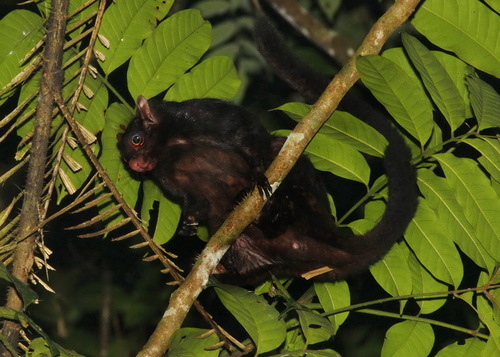
Dorsal fur is dark brown to blackish-brown; the ventral surface is paler, typically greyish-white to buff. The patagium is dark-furred on its dorsal surface and paler beneath. Eyes are conspicuously large and dark-adapted. The tail is long, bushy, and roughly cylindrical with dark brown fur throughout.
Size
Head-body length approximately 28–42 cm; tail length approximately 33–46 cm; total length can exceed 80 cm. Patagium span when fully extended may exceed 60 cm.
Weight
Estimated 500 g to 1.5 kg; precise field measurements for this species are scarce, with estimates extrapolated from closely related Aeromys tephromelas.
Distinctive features
Distinguished from the closely related Aeromys tephromelas by its generally smaller body size and strictly Bornean distribution; A. tephromelas also occurs in Sumatra and Peninsular Malaysia and tends to be darker overall. Larger and more uniformly dark than most sympatric Petaurista species, and with a proportionally broader patagium relative to body size.
Behaviour and diet of the Thomas's Flying Squirrel
Presumed largely solitary outside the breeding season, as is typical for flying squirrels. Individuals likely maintain overlapping home ranges but generally forage and rest independently. No evidence of complex social groupings.
When it is active
Strictly nocturnal. Individuals emerge from tree hollow roosts after dusk, remain active throughout the night foraging across the canopy, and return to roost sites before dawn.
Diet
Primarily frugivorous and folivorous, feeding on fruits, seeds, bark, leaves, and likely flowers and buds. As with related Sciuridae, opportunistic consumption of insects, fungi, or other invertebrates may supplement the diet, making it a generalist omnivore with a plant-heavy diet.
How it feeds and hunts
Forages arboreal resources by gliding between trees to access distant or patchy food patches. Uses large, sensitive eyes and vibrissae to detect food in low-light conditions. Gnaws bark and husks with strong incisors to access seeds and sap.
Communication
Likely communicates via vocalizations (soft chirps or alarm calls), scent marking from glands on the face and body, and tactile signals. Flying squirrels are generally quiet, but ultrasonic calls may be used that are inaudible to humans. Scent marking likely plays a role in territory advertisement and reproductive signaling.
Interactions with other species
Natural predators likely include large forest owls (e.g., Buffy Fish Owl Ketupa ketupu, Barred Eagle-Owl Bubo sumatranus), arboreal pythons, and civets. It may compete with other large Bornean flying squirrels (Petaurista petaurista, P. elegans) for fruit resources and nest hollows. As a frugivore, it may function as a secondary seed disperser for large-seeded forest trees.
Role in its ecosystem
Functions as a seed disperser and arboreal consumer in the Bornean rainforest ecosystem. Its long-distance gliding ability allows it to link spatially separated food patches, potentially facilitating gene flow and seed movement across larger forest areas than ground-dwelling rodents.
Reproduction and lifecycle
Reproductive biology is poorly documented for this species. Based on related congeners and similar tropical flying squirrels, litter size is likely 1–2 young. In the aseasonal equatorial rainforest of Borneo, breeding may occur throughout the year rather than being confined to a single season.
Raising the young
Young are believed to be born altricial (helpless, with closed eyes) and raised in a nest within a tree hollow by the mother. Duration of maternal care and weaning age are undocumented; in related species, juveniles remain dependent for several weeks to months.
Maturity and lifespan
Age at sexual maturity and wild lifespan are undocumented for this species. Based on related flying squirrels, sexual maturity likely occurs at 1–2 years of age, with a potential wild lifespan of 5–10 years and possibly longer in captivity.
Taxonomy and naming of the Thomas's Flying Squirrel
Classification
Mammalia > Rodentia > Sciuridae > Aeromys > Aeromys thomasi
Scientific synonyms
Sciuropterus thomasi Bonhote, 1900 (original combination); sometimes listed as Aeromys thomasi Bonhote, 1900.
What research says
Recent studies
Molecular phylogenetic studies of the tribe Pteromyini (Old World flying squirrels) have confirmed that Aeromys represents a relatively early-diverging lineage within this group. Recent biodiversity surveys using camera traps and spotlighting in Borneo have contributed new locality records, though targeted studies on A. thomasi ecology and behavior remain lacking.
Compared with similar species
Aeromys thomasi is most closely related to A. tephromelas (Black Flying Squirrel), with which it shares its large size and dark coloration but differs in range (Borneo-endemic vs. broader Sundaland distribution) and slightly smaller body dimensions. Both Aeromys species are distinct from the larger genus Petaurista in cranial morphology and tail shape. Compared to the Giant Flying Squirrel (Petaurista petaurista), A. thomasi is smaller, darker, and has a less conspicuous bicolored tail.
The Thomas's Flying Squirrel and people
Thomas's Flying Squirrel can cover over 100 meters in a single glide by expanding its patagium — the equivalent of gliding across a football field without flapping a wing. Despite the name 'flying squirrel,' it cannot generate lift or true flight; it is entirely dependent on gravity-assisted gliding, using body posture to steer. Its namesake, Oldfield Thomas, personally described over 2,000 mammal species and subspecies during his career at the Natural History Museum in London — one of the greatest individual contributions to mammalogy in scientific history.
Where and how to see it
Best observed after dusk in primary lowland rainforest using a red-filtered headlamp to minimize disturbance. Protected areas such as Danum Valley Conservation Area and Maliau Basin in Sabah, Malaysia, offer excellent habitat. Scanning emergent tree trunks and listening for the sound of landing impacts on bark after a glide significantly increases detection probability.
Risks to humans
No notable risk to humans.
Countries where the Thomas's Flying Squirrel is recorded
The 3 countries named in the range description of its IUCN Red List assessment.
Questions about the Thomas's Flying Squirrel
Where does the Thomas's Flying Squirrel live?
The Thomas's Flying Squirrel is recorded in Brunei, Indonesia and Malaysia across Asia. These countries come from the range description of its IUCN Red List assessment, and they are what place the species on the interactive map.
Is the Thomas's Flying Squirrel endangered?
The IUCN Red List assesses the Thomas's Flying Squirrel as Least Concern. The species is widespread and abundant enough not to qualify for any threatened category. It does not mean the species is safe forever, only that nothing in the current data raises an alarm.
How many are left in the wild?
No precise global population estimate exists. This figure comes from the species assessment on the IUCN Red List; population estimates for wild mammals are ranges, not counts, and are revised at each assessment.
What habitat does the Thomas's Flying Squirrel live in?
Primarily tall, closed-canopy lowland tropical rainforest and submontane forest with large emergent trees used as gliding launch points.
What is the scientific name of the Thomas's Flying Squirrel?
The Thomas's Flying Squirrel is Aeromys thomasi, in the family Sciuridae, order Rodentia.
Other species in the genus Aeromys
Other species in the family Sciuridae
Species that share its range
Sources
Conservation status, range description and population estimate come from the IUCN Red List assessment for Aeromys thomasi. Countries are derived from that range description, not from a mapped country list. Last refreshed on .
The distribution map is drawn from the IUCN Red List spatial data compiled in 2008. IUCN (International Union for Conservation of Nature)