
Thespian Grass Mouse
Akodon mimus
Red List assessment
Least Concernon the IUCN Red List
- EXExtinct
- EWExtinct in the Wild
- CRCritically Endangered
- ENEndangered
- VUVulnerable
- NTNear Threatened
- LCLeast Concern
The Thespian Grass Mouse is recorded in 2 countries across South America. The IUCN Red List assesses the Thespian Grass Mouse as Least Concern. No precise global population estimate is available.
- Family
- Cricetidae
- Order
- Rodentia
- Genus
- Akodon
- Countries recorded
- 2
- Continents
- South America
- Red List category
- Least Concern
- Data updated
- August 9, 2026
What is the Thespian Grass Mouse?
Akodon mimus, the Thespian Grass Mouse, is a small South American rodent belonging to the diverse genus Akodon, commonly known as grass mice or field mice. It inhabits the humid montane forests and cloud-forest edge habitats (yungas) along the eastern Andean slopes of Peru. The species' scientific name 'mimus' (Latin for actor or mime) gave rise to its distinctive English common name. Like most Akodon, it plays an important ecological role as both a seed disperser and prey item in montane ecosystems.
Where does the Thespian Grass Mouse live?
Eastern slopes of the Andes in Peru (departments of Cusco, Puno, Madre de Dios, and Ayacucho) and possibly extreme northwestern Bolivia; primarily associated with the yungas transition zone.
Restricted to South America; range centered on the eastern Andean slopes of Peru, including the departments of Cusco, Puno, Madre de Dios, and Ayacucho. Records suggest possible occurrence into northwestern Bolivia, though its precise limits there remain uncertain.
Altitude and depth
Typically recorded between approximately 500 m and 2,500 m above sea level, with highest densities likely in the 1,000–2,000 m yungas belt. Occasional records may extend slightly outside this range.
Seasonal movements
No documented seasonal migrations. Activity and reproductive intensity may peak during the austral wet season (October–April) when food resources are most abundant, but the species is presumed resident year-round.
Habitat of the Thespian Grass Mouse
Primary habitat is the yungas zone—humid montane forest and forest-grassland ecotones on the eastern Andean slopes. It is also found in dense grass patches, shrubby margins of cloud forest, and riparian vegetation. It tolerates some degree of habitat disturbance but generally prefers areas with dense ground cover.
Adaptations to its environment
Dense underfur provides insulation in cool montane environments. Strong incisors and a generalist digestive system allow exploitation of a varied diet including hard seeds and invertebrates. Cryptic brownish coloration provides camouflage among leaf litter and grasses.
Conservation status and numbers
Listed as Least Concern (LC) by the IUCN. The species is considered to have a sufficiently large and stable population within its range, with no evidence of rapid decline meeting threatened thresholds. Its occurrence across multiple protected areas further supports this assessment.
Estimated population
No precise global population estimate is available. The population is believed to be stable, though localized declines may occur in heavily deforested areas. Trend is considered stable overall.
What threatens the Thespian Grass Mouse?
Deforestation and agricultural expansion on the eastern Andean slopes represent the most significant long-term threats. Climate change may cause upward altitudinal shifts in its suitable habitat. Predation pressure from introduced species (cats, rats) in disturbed areas is a secondary concern.
Diseases and parasites
Like other Akodon species, likely harbors ectoparasites (mites, fleas, lice) and endoparasites (nematodes, cestodes). Some Akodon species act as reservoirs for hantaviruses and other zoonotic pathogens; specific documentation for A. mimus is lacking.
What is being done to protect it?
Part of its range falls within protected areas such as Manu National Park and Bahuaja-Sonene National Park in Peru, which provide substantial habitat protection. No species-specific conservation programs are known to exist for A. mimus.
Recommended actions
Continued monitoring of population trends using live-trapping surveys; expanded assessment of distribution limits in Bolivia; protection and restoration of yungas forest corridors; integration into broader Andean small-mammal biodiversity monitoring programs.
What the Thespian Grass Mouse looks like
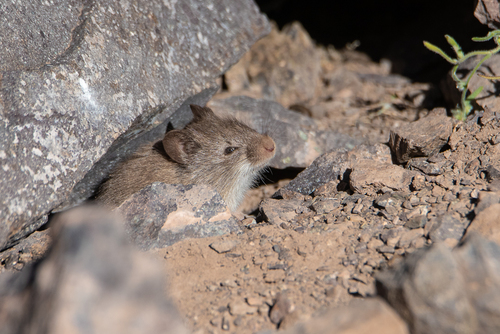
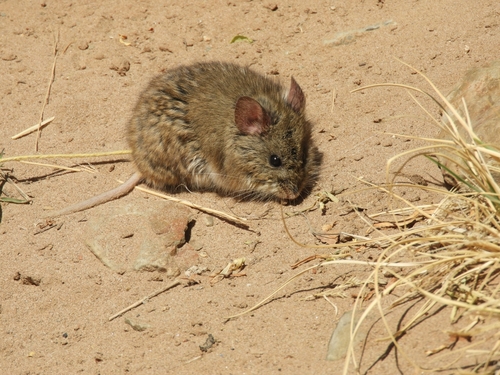
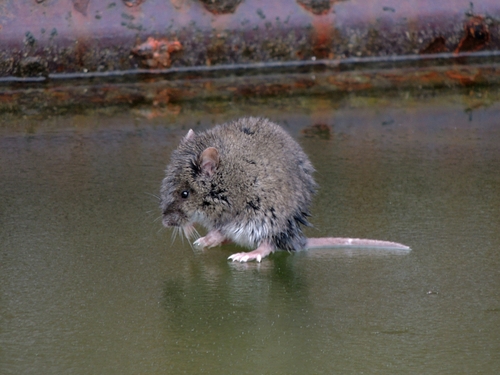
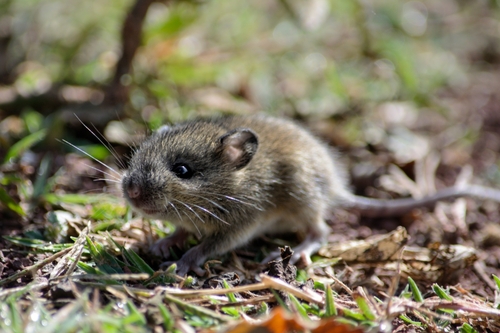
Dorsal fur is brownish to grayish-brown, often with a slight olivaceous tinge; ventral surface is paler grayish or buffy-white. The tail is bicolored (darker above, paler below) and moderately haired. Eyes are small and dark; ears are rounded and moderately large.
Size
Head-body length approximately 80–115 mm; tail length approximately 60–90 mm. Similar in size to other mid-sized Akodon species.
Weight
Estimated weight range 15–35 g; sexual size dimorphism is minimal, with males and females of similar mass.
Distinctive features
Distinguishable from sympatric Akodon species by subtle combinations of cranial morphology (notably the shape of the incisive foramina and braincase) and body measurements. Field identification is difficult without specimen examination; molecular data are most reliable for definitive diagnosis.
Differences between males and females
Minimal sexual dimorphism in external appearance and body size. Males may be marginally heavier than females on average, but the difference is not diagnostic in the field.
Behaviour and diet of the Thespian Grass Mouse
Presumed to be largely solitary outside the breeding season, as is typical for Akodon. Home ranges may overlap partially. No documented complex social hierarchy.
When it is active
Primarily nocturnal and crepuscular. Most foraging activity occurs during the night and around dusk and dawn, reducing overlap with diurnal predators and heat stress.
Diet
Omnivorous; diet includes seeds, plant material (fruits, roots, green vegetation), fungi, and invertebrates such as insects, worms, and larvae. The relative proportion of animal versus plant matter likely varies seasonally with availability.
How it feeds and hunts
Forages opportunistically on the ground and in low vegetation; uses olfaction and vibrissae to detect food items under leaf litter. Insects and soft invertebrates are seized and consumed directly; seeds may be husked with the incisors.
Communication
Communication likely involves ultrasonic vocalizations, olfactory signals via urine and scent glands, and tactile interaction. Scent marking may delineate home ranges. Vocalizations during agonistic or mating encounters have not been specifically documented for this species.
Interactions with other species
Predators include owls (e.g., Tyto alba, Strix species), small raptors, snakes, and small felids such as the Andean cat (Leopardus jacobita). Competes with other small rodents (other Akodon, Oligoryzomys) for food resources. May serve as an intermediate host for hemoparasites.
Role in its ecosystem
Functions as a secondary consumer and prey base within montane ecosystems. Contributes to seed dispersal of small-fruited plants and regulation of invertebrate populations. Its burrowing and nesting activities may influence soil aeration on a small scale.
Reproduction and lifecycle
Breeding likely peaks during the wet season (October–April) but may occur year-round given stable tropical montane conditions. Gestation period estimated at approximately 21–23 days (typical for genus). Litter size is typically 2–5 young.
Raising the young
Altricial young are born hairless and dependent. The female provides primary parental care, nursing young in a grass-lined nest. Weaning occurs at approximately 3 weeks; juveniles reach independence shortly thereafter.
Maturity and lifespan
Sexual maturity is likely reached at 6–8 weeks of age, consistent with the genus. Wild lifespan is estimated at 1–2 years; captive individuals of related species have survived up to 3 years.
Taxonomy and naming of the Thespian Grass Mouse
Classification
Mammalia > Rodentia > Cricetidae (subfamily Sigmodontinae) > Akodon > Akodon mimus. Described by Oldfield Thomas in 1901.
Scientific synonyms
No widely recognized taxonomic synonyms are currently documented; Thomas's 1901 original description remains the accepted reference.
What research says
Recent studies
No high-profile recent studies specific to A. mimus are documented. Phylogenomic studies of the Akodon genus have helped clarify species boundaries and relationships within the boliviensis species group, to which A. mimus may be allied.
Genome and DNA
The genus Akodon is noted for extraordinary karyotypic diversity, with diploid numbers ranging from 2n=10 to 2n=44 across species. The specific karyotype of A. mimus has not been widely published; exact chromosome count is not confirmed in available literature.
Compared with similar species
Most closely related to other members of the Akodon boliviensis complex from the Peruvian and Bolivian Andes. Distinguished from Akodon boliviensis by cranial and morphometric differences. Resembles Akodon subfuscus and Akodon surdus, with which it may be sympatric at certain elevations.
The Thespian Grass Mouse and people
The species' name 'mimus' (meaning actor or mime in Latin) inspired the whimsical common name 'Thespian Grass Mouse,' making it one of the most dramatically named small rodents in science. Like all Akodon, it possesses a baculum (penile bone), the shape of which is used by taxonomists as a key diagnostic character. Despite its modest appearance, the Akodon genus to which it belongs is one of the most species-rich rodent genera in South America, with over 40 recognized species.
Where and how to see it
Best observed at night using headlamps along forest-edge trails in the yungas zone of Manu National Park or Kosñipata Valley in Cusco, Peru. Sherman live traps baited with oats or peanut butter set along runways in dense grass near forest margins yield the best results. The rainy season (November–March) tends to increase activity and capture rates.
Risks to humans
No notable risk under normal conditions. As with all wild small rodents, handling should be avoided without appropriate protective equipment due to the theoretical risk of zoonotic disease transmission (e.g., hantavirus). Bite risk is minor but possible if the animal is cornered.
Countries where the Thespian Grass Mouse is recorded
The 2 countries named in the range description of its IUCN Red List assessment.
Questions about the Thespian Grass Mouse
Where does the Thespian Grass Mouse live?
The Thespian Grass Mouse is recorded in Bolivia and Peru across South America. These countries come from the range description of its IUCN Red List assessment, and they are what place the species on the interactive map.
Is the Thespian Grass Mouse endangered?
The IUCN Red List assesses the Thespian Grass Mouse as Least Concern. The species is widespread and abundant enough not to qualify for any threatened category. It does not mean the species is safe forever, only that nothing in the current data raises an alarm.
How many are left in the wild?
No precise global population estimate is available. This figure comes from the species assessment on the IUCN Red List; population estimates for wild mammals are ranges, not counts, and are revised at each assessment.
What habitat does the Thespian Grass Mouse live in?
Primary habitat is the yungas zone—humid montane forest and forest-grassland ecotones on the eastern Andean slopes.
What is the scientific name of the Thespian Grass Mouse?
The Thespian Grass Mouse is Akodon mimus, in the family Cricetidae, order Rodentia.
Other species in the genus Akodon

Other species in the family Cricetidae
Sources
Conservation status, range description and population estimate come from the IUCN Red List assessment for Akodon mimus. Countries are derived from that range description, not from a mapped country list. Last refreshed on .
The distribution map is drawn from the IUCN Red List spatial data compiled in 2008. IUCN (International Union for Conservation of Nature)