
Sumatran Rhinoceros
Dicerorhinus sumatrensis
Red List assessment
Critically Endangeredon the IUCN Red List
- EXExtinct
- EWExtinct in the Wild
- CRCritically Endangered
- ENEndangered
- VUVulnerable
- NTNear Threatened
- LCLeast Concern
The Sumatran Rhinoceros is recorded in 6 countries across Asia. The IUCN Red List assesses the Sumatran Rhinoceros as Critically Endangered. Fewer than 80 individuals remaining in the wild, with a sharply declining trend; a handful also held in captive breeding programs.
- Family
- Rhinocerotidae
- Order
- Perissodactyla
- Genus
- Dicerorhinus
- Countries recorded
- 6
- Continents
- Asia
- Red List category
- Critically Endangered
- Data updated
- August 9, 2026
What is the Sumatran Rhinoceros?
The Sumatran Rhinoceros is the smallest and most ancient of living rhino species, covered in reddish-brown hair, a trait linking it to extinct woolly rhinos. It inhabits dense tropical rainforests of Sumatra and possibly Borneo. Critically endangered with fewer than 80 individuals remaining, it is one of the rarest large mammals on Earth. Its solitary, elusive nature and shrinking fragmented habitat make it exceptionally difficult to study and protect.
Where does the Sumatran Rhinoceros live?
Indonesia (Sumatra), with a small population possibly remaining in Kalimantan (Borneo)
Historically ranged from the Himalayan foothills of Bhutan and India through Myanmar, Thailand, Malaysia, Sumatra, and Borneo. Now restricted to a few isolated pockets in Sumatra (Indonesia), primarily in Way Kambas, Bukit Barisan Selatan, and Gunung Leuser National Parks, with possible remnants in Kalimantan.
Altitude and depth
0-2000m, typically favoring hill forests between 200-1000m
Habitat of the Sumatran Rhinoceros
Dense lowland and highland tropical rainforest, often near hilly terrain with abundant mud wallows and water sources; also found in swampy areas and secondary forest with dense understory vegetation.
Adaptations to its environment
Prehensile upper lip allows selective browsing on leaves and shoots; thick but sparse hair helps regulate temperature and may relate to cooler ancestral habitats. Wallowing in mud protects skin from parasites and heat; excellent sense of smell and hearing compensate for poor eyesight in dense forest.
Conservation status and numbers
Critically Endangered (IUCN); population has declined by over 70% in the last two decades due to poaching and habitat fragmentation, with fewer than 80 mature individuals estimated to remain in small, isolated subpopulations.
Estimated population
Fewer than 80 individuals remaining in the wild, with a sharply declining trend; a handful also held in captive breeding programs.
What threatens the Sumatran Rhinoceros?
Poaching for horn used in traditional medicine, severe habitat loss from logging and agricultural expansion (palm oil), population fragmentation leading to inbreeding and reduced breeding opportunities.
Diseases and parasites
Susceptible to internal parasites and skin conditions; captive individuals have shown vulnerability to trypanosomiasis and other infections linked to stress and habitat changes.
What is being done to protect it?
Sumatran Rhino Rescue program relocates isolated individuals into managed breeding sanctuaries; protected status under Indonesian law; captive breeding at Way Kambas Sumatran Rhino Sanctuary; anti-poaching patrols in key national parks.
Recommended actions
Intensify anti-poaching enforcement, expand captive breeding and assisted reproduction (including IVF), consolidate fragmented populations into managed breeding sanctuaries, and protect remaining forest habitat corridors.
What the Sumatran Rhinoceros looks like
Reddish-brown to grayish skin covered in coarse hair, more pronounced in younger individuals and thinning with age. Two horns, a larger nasal horn (15-25 cm) and a smaller posterior horn, with folded, ridged skin along the body.
Size
Shoulder height of 112-145 cm; body length of 236-318 cm
Weight
500-960 kg, with males and females similar in size
Distinctive features
Smallest living rhino species and only Asian rhino with two horns; distinguished by its hairy coat, smaller size, and more prominent skin folds compared to Indian or Javan rhinos.
Differences between males and females
Minimal size difference between sexes; males may have slightly larger horns, but overall dimorphism is not pronounced.
Behaviour and diet of the Sumatran Rhinoceros
Largely solitary except for mothers with calves or brief pairing during mating; individuals maintain large home ranges marked by scrapes, scent, and twisted saplings.
When it is active
Primarily crepuscular and nocturnal, resting in mud wallows or dense vegetation during the heat of the day and foraging during cooler hours.
Diet
Herbivorous browser feeding on saplings, leaves, twigs, fruit, and shoots of over 100 plant species; particularly favors fig trees and mangoes when available.
Communication
Communicates through vocalizations including whistles, squeaks, and eeps; also uses scent marking via urine, feces, and scrapes, plus visual signals like broken saplings to mark territory.
Interactions with other species
Adults have virtually no natural predators due to size, though calves may be vulnerable to tigers; shares habitat with other large mammals like elephants and tapirs with minimal direct competition due to different dietary niches.
Role in its ecosystem
Acts as a seed disperser for various forest plant species through its browsing and movement patterns, contributing to forest regeneration and plant diversity in its rainforest habitat.
Reproduction and lifecycle
Breeding can occur year-round; gestation lasts approximately 15-16 months, resulting in a single calf. Females typically give birth every 3-4 years due to long inter-birth intervals and reproductive challenges in fragmented populations.
Raising the young
Calves stay with their mothers for 2-3 years, learning foraging routes and wallow locations before becoming independent; mothers are highly protective during this period.
Maturity and lifespan
Sexual maturity reached around 6-7 years in females and slightly later in males; lifespan is approximately 30-45 years in the wild, similar or slightly longer in captivity.
Taxonomy and naming of the Sumatran Rhinoceros
Classification
Class Mammalia > Order Perissodactyla > Family Rhinocerotidae > Genus Dicerorhinus > Species D. sumatrensis
Subspecies
Dicerorhinus sumatrensis sumatrensis (Sumatra), D. s. harrissoni (Bornean rhinoceros, Borneo, now extremely rare or extinct in wild), D. s. lasiotis (Northern subspecies, likely extinct)
Scientific synonyms
Rhinoceros sumatrensis, Didermocerus sumatrensis
What research says
Recent studies
Recent studies have used environmental DNA and camera trapping to estimate remaining population sizes in Sumatra and Kalimantan; genetic research is exploring assisted reproduction technologies to boost fertility.
Genome and DNA
Genome sequencing efforts are underway to support conservation genetics and assess genetic diversity among remaining fragmented populations, aiding decisions on breeding pairings.
Compared with similar species
Smaller and hairier than the Indian and Javan rhinos, and unlike them, retains two horns similar to African rhino species, though more closely related to the extinct woolly rhinoceros.
The Sumatran Rhinoceros and people
It is the only Asian rhino with two horns and the most vocal of all rhino species, using whistle-like calls similar to humpback whale songs. It is also the closest living relative of the extinct woolly rhinoceros.
Where and how to see it
Extremely difficult to observe in the wild due to its rarity and elusive nature; best chances are through camera trap footage or visits to managed sanctuaries like the Sumatran Rhino Sanctuary in Way Kambas National Park.
Risks to humans
No notable risk to humans under normal circumstances; generally shy and avoids human contact.
Human uses
Historically hunted for its horn, used in traditional Asian medicine despite lacking proven pharmacological benefits; today the species has no legal trade and is strictly protected.
Myths and legends
In some regional folklore, rhino horn was believed to possess medicinal or mystical healing properties, contributing historically to intense poaching pressure despite no scientific evidence supporting such claims.
Countries where the Sumatran Rhinoceros is recorded
The 6 countries named in the range description of its IUCN Red List assessment.
Questions about the Sumatran Rhinoceros
Where does the Sumatran Rhinoceros live?
The Sumatran Rhinoceros is recorded in Bhutan, India, Indonesia, Malaysia and Myanmar, among 6 countries in total across Asia. These countries come from the range description of its IUCN Red List assessment, and they are what place the species on the interactive map.
Is the Sumatran Rhinoceros endangered?
Yes. The IUCN Red List assesses the Sumatran Rhinoceros as Critically Endangered, one of the three threatened categories. The species faces an extremely high risk of extinction in the wild. This is the last category before extinction, and it is reached through a very small or steeply declining population, a tiny range, or both.
How many are left in the wild?
Fewer than 80 individuals remaining in the wild, with a sharply declining trend; a handful also held in captive breeding programs. This figure comes from the species assessment on the IUCN Red List; population estimates for wild mammals are ranges, not counts, and are revised at each assessment.
What habitat does the Sumatran Rhinoceros live in?
Dense lowland and highland tropical rainforest, often near hilly terrain with abundant mud wallows and water sources; also found in swampy areas and secondary forest with dense understory vegetation.
What is the scientific name of the Sumatran Rhinoceros?
The Sumatran Rhinoceros is Dicerorhinus sumatrensis, in the family Rhinocerotidae, order Perissodactyla.
Other species in the family Rhinocerotidae
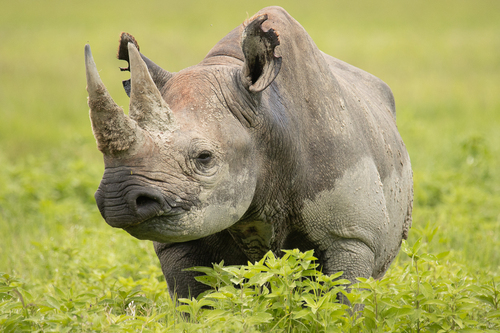
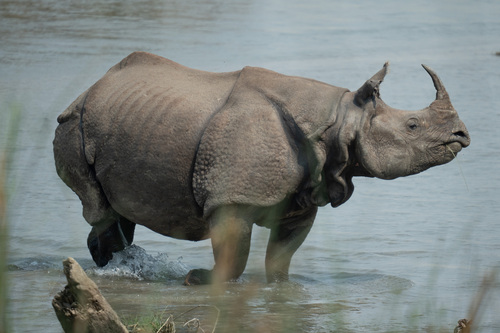

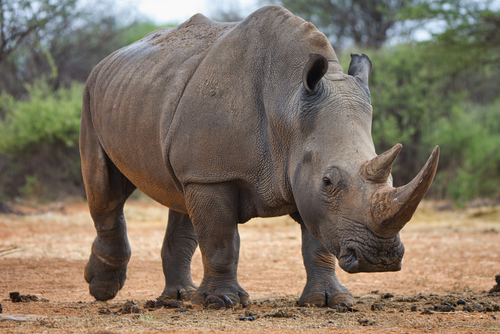
Species that share its range
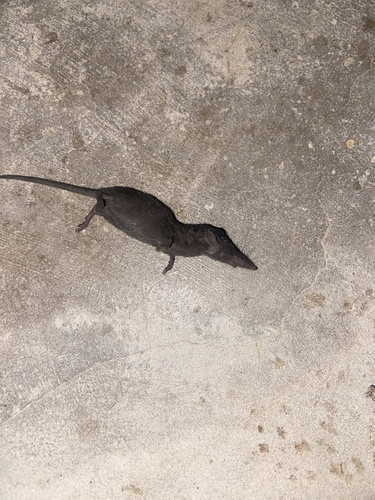
Sources
Conservation status, range description and population estimate come from the IUCN Red List assessment for Dicerorhinus sumatrensis. Countries are derived from that range description, not from a mapped country list. Last refreshed on .
The distribution map is drawn from the IUCN Red List spatial data compiled in 2020. IUCN (International Union for Conservation of Nature)