
Javan Rhinoceros
Rhinoceros sondaicus
Red List assessment
Critically Endangeredon the IUCN Red List
- EXExtinct
- EWExtinct in the Wild
- CRCritically Endangered
- ENEndangered
- VUVulnerable
- NTNear Threatened
- LCLeast Concern
The Javan Rhinoceros is recorded in 8 countries across Asia. The IUCN Red List assesses the Javan Rhinoceros as Critically Endangered. Approximately 76 individuals as of recent surveys (2023), showing a slow but positive population trend due to intensive protection efforts.
- Family
- Rhinocerotidae
- Order
- Perissodactyla
- Genus
- Rhinoceros
- Countries recorded
- 8
- Continents
- Asia
- Red List category
- Critically Endangered
- Data updated
- August 9, 2026
What is the Javan Rhinoceros?
The Javan rhinoceros is one of the rarest large mammals on Earth, now confined to a single population in Ujung Kulon National Park on the island of Java, Indonesia. It is a solitary, elusive forest-dwelling rhino with a single small horn and distinctive mosaic-patterned skin folds. Once ranging across Southeast Asia, it has been reduced by hunting and habitat loss to fewer than 80 individuals, making it critically endangered. Its extreme rarity and shyness make it one of the least-observed large mammals in the wild.
Where does the Javan Rhinoceros live?
Ujung Kulon National Park, western Java, Indonesia (the only surviving population in the world)
Historically distributed from northeastern India and Bangladesh through Myanmar, Thailand, Laos, Cambodia, Vietnam, and the Malay Peninsula to Java and possibly Sumatra; today restricted entirely to Ujung Kulon National Park on the western tip of Java, Indonesia.
Altitude and depth
0-500 meters, primarily lowland forest and coastal plains
Seasonal movements
No long-distance migration; individuals may shift local habitat use seasonally in response to monsoon rains and food availability, favoring wallows more during hot dry periods.
Habitat of the Javan Rhinoceros
Dense lowland tropical rainforest, secondary forest, and coastal alluvial plains with abundant mud wallows and dense understory vegetation for browsing and cover.
Adaptations to its environment
Possesses a prehensile upper lip adapted for selectively browsing leaves and twigs from dense vegetation. Thick, folded skin and frequent mud wallowing protect against insects, parasites, and overheating in the humid tropical climate. Its relatively small, compact body allows it to move through dense forest undergrowth more easily than larger rhino species.
Conservation status and numbers
Critically Endangered (IUCN); the species survives as a single population with an extremely restricted range, making it highly vulnerable to disease outbreaks, natural disasters (including nearby volcanic activity from Anak Krakatau), and stochastic events.
Estimated population
Approximately 76 individuals as of recent surveys (2023), showing a slow but positive population trend due to intensive protection efforts.
What threatens the Javan Rhinoceros?
Historical poaching for horn (used in traditional Asian medicine), habitat loss and fragmentation, invasive Arenga palm outcompeting native food plants, disease transmission risk from domestic livestock, genetic bottleneck due to small population size, and catastrophic risk from tsunamis or volcanic eruption given single-site confinement.
Diseases and parasites
Susceptible to parasitic infections and potentially serious diseases transmissible from domestic livestock, such as anthrax and foot-and-mouth disease, which pose a significant risk given the small, isolated population.
What is being done to protect it?
Protection within Ujung Kulon National Park (a UNESCO World Heritage Site) via Rhino Protection Units, extensive camera-trap monitoring for individual identification, habitat management including invasive palm removal, and long-term planning for establishing a second population site to reduce extinction risk from a single catastrophic event.
Recommended actions
Establish a second, geographically separate population to reduce single-site risk, continue and expand anti-poaching patrols, implement disease surveillance and livestock exclusion zones, and pursue genetic management strategies to preserve remaining diversity.
What the Javan Rhinoceros looks like
Grey to greyish-brown hairless skin arranged in deep folds creating a mosaic, armor-plate-like appearance, particularly pronounced around the shoulders and hindquarters. A single horn, usually small (up to about 25 cm) and often absent or reduced in females, sits atop the snout.
Size
Shoulder height approximately 1.5-1.7 meters; body length 2-4 meters
Weight
900 to 2,300 kg, with males generally slightly larger than females
Distinctive features
Distinguished from the Indian rhinoceros by its smaller size, less pronounced skin folds, and single small horn present mainly in males; distinguished from the Sumatran rhino by its hairless skin and single horn versus the Sumatran's hairy body and two horns.
Differences between males and females
Males typically possess a visible, though small, horn while females often have only a knob or lack a horn entirely; males are also slightly larger in body size.
Behaviour and diet of the Javan Rhinoceros
Predominantly solitary, with individuals maintaining overlapping home ranges; the only stable social bond is between a mother and her calf, which may last up to two years.
When it is active
Primarily active during dawn, dusk, and nighttime (crepuscular/nocturnal), especially in areas with human disturbance, though can be active during the day within the protected core of its range.
Diet
Strict herbivore, browsing on leaves, twigs, fallen fruit, and shoots from more than 150 plant species, showing a preference for saplings and understory vegetation in disturbed or regenerating forest patches.
Communication
Communicates through vocalizations such as whistles, snorts, and bleats, along with scent marking via urine spraying, dung piles (middens), and ground scraping to signal territory and reproductive status.
Interactions with other species
Adults have no significant natural predators today, though historically tigers may have preyed on calves; the species shares habitat and food resources with banteng (wild cattle) and other forest herbivores, sometimes leading to competition for browse.
Role in its ecosystem
Acts as a seed disperser for various forest plants through its droppings and helps shape forest understory structure through selective browsing, contributing to habitat heterogeneity within its ecosystem.
Reproduction and lifecycle
No strict breeding season; gestation lasts approximately 15-16 months, resulting in a single calf per birth, with calving intervals typically of 3-4 years.
Raising the young
The mother provides sole parental care, nursing and protecting the calf, which remains with her for around two years before becoming independent; weaning generally occurs within the first one to two years.
Maturity and lifespan
Females typically reach sexual maturity around 5-7 years and males around 7-10 years; lifespan in the wild is estimated at 30-40 years, though no individuals currently exist in captivity to provide comparative data.
Taxonomy and naming of the Javan Rhinoceros
Classification
Mammalia > Perissodactyla > Rhinocerotidae > Rhinoceros > Rhinoceros sondaicus
Subspecies
R. s. sondaicus (Java, Indonesia - only surviving population); R. s. annamiticus (Vietnam - declared extinct in 2010); R. s. inermis (India/Bangladesh - extinct since early 20th century)
Scientific synonyms
Rhinoceros javanicus; historically also referred to under various regional names before taxonomic consolidation
What research says
Recent studies
Recent camera-trap census work (2023) has refined population estimates and individual identification; ongoing genetic research is assessing population viability and informing plans for translocation to establish a second population site, potentially in the Cikepuh Wildlife Reserve.
Genome and DNA
Diploid chromosome number of 2n=82; genetic studies indicate very low genetic diversity due to the severe population bottleneck, raising concerns about inbreeding depression.
Compared with similar species
Smaller and less heavily armored than the Indian rhinoceros (Rhinoceros unicornis), which has more pronounced skin folds and horns in both sexes; differs from the Sumatran rhinoceros (Dicerorhinus sumatrensis) by lacking body hair and possessing only a single horn rather than two.
The Javan Rhinoceros and people
The Javan rhinoceros is considered the rarest large mammal species on Earth, with its entire global population confined to one national park. Sightings by researchers are so rare that most population data comes exclusively from camera traps rather than direct observation. Females often have no visible horn at all, unlike almost any other rhino species.
Where and how to see it
Direct wild observation is essentially impossible due to the species' extreme shyness and critically low numbers; visitors to Ujung Kulon National Park may join ranger-led educational treks, though sightings are exceedingly rare and most evidence of the species comes from camera-trap footage.
Risks to humans
No notable risk; the species is naturally reclusive and avoids human contact, though like any large wild animal it could become dangerous if directly cornered or threatened.
Human uses
Historically hunted for its horn used in traditional medicine, though this trade is now illegal and heavily restricted; today its primary human value lies in ecotourism and its symbolic importance for global conservation efforts.
Myths and legends
Historically, rhinoceros horn—including that of the Javan rhino—was prized in traditional Chinese medicine for supposed healing properties, despite being composed of keratin with no proven medicinal effect; this belief drove centuries of poaching pressure across Asia.
Countries where the Javan Rhinoceros is recorded
The 8 countries named in the range description of its IUCN Red List assessment.
Questions about the Javan Rhinoceros
Where does the Javan Rhinoceros live?
The Javan Rhinoceros is recorded in Bangladesh, Cambodia, India, Indonesia and Laos, among 8 countries in total across Asia. These countries come from the range description of its IUCN Red List assessment, and they are what place the species on the interactive map.
Is the Javan Rhinoceros endangered?
Yes. The IUCN Red List assesses the Javan Rhinoceros as Critically Endangered, one of the three threatened categories. The species faces an extremely high risk of extinction in the wild. This is the last category before extinction, and it is reached through a very small or steeply declining population, a tiny range, or both.
How many are left in the wild?
Approximately 76 individuals as of recent surveys (2023), showing a slow but positive population trend due to intensive protection efforts. This figure comes from the species assessment on the IUCN Red List; population estimates for wild mammals are ranges, not counts, and are revised at each assessment.
What habitat does the Javan Rhinoceros live in?
Dense lowland tropical rainforest, secondary forest, and coastal alluvial plains with abundant mud wallows and dense understory vegetation for browsing and cover.
What is the scientific name of the Javan Rhinoceros?
The Javan Rhinoceros is Rhinoceros sondaicus, in the family Rhinocerotidae, order Perissodactyla.
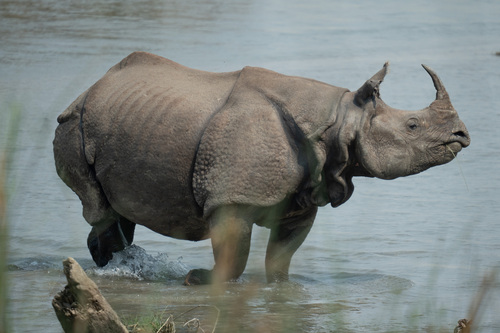
Other species in the genus Rhinoceros
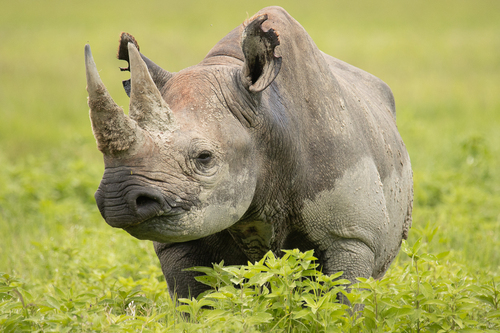
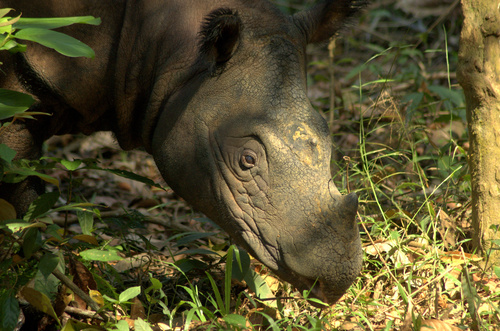
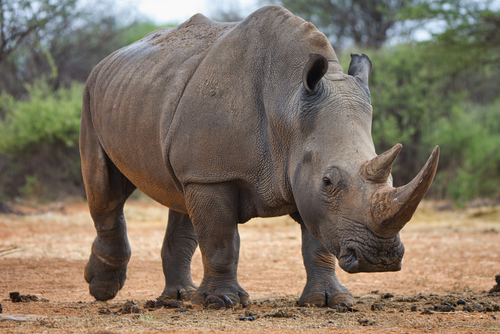
Other species in the family Rhinocerotidae
Species that share its range
Sources
Conservation status, range description and population estimate come from the IUCN Red List assessment for Rhinoceros sondaicus. Countries are derived from that range description, not from a mapped country list. Last refreshed on .
The distribution map is drawn from the IUCN Red List spatial data compiled in 2020. IUCN (International Union for Conservation of Nature)