
Spotted Wrinkle-lipped Bat
Mops bivittatus
Red List assessment
Least Concernon the IUCN Red List
- EXExtinct
- EWExtinct in the Wild
- CRCritically Endangered
- ENEndangered
- VUVulnerable
- NTNear Threatened
- LCLeast Concern
The Spotted Wrinkle-lipped Bat is recorded in 6 countries across Asia. The IUCN Red List assesses the Spotted Wrinkle-lipped Bat as Least Concern. No precise global population estimate exists, but the species is considered locally common in suitable habitat; overall population trend is believed to be stable to slightly declining in areas with high human disturbance.
- Family
- Molossidae
- Order
- Chiroptera
- Genus
- Mops
- Countries recorded
- 6
- Continents
- Asia
- Red List category
- Least Concern
- Data updated
- August 9, 2026
What is the Spotted Wrinkle-lipped Bat?
The Spotted Wrinkle-lipped Bat is a small free-tailed bat native to the lowlands and forested regions of mainland Southeast Asia. It is named for its wrinkled upper lip and distinctive mottled or spotted fur pattern, which sets it apart from many close relatives. This species roosts in caves and man-made structures, forming colonies that can number in the thousands. It plays an important ecological role as a nocturnal insect predator, helping to control agricultural and forest pest populations.
Where does the Spotted Wrinkle-lipped Bat live?
Southeast Asia, primarily Myanmar, Thailand, Cambodia, Vietnam, and Laos, with some records from Indonesia (Java)
Distributed across mainland Southeast Asia including Myanmar, Thailand, Cambodia, Vietnam, and Laos, with additional occurrence records reported from parts of Indonesia. Its range is patchy, closely tied to the availability of suitable cave systems and forest-edge foraging habitat.
Altitude and depth
Typically found from sea level up to around 1000 meters elevation, favoring lowland and hill forest zones near karst formations.
Seasonal movements
No long-distance migration is documented; the species may shift roosting sites seasonally in response to monsoon rains and insect prey availability.
Habitat of the Spotted Wrinkle-lipped Bat
Found in lowland tropical and subtropical forests, agricultural mosaics, and karst limestone landscapes rich in caves. It readily adapts to human-modified environments such as villages and plantations where roosting sites and insect prey are abundant.
Adaptations to its environment
Its narrow, pointed wings and fast flight enable efficient aerial insect hunting in open and semi-open habitats. Echolocation calls are adapted for detecting small flying insects at height, and its wrinkled lips are thought to aid in funneling prey or amplifying echolocation signals during feeding.
Conservation status and numbers
Listed as Least Concern (LC) by the IUCN due to its relatively wide distribution and presumed large population size, though local declines have been noted near degraded roost sites.
Estimated population
No precise global population estimate exists, but the species is considered locally common in suitable habitat; overall population trend is believed to be stable to slightly declining in areas with high human disturbance.
What threatens the Spotted Wrinkle-lipped Bat?
Main threats include cave disturbance and destruction from limestone quarrying, guano harvesting, deforestation of foraging habitat, and pesticide use that reduces insect prey availability.
Diseases and parasites
Like other cave-dwelling bats, it can host ectoparasites such as mites and bat flies, and may carry various coronaviruses, though specific pathogen studies remain limited.
What is being done to protect it?
Protection occurs indirectly through regional cave and karst conservation initiatives and protected areas in Southeast Asia, though species-specific conservation programs are limited.
Recommended actions
Recommended actions include protecting key cave roosts from quarrying and tourism disturbance, monitoring population trends, and promoting sustainable agricultural practices that reduce pesticide impacts on insect prey.
What the Spotted Wrinkle-lipped Bat looks like
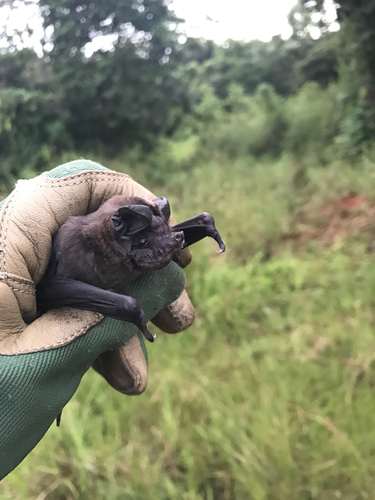
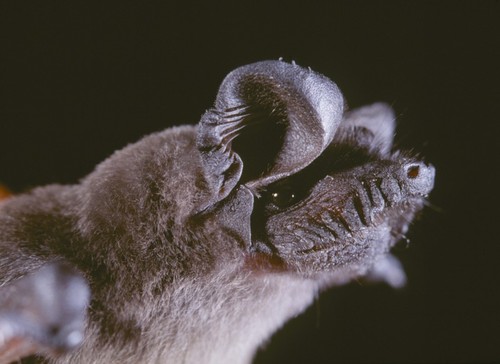
The fur is dark brown to blackish, often with lighter mottled or spotted patches on the underside, giving rise to its common name. It has broad, wrinkled lips, small eyes, and forward-directed ears typical of free-tailed bats.
Size
Body length approximately 5-7 cm, with a wingspan of roughly 25-30 cm.
Weight
Adults typically weigh between 10 and 15 grams.
Distinctive features
Distinguished from other Mops species by its unique spotted or mottled ventral fur pattern and specific skull and dental characteristics used in taxonomic identification.
Differences between males and females
Sexual dimorphism is minimal, with males and females showing similar size and coloration.
Behaviour and diet of the Spotted Wrinkle-lipped Bat
Highly gregarious, forming colonies ranging from a few hundred to several thousand individuals in caves or building roosts, often mixed with other bat species.
When it is active
Strictly nocturnal, emerging at dusk to forage and returning to roost before dawn.
Diet
Insectivorous, feeding primarily on small flying insects such as moths, beetles, and flies caught on the wing.
How it feeds and hunts
Uses fast, agile flight combined with echolocation to detect and capture insects in open airspace above forests and agricultural land.
Communication
Communicates through ultrasonic echolocation calls for navigation and foraging, as well as social vocalizations within roosting colonies for group cohesion.
Interactions with other species
Predators likely include owls, snakes, and small carnivorous mammals near roost entrances; it often shares roosts with other bat species, contributing to complex cave ecosystems.
Role in its ecosystem
Serves as an important insectivorous predator, helping regulate populations of night-flying insects, including agricultural pests, and contributing nutrient input to cave ecosystems through guano deposits.
Reproduction and lifecycle
Breeding is thought to occur once or twice annually, with females typically giving birth to a single pup after a gestation period of approximately 2-3 months, consistent with other molossid bats.
Raising the young
Females nurse and care for the single pup within the maternity roost, with young becoming volant and independent within a few weeks after birth.
Maturity and lifespan
Sexual maturity is likely reached within the first year of life; lifespan in the wild is estimated at 5-10 years, based on comparable molossid species.
Taxonomy and naming of the Spotted Wrinkle-lipped Bat
Classification
Class Mammalia > Order Chiroptera > Family Molossidae > Genus Mops > Species Mops bivittatus
Scientific synonyms
Chaerephon bivittatus, Tadarida bivittata
What research says
Recent studies
Recent taxonomic revisions have clarified the placement of this species within Mops versus Chaerephon, based on molecular phylogenetic analyses of Southeast Asian free-tailed bats.
Compared with similar species
Similar to other Mops and Chaerephon species in general body plan, but distinguished by its spotted underside fur and specific cranial measurements; it is smaller than the larger Mops species found in Africa.
The Spotted Wrinkle-lipped Bat and people
Its wrinkled lips, a hallmark of free-tailed bats, are believed to help fold and manage the mouth during rapid insect capture in flight. Colonies can consume enormous quantities of insects nightly, benefiting local agriculture. The species' spotted fur pattern is quite rare among molossid bats, making it a distinctive subject for bat researchers.
Where and how to see it
Best observed at dusk near cave entrances or karst limestone areas in Thailand, Myanmar, or Cambodia, particularly during the dry season when colonies are most active and visible.
Risks to humans
No notable risk to humans, though as with all bats, direct handling should be avoided due to potential zoonotic disease transmission.
Human uses
No significant direct human use, though its guano may be collected locally as fertilizer, and its insect-control ecosystem service benefits nearby agriculture.
Countries where the Spotted Wrinkle-lipped Bat is recorded
The 6 countries named in the range description of its IUCN Red List assessment.
Questions about the Spotted Wrinkle-lipped Bat
Where does the Spotted Wrinkle-lipped Bat live?
The Spotted Wrinkle-lipped Bat is recorded in Cambodia, Indonesia, Laos, Myanmar and Thailand, among 6 countries in total across Asia. These countries come from the range description of its IUCN Red List assessment, and they are what place the species on the interactive map.
Is the Spotted Wrinkle-lipped Bat endangered?
The IUCN Red List assesses the Spotted Wrinkle-lipped Bat as Least Concern. The species is widespread and abundant enough not to qualify for any threatened category. It does not mean the species is safe forever, only that nothing in the current data raises an alarm.
How many are left in the wild?
No precise global population estimate exists, but the species is considered locally common in suitable habitat; overall population trend is believed to be stable to slightly declining in areas with high human disturbance. This figure comes from the species assessment on the IUCN Red List; population estimates for wild mammals are ranges, not counts, and are revised at each assessment.
What habitat does the Spotted Wrinkle-lipped Bat live in?
Found in lowland tropical and subtropical forests, agricultural mosaics, and karst limestone landscapes rich in caves.
What is the scientific name of the Spotted Wrinkle-lipped Bat?
The Spotted Wrinkle-lipped Bat is Mops bivittatus, in the family Molossidae, order Chiroptera.
Other species in the genus Mops

Other species in the family Molossidae

Sources
Conservation status, range description and population estimate come from the IUCN Red List assessment for Mops bivittatus. Countries are derived from that range description, not from a mapped country list. Last refreshed on .
The distribution map is drawn from the IUCN Red List spatial data compiled in 2008. IUCN (International Union for Conservation of Nature)