
Southern Water Vole
Arvicola sapidus
Red List assessment
Near Threatenedon the IUCN Red List
- EXExtinct
- EWExtinct in the Wild
- CRCritically Endangered
- ENEndangered
- VUVulnerable
- NTNear Threatened
- LCLeast Concern
The Southern Water Vole is recorded in 3 countries across Europe. The IUCN Red List assesses the Southern Water Vole as Near Threatened. No precise global population estimate is available.
- Family
- Cricetidae
- Order
- Rodentia
- Genus
- Arvicola
- Countries recorded
- 3
- Continents
- Europe
- Red List category
- Near Threatened
- Data updated
- August 9, 2026
What is the Southern Water Vole?
The Southern Water Vole is a large, semi-aquatic rodent restricted to the Iberian Peninsula and southwestern France. It inhabits the banks of rivers, streams, ponds, marshes, and irrigation channels, where it constructs extensive burrow systems with underwater entrances. It is among the largest voles in Europe and is a capable swimmer and diver. Listed as Near Threatened, its populations are declining due to invasive predators and riparian habitat degradation.
Where does the Southern Water Vole live?
Iberian Peninsula (Spain and Portugal) and southwestern France
Distributed throughout most of the Iberian Peninsula in Spain and Portugal, extending into southwestern and south-central France (Atlantic coast, Languedoc, Pyrenean foothills, and scattered localities northward to the Loire Valley). Absent from the most arid zones of southeastern Spain and from the highest mountain massifs.
Altitude and depth
Typically found from sea level to approximately 1,800–2,000 m elevation, following watercourses into mountain valleys. Most abundant at lower and mid elevations where riparian vegetation is lush and permanent water is available.
Seasonal movements
Does not hibernate and remains active year-round. Activity may be reduced during cold spells in winter. Reproductive activity is strongly seasonal, concentrated from late winter through early autumn (approximately March–October), with peaks in spring and early summer.
Habitat of the Southern Water Vole
Strongly associated with semi-aquatic and riparian habitats including riverbanks, lake margins, marshes, ponds, and irrigation ditches with dense emergent vegetation such as reeds (Phragmites), sedges (Carex), rushes (Juncus), and tall grasses. Requires soft, stable, vegetated banks suitable for burrowing close to permanent water.
Adaptations to its environment
Dense, water-repellent underfur provides insulation in cold water. Partially webbed hind feet enhance swimming efficiency. Burrow entrances positioned at or just below the waterline allow rapid escape from terrestrial predators. The relatively long, well-furred tail assists with balance and aquatic locomotion.
Conservation status and numbers
Near Threatened (NT) on the IUCN Red List (last assessed 2016). The species does not currently meet the quantitative thresholds for Vulnerable status but is experiencing a continuous, documented population decline across its range, particularly due to American mink predation and wetland habitat loss.
Estimated population
No precise global population estimate is available. The population trend is described as declining by the IUCN, with local extirpations documented across northwestern Spain and southwestern France, particularly in areas invaded by American mink.
What threatens the Southern Water Vole?
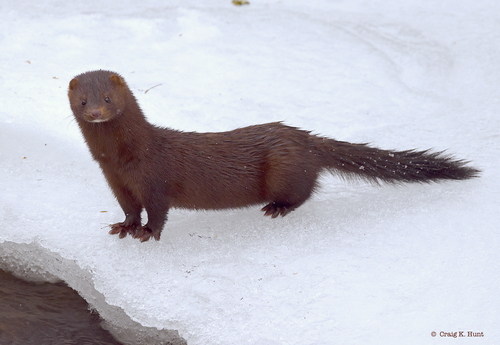
The invasive American mink (Neovison vison) is the primary driver of local population collapses, as it is a specialized semi-aquatic predator capable of entering burrows. Additional threats include drainage and channelization of rivers and wetlands, agricultural intensification in riparian zones, water pollution, and incidental poisoning by rodenticides used in agricultural contexts.
Diseases and parasites
Known to be susceptible to leptospirosis (Leptospira spp.) and tularemia (Francisella tularensis), both of which are zoonotic. Carries various internal parasites including cestodes and nematodes. Ectoparasites such as fleas, lice, and ticks have been documented. Its potential role as a hantavirus reservoir in its range has not been fully characterized.
What is being done to protect it?
Protected under Annex III of the Bern Convention. Listed as a protected species under Spanish national legislation (Ley 42/2007 del Patrimonio Natural y de la Biodiversidad) and regional equivalents. American mink trapping and eradication campaigns in Galicia, Cantabria, and parts of France indirectly benefit this species. Included in national biodiversity monitoring programs in both Spain and France.
Recommended actions
Priority actions include the expansion and coordination of American mink eradication programs across the species' range. Riparian habitat restoration through vegetation buffer zones along watercourses is critical. Reduction of water pollution and sustainable water flow management are needed. Improved population monitoring using eDNA and camera-trap techniques, along with development of dedicated regional conservation action plans, particularly in France where it is near its range limit.
What the Southern Water Vole looks like
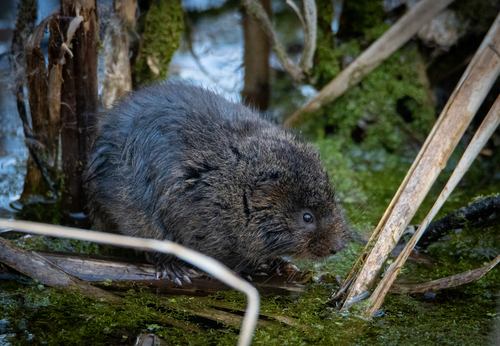
Stocky, rounded body with a blunt snout, very small rounded ears mostly concealed within dense fur, and a relatively long, well-furred tail. Dorsal pelage is dark chestnut-brown to dark grey-brown; ventral fur is paler, greyish to yellowish-grey. Fur is dense and somewhat water-resistant. Eyes are small and black.
Size
Body length 14–22 cm; tail length 9–14 cm (approximately 55–65% of body length); hind foot 30–37 mm. It is one of the largest voles in Europe.
Weight
Typically 70–250 g in adults, most commonly 100–200 g. Significant individual variation exists; sexual size dimorphism is limited.
Distinctive features
Larger and darker than most sympatric vole species. Distinguished from the European Water Vole (Arvicola amphibius) by its generally greater size, more uniformly dark and dense pelage, proportionally longer tail, and restriction to the Iberian Peninsula and France. Its strictly riparian and semi-aquatic habits also differ from the fossorial ecotypes found in A. amphibius.
Differences between males and females
Sexual dimorphism is minimal. Males may average marginally larger in body mass than females, but overlap is extensive and sexes cannot be reliably distinguished in the field by size or coloration.
Behaviour and diet of the Southern Water Vole
Largely solitary and territorial. Adults, particularly males, defend sections of riverbank and associated burrow systems against conspecifics. Home ranges are elongated along waterways. Females may show greater tolerance toward conspecifics during the breeding season. Population density varies widely depending on habitat quality and predation pressure.
When it is active
Primarily crepuscular and nocturnal, with peak activity around dawn and dusk. Individuals can be observed during daylight hours, particularly in areas with low predation pressure or during summer when days are long. Foraging trips typically start and end near water.
Diet
Strictly herbivorous. Diet consists mainly of aquatic and bankside vegetation: stems, leaves, roots, and rhizomes of reeds, sedges, rushes, grasses, and waterside herbs. Also consumes bark, bulbs, and roots of riparian shrubs and trees, especially in winter when green vegetation is scarce.
Communication
Communicates primarily through scent marking using secretions from flank glands and urine deposited along burrow systems and runways to signal territory and reproductive status. Produces soft squeaking and chattering vocalizations, particularly alarm calls when threatened. Ultrasonic communication between mother and offspring has been inferred but not well studied in this species.
Interactions with other species
Natural predators include the Eurasian otter (Lutra lutra), barn owl (Tyto alba), marsh harrier (Circus aeruginosus), grey heron (Ardea cinerea), European polecat (Mustela putorius), and weasel (Mustela nivalis). The invasive American mink (Neovison vison) is by far the most ecologically damaging predator. Competes for riparian resources with other small rodents and, to some extent, with the Eurasian water shrew.
Role in its ecosystem
Plays an important ecological role in riparian ecosystems as a primary consumer of aquatic and bankside vegetation, helping to control plant biomass. Serves as a key prey species for multiple semi-aquatic and wetland predators, forming a critical link in riparian food webs. Burrowing activity contributes to bank soil aeration and structure.
Reproduction and lifecycle
Breeding season extends from approximately March to October, peaking in spring. Gestation lasts around 21–22 days. Litter size ranges from 3 to 8 young (typically 4–6). Females can produce 3–5 litters per year under favorable conditions, with rapid population recovery possible in good habitats.
Raising the young
Young are born blind, hairless, and helpless in a grass-lined nest within the burrow. The female provides all parental care, nursing the young for approximately 3 weeks. Juveniles grow rapidly and disperse shortly after weaning. Young of early litters may breed in the same year they are born.
Maturity and lifespan
Sexual maturity is reached at approximately 4–8 weeks of age, though meaningful reproductive contribution typically begins in the first breeding spring following birth. Lifespan in the wild is generally 1–2 years due to high predation pressure. Captive individuals have been recorded living up to 3–4 years.
Taxonomy and naming of the Southern Water Vole
Classification
Mammalia > Rodentia > Cricetidae > Arvicola > Arvicola sapidus
Subspecies
Two subspecies are generally recognized: Arvicola sapidus sapidus (Miller, 1908), distributed across most of the Iberian Peninsula; and Arvicola sapidus tenebricus (Miller, 1908), found in southwestern France and along the northern slopes of the Pyrenees. Subspecific boundaries are not always clearly defined.
Scientific synonyms
Arvicola terrestris sapidus Miller, 1908; formerly treated as a subspecies of Arvicola terrestris or considered conspecific with Arvicola amphibius before molecular and morphological studies confirmed its distinct species status.
What research says
Recent studies
Recent work employing environmental DNA (eDNA) from water samples has shown promise as a non-invasive detection tool for this cryptic species in France, where traditional survey methods are unreliable. Studies in Galicia and the Cantabrian coast have quantitatively documented American mink-driven population crashes, providing strong evidence for mink control as the single most effective conservation intervention. Genetic studies continue to refine understanding of population connectivity and refugial history.
Genome and DNA
Karyotype of 2n = 36 chromosomes, notably stable compared to the highly variable karyotype of the closely related Arvicola amphibius (2n = 36–61). Phylogeographic studies based on mitochondrial and nuclear DNA markers have identified distinct genetic lineages across the Iberian Peninsula, consistent with survival in multiple glacial refugia during the Pleistocene.
Compared with similar species
Most closely related to the European Water Vole (Arvicola amphibius), from which it was long considered inseparable. A. sapidus is consistently larger and darker, more strictly tied to semi-aquatic habitats, and does not form the widespread fossorial (field-dwelling) ecotypes characteristic of A. amphibius. Unlike A. amphibius, it does not undergo dramatic multi-annual population boom-bust cycles. Its range is exclusively southwestern European, contrasting with the broad Palearctic distribution of A. amphibius.
The Southern Water Vole and people
The Southern Water Vole can slip into water almost silently and swim submerged for up to 20 seconds to evade predators, making it surprisingly elusive despite its relatively large size. Its burrow systems can be elaborate engineering feats, with multiple chambers for nesting and food storage connected by tunnels that open both above and below the waterline. Despite being a rodent with a lifespan of only 1–2 years, a single female can theoretically produce over 20 offspring in a single breeding season.
Where and how to see it
Best observed at dawn or dusk along slow-flowing rivers, irrigation channels, and reed-fringed pond margins in Spain and southwestern France. Observers should look and listen for the characteristic quiet 'plop' of an animal entering the water, half-eaten plant stems arranged on the bank or on small platforms, and burrow entrances just above or at the waterline. The river systems of Galicia, Cantabria, and the Pyrenean foothills are among the most reliable locations. Sitting quietly near suitable habitat for 20–30 minutes greatly increases the chance of observation.
Risks to humans
No notable direct risk to humans. As a wild rodent, it can theoretically carry zoonotic pathogens such as Leptospira; direct handling without protective gloves should be avoided. It will bite if handled and cornered but poses no significant threat under normal observation conditions.
Human uses
No significant current human use is documented. Water voles were historically trapped for fur in parts of Europe, but this practice is not specifically documented as significant for this species. It has no known role in traditional medicine or commercial trade.
Countries where the Southern Water Vole is recorded
The 3 countries named in the range description of its IUCN Red List assessment.
Questions about the Southern Water Vole
Where does the Southern Water Vole live?
The Southern Water Vole is recorded in France, Portugal and Spain across Europe. These countries come from the range description of its IUCN Red List assessment, and they are what place the species on the interactive map.
Is the Southern Water Vole endangered?
The IUCN Red List assesses the Southern Water Vole as Near Threatened. The species does not qualify as threatened today, but it is close to the thresholds and likely to cross them soon. It is the category that most often changes at the next assessment.
How many are left in the wild?
No precise global population estimate is available. This figure comes from the species assessment on the IUCN Red List; population estimates for wild mammals are ranges, not counts, and are revised at each assessment.
What habitat does the Southern Water Vole live in?
Strongly associated with semi-aquatic and riparian habitats including riverbanks, lake margins, marshes, ponds, and irrigation ditches with dense emergent vegetation such as reeds (Phragmites), sedges (Carex), rushes (Juncus), and tall grasses.
What is the scientific name of the Southern Water Vole?
The Southern Water Vole is Arvicola sapidus, in the family Cricetidae, order Rodentia.
Other species in the genus Arvicola
Other species in the family Cricetidae
Species that share its range
Sources
Conservation status, range description and population estimate come from the IUCN Red List assessment for Arvicola sapidus. Countries are derived from that range description, not from a mapped country list. Last refreshed on .
The distribution map is drawn from the IUCN Red List spatial data compiled in 2023. IUCN SSC Small Mammal Specialist Group