
Southern Hairy-nosed Wombat
Lasiorhinus latifrons
Red List assessment
Least Concernon the IUCN Red List
- EXExtinct
- EWExtinct in the Wild
- CRCritically Endangered
- ENEndangered
- VUVulnerable
- NTNear Threatened
- LCLeast Concern
The Southern Hairy-nosed Wombat is recorded in 2 countries across Europe and Oceania. The IUCN Red List assesses the Southern Hairy-nosed Wombat as Least Concern. Estimated at over 100,000 individuals, with the population considered generally stable, though subject to fluctuations tied to drought and rainfall cycles.
- Family
- Vombatidae
- Order
- Diprotodontia
- Genus
- Lasiorhinus
- Countries recorded
- 2
- Continents
- Europe and Oceania
- Red List category
- Least Concern
- Data updated
- August 9, 2026
What is the Southern Hairy-nosed Wombat?
The Southern Hairy-nosed Wombat is a stocky, burrowing marsupial endemic to semi-arid regions of southern Australia. It is the smallest of the three wombat species and is distinguished by its broad muzzle covered in fine hair. Highly adapted to arid conditions, it lives in extensive burrow systems called warrens that provide refuge from extreme heat. It is the official faunal emblem of South Australia.
Where does the Southern Hairy-nosed Wombat live?
South Australia, with small populations in western New South Wales and the Nullarbor region extending into Western Australia
Found primarily across the semi-arid regions of South Australia, including the Nullarbor Plain, Eyre Peninsula, and parts of the Murray-Darling basin. Isolated populations also occur in far western New South Wales and along the South Australia-Western Australia border region.
Altitude and depth
0-300m above sea level, typically in low-lying arid plains
Seasonal movements
No true migration or hibernation, but activity patterns shift seasonally, with more daytime activity in cooler months and strictly nocturnal behavior during hot summer periods to avoid heat stress.
Habitat of the Southern Hairy-nosed Wombat
Semi-arid grasslands, shrublands, and open woodlands with sandy or loamy soils suitable for burrowing. Prefers areas with low, tussocky vegetation such as saltbush and bluebush that provide both food and cover near warren entrances.
Adaptations to its environment
Possesses a slow metabolism and low water requirements, allowing survival on minimal food and moisture in arid environments. Backward-facing pouch prevents dirt from entering while digging, and cartilaginous rump plates protect against predators in burrow entrances. Complex warren systems maintain stable, cool microclimates during extreme surface temperatures.
Conservation status and numbers
Least Concern (IUCN), reflecting a generally stable and locally abundant population across its core range in South Australia, though some peripheral populations face localized declines. The species benefits from large protected populations on pastoral and conservation lands.
Estimated population
Estimated at over 100,000 individuals, with the population considered generally stable, though subject to fluctuations tied to drought and rainfall cycles.
What threatens the Southern Hairy-nosed Wombat?
Drought and habitat degradation from livestock grazing competition, land clearing for agriculture, and periodic disease outbreaks such as mange. Vehicle collisions and illegal shooting by farmers (due to perceived competition with livestock) also impact local populations.
Diseases and parasites
Susceptible to sarcoptic mange caused by Sarcoptes scabiei mites, which can cause significant morbidity and mortality in local populations. Various internal parasites and ticks also affect wild individuals.
What is being done to protect it?
Protected under South Australian wildlife legislation, with key populations conserved in areas like Brookfield Conservation Park, a dedicated wombat reserve. Ongoing monitoring programs track population trends and warren activity across its range.
Recommended actions
Continued habitat protection and drought refugia management, disease monitoring for mange outbreaks, and mitigation of human-wildlife conflict with pastoralists through education and compensation schemes.
What the Southern Hairy-nosed Wombat looks like
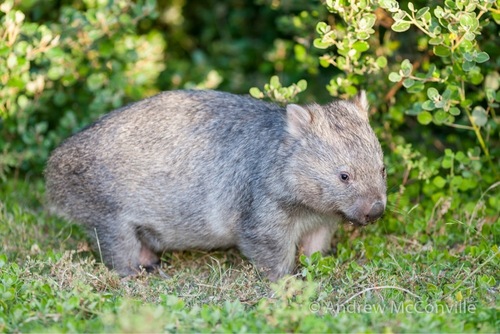
Soft grey to sandy-brown fur, sometimes with darker patches, and a distinctive broad nose covered in fine hairs (unlike the bare nose of the common wombat). The body is barrel-shaped and low-slung, with short powerful legs and strong claws adapted for digging.
Size
Body length of 77-94 cm, with a shoulder height of approximately 25-30 cm
Weight
19-32 kg, with males and females showing minimal size difference
Distinctive features
Distinguished from the common wombat by its hairy nose, softer fur, larger ears, and paler coloration; distinguished from the Northern Hairy-nosed Wombat by smaller size and different, more southerly range.
Differences between males and females
Minimal sexual dimorphism; males and females are similar in size and appearance, making visual sex determination difficult in the field.
Behaviour and diet of the Southern Hairy-nosed Wombat
Semi-social, living in warren systems that may be shared by several individuals, though foraging is typically solitary. Warrens can be extensive, interconnected structures used by multiple wombats with some territorial behavior at burrow entrances.
When it is active
Primarily nocturnal, especially in warmer months, emerging from warrens after sunset to forage; may show crepuscular or even diurnal activity during cooler winter periods.
Diet
Herbivorous grazer, feeding mainly on native and introduced grasses, particularly drought-tolerant species. Capable of surviving on low-quality, fibrous vegetation due to an efficient digestive system and slow metabolic rate.
Communication
Communicates through scent marking via cube-shaped droppings placed prominently to mark territory, along with vocalizations such as grunts, hisses, and growls during social interactions or threats.
Interactions with other species
Few natural predators as adults due to their tough hide and burrowing habits, though dingoes and wedge-tailed eagles may prey on young or vulnerable individuals. Competes with introduced species like rabbits and livestock for food resources in shared arid habitats.
Role in its ecosystem
Plays an important ecological role as an ecosystem engineer, with its extensive burrow systems providing shelter for numerous other species including reptiles, invertebrates, and small mammals. Its grazing also influences vegetation structure in arid grassland ecosystems.
Reproduction and lifecycle
Breeding is closely tied to rainfall and food availability, often occurring after good rains in spring. Gestation lasts about 20-22 days, resulting in a single joey that remains in the pouch for approximately 6 months before beginning to emerge.
Raising the young
The mother provides all parental care, nursing the joey in her pouch for six months and then allowing it to remain near the burrow, weaning occurring at around 9-12 months of age. Joeys become independent by about one year old.
Maturity and lifespan
Reaches sexual maturity at around 2-3 years of age; lifespan in the wild is typically 10-15 years, while captive individuals have been recorded living up to 20 years or more.
Taxonomy and naming of the Southern Hairy-nosed Wombat
Classification
Mammalia > Diprotodontia > Vombatidae > Lasiorhinus > Lasiorhinus latifrons
Scientific synonyms
Phascolomys latifrons (original combination)
What research says
Recent studies
Recent research has focused on warren thermal dynamics and how burrow architecture buffers wombats against climate extremes, as well as genetic studies examining population connectivity across South Australia's semi-arid landscape.
Genome and DNA
Diploid chromosome number of 2n=20; genetic studies have been used to assess population structure and connectivity across fragmented habitats in South Australia.
Compared with similar species
Compared to the Common Wombat (Vombatus ursinus), it has softer fur, a hairy nose, and larger ears, and inhabits drier habitats. It is smaller and more southerly distributed than its critically endangered relative, the Northern Hairy-nosed Wombat (Lasiorhinus krefftii).
The Southern Hairy-nosed Wombat and people
Southern Hairy-nosed Wombats produce distinctively cube-shaped droppings, one of the only mammals known to do so, likely to prevent them from rolling away from scent-marking sites. They can dig extensive warren systems up to 89 meters long with multiple entrances and chambers.
Where and how to see it
Best observed in South Australian reserves such as Brookfield Conservation Park during early morning or late evening hours, particularly in cooler months when wombats are more likely to be active outside their burrows during daylight.
Risks to humans
No notable risk to humans; wombats are generally shy and avoid confrontation, though they can defend themselves powerfully if cornered.
Human uses
Historically hunted by Aboriginal peoples for food; today, the species holds cultural significance as the state faunal emblem of South Australia and is a popular subject for ecotourism.
Myths and legends
Featured in Aboriginal Dreamtime stories as a burrowing creature associated with the earth and underground world, though specific widespread legends are less documented compared to other Australian icons.
Countries where the Southern Hairy-nosed Wombat is recorded
The 2 countries named in the range description of its IUCN Red List assessment.
Questions about the Southern Hairy-nosed Wombat
Where does the Southern Hairy-nosed Wombat live?
The Southern Hairy-nosed Wombat is recorded in Australia and United Kingdom across Europe and Oceania. These countries come from the range description of its IUCN Red List assessment, and they are what place the species on the interactive map.
Is the Southern Hairy-nosed Wombat endangered?
The IUCN Red List assesses the Southern Hairy-nosed Wombat as Least Concern. The species is widespread and abundant enough not to qualify for any threatened category. It does not mean the species is safe forever, only that nothing in the current data raises an alarm.
How many are left in the wild?
Estimated at over 100,000 individuals, with the population considered generally stable, though subject to fluctuations tied to drought and rainfall cycles. This figure comes from the species assessment on the IUCN Red List; population estimates for wild mammals are ranges, not counts, and are revised at each assessment.
What habitat does the Southern Hairy-nosed Wombat live in?
Semi-arid grasslands, shrublands, and open woodlands with sandy or loamy soils suitable for burrowing.
What is the scientific name of the Southern Hairy-nosed Wombat?
The Southern Hairy-nosed Wombat is Lasiorhinus latifrons, in the family Vombatidae, order Diprotodontia.
Other species in the genus Lasiorhinus

Other species in the family Vombatidae
Species that share its range

Sources
Conservation status, range description and population estimate come from the IUCN Red List assessment for Lasiorhinus latifrons. Countries are derived from that range description, not from a mapped country list. Last refreshed on .
The distribution map is drawn from the IUCN Red List spatial data compiled in 2024. sRedList Working Group