
Northern Hairy-nosed Wombat
Lasiorhinus krefftii
Red List assessment
Critically Endangeredon the IUCN Red List
- EXExtinct
- EWExtinct in the Wild
- CRCritically Endangered
- ENEndangered
- VUVulnerable
- NTNear Threatened
- LCLeast Concern
The Northern Hairy-nosed Wombat is recorded in 2 countries across Europe and Oceania. The IUCN Red List assesses the Northern Hairy-nosed Wombat as Critically Endangered. Approximately 300-400 individuals as of recent surveys, trend increasing due to intensive management and translocation efforts.
- Family
- Vombatidae
- Order
- Diprotodontia
- Genus
- Lasiorhinus
- Countries recorded
- 2
- Continents
- Europe and Oceania
- Red List category
- Critically Endangered
- Data updated
- August 9, 2026
What is the Northern Hairy-nosed Wombat?
The Northern Hairy-nosed Wombat is one of the rarest large mammals on Earth, historically confined to a single small population in Epping Forest National Park, Queensland. It is a burrowing marsupial grazer with a stocky build and distinctive fringed nose hairs. Its extreme rarity and recovery from near-extinction make it a flagship species for Australian conservation efforts.
Where does the Northern Hairy-nosed Wombat live?
Central Queensland, Australia, restricted to Epping Forest National Park and a reintroduced population at Richard Underwood Nature Refuge
Endemic to Australia, historically found across Queensland, New South Wales and Victoria; now restricted to a single natural population in Epping Forest National Park, central Queensland, plus a translocated population at Richard Underwood Nature Refuge near St George.
Altitude and depth
Approximately 200-400 meters above sea level
Seasonal movements
No migration; wombats reduce surface activity and burrow use shifts seasonally, with more nocturnal foraging in hot summer months and increased daytime activity in cooler winter months.
Habitat of the Northern Hairy-nosed Wombat
Semi-arid grassy woodland with sandy soils suitable for digging extensive burrow systems, dominated by buffel grass and native grasses under a canopy of brigalow and eucalypt woodland.
Adaptations to its environment
Powerful claws and forelimbs adapted for digging extensive multi-entrance burrow systems that provide thermal refuge from extreme heat. A slow metabolism and ability to survive on low-quality, fibrous grasses allow it to endure prolonged droughts with minimal water intake.
Conservation status and numbers
Critically Endangered (IUCN); the species has one of the smallest ranges of any large mammal, having declined from historical widespread distribution to a single wild population reduced to roughly 30-40 individuals in the 1980s before recovering through intensive conservation management.
Estimated population
Approximately 300-400 individuals as of recent surveys, trend increasing due to intensive management and translocation efforts.
What threatens the Northern Hairy-nosed Wombat?
Habitat loss from agricultural conversion, competition and habitat degradation from introduced cattle and sheep grazing, predation by wild dogs and dingoes, drought exacerbated by climate change, and extreme vulnerability due to a single restricted population.
Diseases and parasites
Susceptible to mange caused by Sarcoptes scabiei mites, a disease that has severely impacted related wombat species, though it is closely monitored in this population to prevent outbreaks.
What is being done to protect it?
Epping Forest National Park is fully protected and predator-fenced; a second population was established via translocation to Richard Underwood Nature Refuge starting in 2009 to reduce extinction risk from a single-site catastrophe. Ongoing monitoring, supplementary feeding during drought, and dingo-proof fencing are key management tools.
Recommended actions
Establish additional secure populations across former range, continue predator exclusion and drought mitigation, expand genetic monitoring to maintain diversity, and secure long-term habitat protection against climate variability.
What the Northern Hairy-nosed Wombat looks like
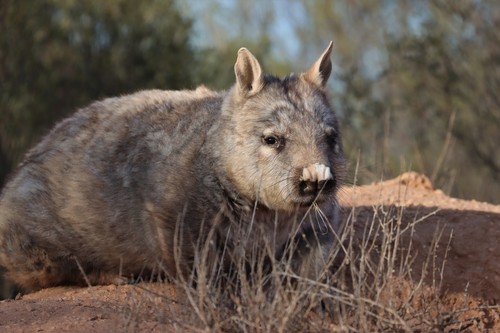
Stocky, barrel-shaped body covered in soft silky grey-brown fur, with a broad head, small eyes, and a distinctive fringe of fine hairs around the nose that gives the species its common name. Short muscular legs end in strong claws suited for digging.
Size
Body length approximately 90-110 cm, shoulder height around 35-40 cm.
Weight
Adults typically weigh 30-40 kg, with males slightly larger than females on average.
Distinctive features
Distinguished from the Southern Hairy-nosed Wombat by larger ears, longer and silkier fur, and a broader muzzle with more pronounced nasal hair fringe; also larger overall body size than its southern relative.
Differences between males and females
Minimal sexual dimorphism; males are marginally larger and heavier than females but are otherwise visually similar.
Behaviour and diet of the Northern Hairy-nosed Wombat
Largely solitary, with individuals maintaining separate burrow systems though burrows may be shared or visited by multiple individuals; loose social tolerance exists within the small population.
When it is active
Primarily nocturnal and crepuscular, resting in burrows during the heat of the day and emerging to graze after dusk.
Diet
Herbivorous grazer feeding mainly on native perennial grasses such as Iseilema (Flinders grass) species, supplementing with other grasses when preferred species are scarce.
Communication
Communicates through scent marking via faeces deposited at burrow entrances and along pathways, along with occasional grunts, hisses, and growls during social encounters or agonistic interactions.
Interactions with other species
Historically preyed upon by dingoes and wild dogs, which remain a significant threat; competes indirectly with introduced livestock and feral herbivores for limited grass resources during drought.
Role in its ecosystem
As a burrowing grazer, it plays a role in soil aeration and nutrient cycling within its grassland habitat, and its burrows can provide shelter for other small native species.
Reproduction and lifecycle
Breeding is closely tied to rainfall and grass availability, with births occurring mainly in warmer months following good rains; gestation lasts about 20-22 days, with a single young typically born per breeding attempt.
Raising the young
The single joey is carried and nursed in the mother's backward-facing pouch for several months, then remains dependent on her burrow and milk for up to a year before becoming fully independent.
Maturity and lifespan
Sexual maturity is reached around 3 years of age; lifespan in the wild is estimated at up to 20 years, with reports of longer longevity possible in protected conditions.
Taxonomy and naming of the Northern Hairy-nosed Wombat
Classification
Mammalia > Diprotodontia > Vombatidae > Lasiorhinus > Lasiorhinus krefftii
Scientific synonyms
Phascolomys krefftii
What research says
Recent studies
Recent research has focused on population genetics to guide translocation strategies and on drought-resilience monitoring using GPS and camera-trap technology to track burrow use and individual health.
Genome and DNA
Genetic studies have confirmed extremely low genetic diversity in the wild population due to historical population bottlenecks, informing management decisions for translocations to safeguard genetic variability.
Compared with similar species
Compared to the more numerous Southern Hairy-nosed Wombat, this species is larger, has silkier fur and bigger ears, and occupies a vastly more restricted and fragile range, making it far more vulnerable to extinction.
The Northern Hairy-nosed Wombat and people
It is sometimes called the world's rarest marsupial due to its history of being reduced to a single tiny population; wombats produce cube-shaped droppings, a trait shared across the wombat family used for scent marking on uneven surfaces.
Where and how to see it
Observation is extremely restricted since Epping Forest National Park is not open to the general public and access is limited to researchers; best viewing opportunities are through official conservation program materials or occasional ranger-guided visits when permitted.
Risks to humans
No notable risk
Countries where the Northern Hairy-nosed Wombat is recorded
The 2 countries named in the range description of its IUCN Red List assessment.
Questions about the Northern Hairy-nosed Wombat
Where does the Northern Hairy-nosed Wombat live?
The Northern Hairy-nosed Wombat is recorded in Australia and United Kingdom across Europe and Oceania. These countries come from the range description of its IUCN Red List assessment, and they are what place the species on the interactive map.
Is the Northern Hairy-nosed Wombat endangered?
Yes. The IUCN Red List assesses the Northern Hairy-nosed Wombat as Critically Endangered, one of the three threatened categories. The species faces an extremely high risk of extinction in the wild. This is the last category before extinction, and it is reached through a very small or steeply declining population, a tiny range, or both.
How many are left in the wild?
Approximately 300-400 individuals as of recent surveys, trend increasing due to intensive management and translocation efforts. This figure comes from the species assessment on the IUCN Red List; population estimates for wild mammals are ranges, not counts, and are revised at each assessment.
What habitat does the Northern Hairy-nosed Wombat live in?
Semi-arid grassy woodland with sandy soils suitable for digging extensive burrow systems, dominated by buffel grass and native grasses under a canopy of brigalow and eucalypt woodland.
What is the scientific name of the Northern Hairy-nosed Wombat?
The Northern Hairy-nosed Wombat is Lasiorhinus krefftii, in the family Vombatidae, order Diprotodontia.
Other species in the genus Lasiorhinus
Other species in the family Vombatidae
Species that share its range

Sources
Conservation status, range description and population estimate come from the IUCN Red List assessment for Lasiorhinus krefftii. Countries are derived from that range description, not from a mapped country list. Last refreshed on .
The distribution map is drawn from the IUCN Red List spatial data compiled in 2008. IUCN (International Union for Conservation of Nature)