
Smoky Grass Mouse
Akodon fumeus
Red List assessment
Least Concernon the IUCN Red List
- EXExtinct
- EWExtinct in the Wild
- CRCritically Endangered
- ENEndangered
- VUVulnerable
- NTNear Threatened
- LCLeast Concern
The Smoky Grass Mouse is recorded in 3 countries across South America. The IUCN Red List assesses the Smoky Grass Mouse as Least Concern. No precise global population estimate is available.
- Family
- Cricetidae
- Order
- Rodentia
- Genus
- Akodon
- Countries recorded
- 3
- Continents
- South America
- Red List category
- Least Concern
- Data updated
- August 9, 2026
What is the Smoky Grass Mouse?
Akodon fumeus, the Smoky Grass Mouse, is a small sigmodontine rodent endemic to the Andean mountain belt of western South America. Its common and scientific names both refer to its characteristically smoky gray-brown dorsal pelage. Like other members of the genus Akodon, it is a terrestrial, largely nocturnal species that occupies montane grasslands and humid forests. It is considered one of the ecologically typical grass mice of the Andean puna and cloud forest zones.
Where does the Smoky Grass Mouse live?
Andean regions of Bolivia, Peru, and northwestern Argentina
Found along the eastern Andes and inter-Andean valleys of central and southern Peru, Bolivia (departments of La Paz, Cochabamba, and Santa Cruz), and the extreme northwest of Argentina (provinces of Jujuy and Salta).
Altitude and depth
Typically recorded between approximately 1,500 m and 4,200 m above sea level, with peak abundance in the 2,500–3,500 m zone.
Seasonal movements
No major seasonal migration is documented. Reproductive activity may be somewhat reduced during the driest austral winter months (June–August), with peaks in the wetter season.
Habitat of the Smoky Grass Mouse
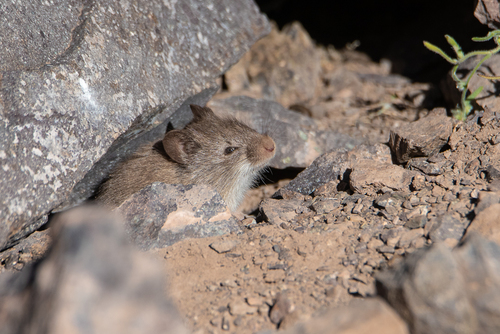
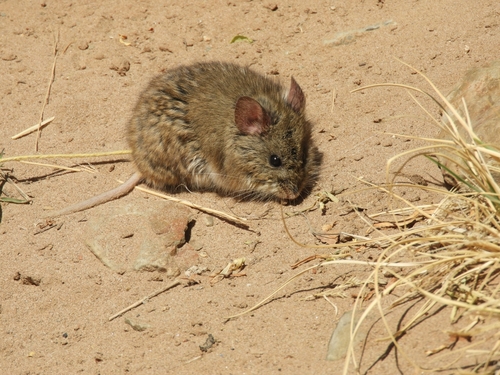
Primarily inhabits montane grasslands (puna and jalca), humid cloud forests, forest edges, and shrubby vegetation along Andean slopes. It also uses rocky terrain, stream margins, and disturbed or secondary vegetation at mid to high altitudes.
Adaptations to its environment
Dense, insulating fur provides thermoregulation in cold, high-altitude environments. Broad dietary flexibility (seeds, arthropods, plant matter) enables survival during seasonal resource scarcity. Compact body morphology with relatively short tail helps retain heat in cold Andean climates.
Conservation status and numbers
Least Concern (LC) on the IUCN Red List. The species has a relatively wide distribution across the Andes, is locally common within appropriate habitat, and does not currently meet the threshold criteria for a threatened category. No significant range-wide population decline has been documented.
Estimated population
No precise global population estimate is available. The species is considered locally common within its range, and the overall population trend is presumed stable.
What threatens the Smoky Grass Mouse?
Habitat degradation from agricultural expansion, overgrazing by livestock (cattle, llamas, sheep), and burning of Andean grasslands are the primary threats. Localized deforestation of cloud forest habitat may also reduce available range.
Diseases and parasites
As with other Akodon species, it is likely host to ectoparasites (fleas, mites, ticks) and internal parasites (nematodes, cestodes). Sigmodontine rodents in the Andes are known reservoirs of hantaviruses and other zoonotic pathogens, though specific documentation for A. fumeus is limited.
What is being done to protect it?
The species occurs within several protected areas across its range, including Madidi National Park (Bolivia), Manu National Park (Peru), and various Argentinean provincial reserves. Its Least Concern status means no specific recovery plans are currently in place.
Recommended actions
Long-term population monitoring in the context of Andean habitat loss, protection of cloud forest and puna corridors, and restriction of uncontrolled burning and overgrazing in key areas are recommended to maintain stable populations.
What the Smoky Grass Mouse looks like
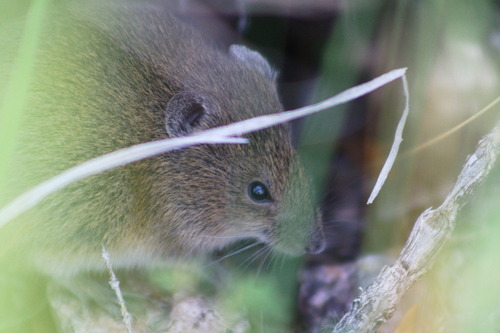
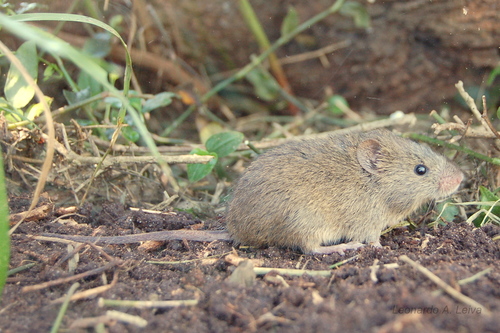
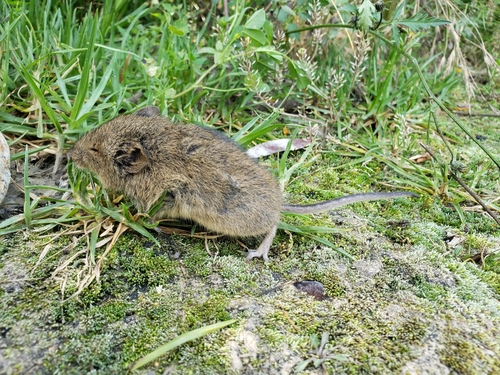
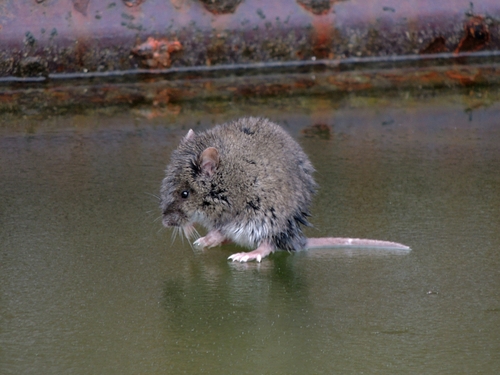
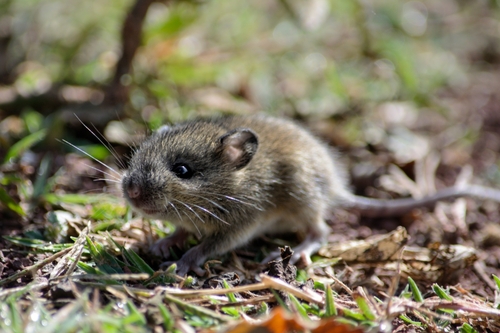
Dorsal fur is grayish-brown to smoky dark brown, giving the animal its common name. The ventral surface is paler, often grayish-white or buff. The fur is soft and relatively dense. Eyes are small and dark; ears are rounded and moderately large; the tail is thinly haired and bicolored (darker above, paler below).
Size
Head-body length approximately 75–110 mm; tail length approximately 55–85 mm (roughly 65–80% of body length).
Weight
Typically 15–35 g; sexual dimorphism in weight is minimal.
Distinctive features
Distinguished from sympatric Akodon species by its overall smoky-gray dorsal coloration, intermediate body size, and specific cranial morphometric characters (notably the shape of the interorbital region and zygomatic arches). Molecular markers have been used to confirm its identity where morphology overlaps with related species such as Akodon boliviensis.
Differences between males and females
Minimal sexual dimorphism; males and females are similar in size and coloration. Males may average very slightly heavier but the difference is not marked.
Behaviour and diet of the Smoky Grass Mouse
Primarily solitary outside of the breeding season. Individuals maintain small home ranges that may overlap marginally with conspecifics. No complex social hierarchy has been reported.
When it is active
Predominantly nocturnal and crepuscular. Activity is concentrated in the hours after dusk and before dawn, with rest periods during the day in burrows, under rocks, or in dense vegetation.
Diet
Omnivorous. Diet includes seeds, green plant material, fungi, and invertebrates such as beetles, larvae, and other arthropods. The balance shifts seasonally depending on resource availability.
How it feeds and hunts
Forages on the ground by exploring substrate with its vibrissae, using a search-and-glean strategy to detect and capture invertebrates and locate seeds. No cooperative foraging is known.
Communication
Communication involves high-frequency ultrasonic vocalizations, particularly between mother and offspring and during mating. Scent marking using urine and glandular secretions is used to delineate home ranges and signal reproductive status.
Interactions with other species
Natural predators include Andean owls (e.g., Asio flammeus), snakes (e.g., Tachymenis), and small mustelids. It competes with other small rodents (Calomys, Phyllotis) for seeds and invertebrates. It may serve as an intermediate host for various helminths and ectoparasites.
Role in its ecosystem
Functions as a secondary consumer and seed disperser/predator in Andean ecosystems. As an abundant small mammal, it represents an important prey base for a variety of Andean predators, linking primary producers to higher trophic levels.
Reproduction and lifecycle
Breeding appears to occur year-round with peaks tied to the rainy season. Gestation is approximately 21–23 days (typical for Akodon). Litter size ranges from 2 to 5 pups. Females can produce several litters per year under favorable conditions.
Raising the young
The female provides all direct parental care. Pups are born altricial (eyes closed, hairless) and are nursed in the nest for approximately 2–3 weeks. The male does not participate in direct pup-rearing.
Maturity and lifespan
Sexual maturity is reached at approximately 6–10 weeks of age, consistent with other Akodon. Wild lifespan is typically 1–2 years due to predation and environmental pressures; captive individuals may survive up to 3 years.
Taxonomy and naming of the Smoky Grass Mouse
Classification
Mammalia > Rodentia > Cricetidae (subfamily Sigmodontinae) > Akodon > Akodon fumeus Thomas, 1902
What research says
Recent studies
Recent phylogeographic studies using mitochondrial and nuclear DNA have clarified the boundaries between A. fumeus and closely related Bolivian Akodon species, confirming it as a distinct lineage. Broader Akodon systematics revisions continue to refine species limits within this speciose genus.
Genome and DNA
The genus Akodon is notable for remarkable chromosomal variation and, in some species, the occurrence of fertile XY females due to Y-chromosome mutations. The specific karyotype of A. fumeus has not been widely published; diploid numbers in Akodon range broadly from 2n=10 to 2n=44 across the genus.
Compared with similar species
Akodon fumeus is closely related to Akodon boliviensis and Akodon subfuscus, with which it is sometimes confused. It is generally distinguished by its more uniform smoky coloration and specific skull measurements. Compared to the widespread Akodon cursor (Brazil), it is smaller and adapted to higher altitudes.
The Smoky Grass Mouse and people
The genus Akodon contains some of the only mammals where chromosomally XY individuals develop as fully fertile females — a remarkable exception to standard mammalian sex determination. The name 'fumeus' is Latin for 'smoky,' a direct reference to its fur color noticed by the describer Oldfield Thomas in 1902. Despite its small size, the Smoky Grass Mouse can survive temperatures near freezing at high Andean altitudes thanks to its thick insulating pelage.
Where and how to see it
Best observed at night using a headlamp near grass or shrub margins in cloud forest or puna zones in Bolivia or southern Peru, especially during the wet season (November–March). Pitfall trapping surveys near Cochabamba or Madidi National Park in Bolivia have yielded reliable records. Patient observers near rocky outcrops or stream edges at 2,500–3,500 m may spot individuals foraging shortly after dusk.
Risks to humans
No notable direct risk to humans. As with all wild rodents in the Andes, there is a theoretical risk of zoonotic disease transmission (e.g., hantavirus) through contact with feces or bites; standard precautions when handling wild rodents are advised.
Countries where the Smoky Grass Mouse is recorded
The 3 countries named in the range description of its IUCN Red List assessment.
Questions about the Smoky Grass Mouse
Where does the Smoky Grass Mouse live?
The Smoky Grass Mouse is recorded in Argentina, Bolivia and Peru across South America. These countries come from the range description of its IUCN Red List assessment, and they are what place the species on the interactive map.
Is the Smoky Grass Mouse endangered?
The IUCN Red List assesses the Smoky Grass Mouse as Least Concern. The species is widespread and abundant enough not to qualify for any threatened category. It does not mean the species is safe forever, only that nothing in the current data raises an alarm.
How many are left in the wild?
No precise global population estimate is available. This figure comes from the species assessment on the IUCN Red List; population estimates for wild mammals are ranges, not counts, and are revised at each assessment.
What habitat does the Smoky Grass Mouse live in?
Primarily inhabits montane grasslands (puna and jalca), humid cloud forests, forest edges, and shrubby vegetation along Andean slopes.
What is the scientific name of the Smoky Grass Mouse?
The Smoky Grass Mouse is Akodon fumeus, in the family Cricetidae, order Rodentia.
Other species in the genus Akodon

Other species in the family Cricetidae
Sources
Conservation status, range description and population estimate come from the IUCN Red List assessment for Akodon fumeus. Countries are derived from that range description, not from a mapped country list. Last refreshed on .
The distribution map is drawn from the IUCN Red List spatial data compiled in 2008. IUCN (International Union for Conservation of Nature)