
Silent Grass Mouse
Akodon surdus
Red List assessment
Vulnerableon the IUCN Red List
- EXExtinct
- EWExtinct in the Wild
- CRCritically Endangered
- ENEndangered
- VUVulnerable
- NTNear Threatened
- LCLeast Concern
The Silent Grass Mouse is recorded in one country, Peru across South America. The IUCN Red List assesses the Silent Grass Mouse as Vulnerable. No precise global population estimate exists; the population is considered small and likely declining due to ongoing habitat loss and fragmentation within its restricted range.
- Family
- Cricetidae
- Order
- Rodentia
- Genus
- Akodon
- Countries recorded
- 1
- Continents
- South America
- Red List category
- Vulnerable
- Data updated
- August 9, 2026
What is the Silent Grass Mouse?
Akodon surdus is a small South American rodent of the subfamily Sigmodontinae, endemic to the Peruvian Andes. It inhabits montane grasslands and humid high-altitude shrublands, where it forages among dense grasses and low vegetation. The species name 'surdus' (Latin for 'deaf' or 'silent') may allude to the animal's inconspicuous nature or the quiet, remote habitats it occupies. Like other Akodon grass mice, it plays an important role as a small herbivore and prey item in Andean ecosystems.
Where does the Silent Grass Mouse live?
Endemic to Peru, primarily in the central and south-central Andes (departments of Ayacucho, Apurímac, and adjacent areas)
Restricted to Peru, with records concentrated in the departments of Ayacucho and Apurímac in the central-south Andes. The species has a limited and fragmented known range, making it one of the more restricted Akodon species in Peru.
Altitude and depth
Typically found between approximately 2,500 and 4,000 m above sea level in Andean montane and puna zones.
Seasonal movements
No known seasonal migrations reported; activity likely remains year-round with possible shifts in microhabitat use during the wet season (October–April) when vegetation is most abundant.
Habitat of the Silent Grass Mouse
Primary habitats include puna grasslands, humid montane shrublands, and ecotonal zones between cloud forest and high-altitude grasslands. Dense grass tussocks, mossy areas, and scrubby vegetation along stream margins are particularly favored microhabitats.
Adaptations to its environment
Thick, dense fur provides insulation against the cold and highly variable temperatures of high-altitude Andean environments. Short limbs and a relatively robust body are well-suited for moving through dense grass tussocks. Like other Akodon, it likely has efficient renal function to manage water balance in variable environments.
Conservation status and numbers
Vulnerable (VU) on the IUCN Red List, assessed due to its restricted geographic range (extent of occurrence estimated below 20,000 km²), ongoing habitat degradation, and continuing decline in habitat quality. The small and fragmented population increases its vulnerability to stochastic events.
Estimated population
No precise global population estimate exists; the population is considered small and likely declining due to ongoing habitat loss and fragmentation within its restricted range.
What threatens the Silent Grass Mouse?
Primary threats include conversion of puna grasslands to agricultural land, overgrazing by livestock (cattle, sheep, camelids), burning of grasslands for pasture renewal, and human settlement expansion. Climate change-driven alteration of high-altitude vegetation zones is an emerging long-term threat.
Diseases and parasites
Like other Akodon rodents, it is likely host to ectoparasites (fleas, mites, ticks) and endoparasites (nematodes, cestodes). Akodon species in South America are also known potential reservoirs of hantaviruses and other zoonotic pathogens, though specific data for A. surdus are lacking.
What is being done to protect it?
The species may receive indirect protection within Peruvian natural protected areas overlapping its range, such as the Ampay National Sanctuary and surrounding conservation units in Apurímac and Ayacucho. No specific targeted conservation program is known to exist for this species.
Recommended actions
Priority actions include updated field surveys to clarify the full extent of the species' range, formal protection of key grassland habitats within its known range, regulation of livestock grazing intensity in occupied areas, and inclusion of the species in regional biodiversity monitoring programs.
What the Silent Grass Mouse looks like
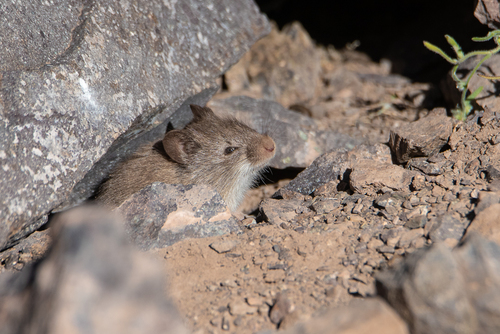
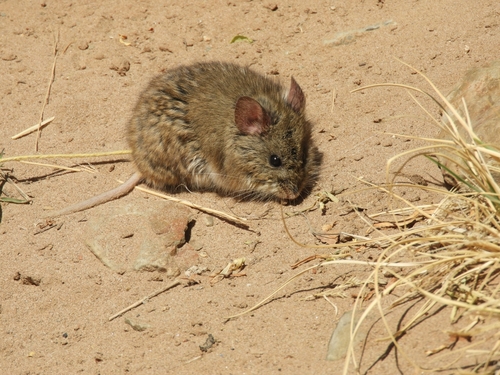
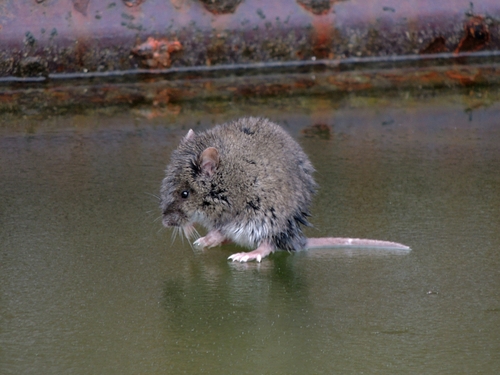
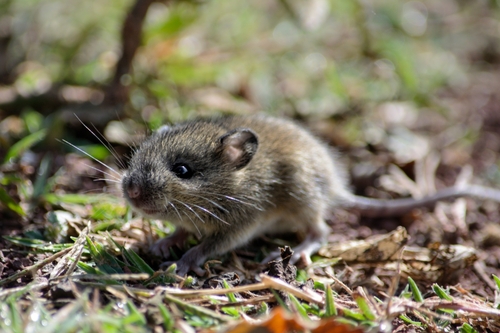
Dorsal fur is generally dark brownish-gray to olivaceous brown, often with a slightly grizzled appearance due to darker hair tips. The ventral surface is paler, typically grayish to buffy-white. The tail is bicolored (darker above, paler below) and moderately haired. Eyes are small and ears relatively short and rounded.
Size
Total body length approximately 85–115 mm; tail length approximately 55–80 mm (tail notably shorter than body); hind foot approximately 18–22 mm.
Weight
Estimated body weight in the range of 18–35 g, typical for medium-sized Akodon; no significant reported sexual size dimorphism in weight.
Distinctive features
Akodon surdus is distinguished from sympatric Akodon species by its combination of relatively dark dorsal coloration, specific cranial and dental morphology (including molar cusp patterns), and its restricted high-altitude distribution. Molecular and karyotypic data help differentiate it from closely related taxa such as A. subfuscus and A. mimus.
Differences between males and females
Sexual dimorphism is minimal, as is typical for Akodon; males and females are broadly similar in size and coloration. Males may average marginally larger in some cranial measurements.
Behaviour and diet of the Silent Grass Mouse
Likely semi-solitary to loosely social, as is typical for Akodon grass mice. Individuals may share overlapping home ranges, particularly during breeding periods, but do not form tight social groups.
When it is active
Primarily nocturnal and crepuscular; most foraging and social activity occurs after dusk and before dawn, allowing avoidance of diurnal raptors that are major predators in puna habitats.
Diet
Omnivorous with a strong herbivorous tendency; diet likely consists of seeds, green plant material, roots, fungi, and invertebrates (insects, larvae). Grass seeds and forbs are probably dietary staples given the grassland habitat.
How it feeds and hunts
Forages opportunistically on the ground and among grass tussocks; invertebrate prey is likely gleaned from soil surface and vegetation rather than actively hunted.
Communication
Communication likely includes ultrasonic vocalizations used in social and reproductive contexts, scent marking via urine and specialized glands to establish territories, and tactile signals during close social interactions.
Interactions with other species
Acts as prey for Andean raptors (e.g., Puna Hawk, American Kestrel), terrestrial carnivores (foxes, weasels, Pampas cats), and large snakes. Competes with other small rodents (other Akodon spp., Oligoryzomys spp.) for food resources. May contribute to seed dispersal of grasses and forbs.
Role in its ecosystem
Functions as a primary consumer in puna grassland food webs, converting plant material into biomass available to higher trophic levels. As prey for numerous predators, it forms a key link in Andean montane ecosystems.
Reproduction and lifecycle
Breeding biology is not well studied; as with other Akodon, reproduction is probably year-round or linked to seasonal peaks in food availability, with gestation lasting approximately 21–23 days and litter sizes of 2–6 pups.
Raising the young
Altricial young are born naked and dependent; the mother provides nursing and warmth in a grass-lined nest. Paternal care is not documented and likely minimal, as is typical for sigmodontine rodents.
Maturity and lifespan
Sexual maturity likely reached at 2–3 months of age, consistent with other Akodon. Lifespan in the wild is estimated at 1–2 years; captive individuals of related species can live up to 3 years.
Taxonomy and naming of the Silent Grass Mouse
Classification
Mammalia > Rodentia > Cricetidae > Akodon > Akodon surdus
Scientific synonyms
Originally described by Oldfield Thomas in 1913; no widely recognized junior synonyms are currently accepted.
What research says
Recent studies
Phylogenomic studies of the genus Akodon have helped clarify the placement of A. surdus within the Akodon boliviensis species group. Taxonomic revisions using molecular and morphological data have confirmed its status as a valid species distinct from closely related Peruvian taxa.
Genome and DNA
Diploid chromosome number (2n) has been reported as 2n = 40 for this species, consistent with the Akodon boliviensis group, though karyotypic data may vary by population; detailed genomic studies are limited.
Compared with similar species
Akodon surdus is closely related to A. subfuscus (Puno Grass Mouse) and A. mimus, all members of a high-Andean Peruvian radiation. It differs from A. subfuscus in cranial morphology and coloration details, and from A. mimus in distributional range and karyotype. All share general Akodon body plan features but are allopatrically or parapatrically distributed across Andean Peru.
The Silent Grass Mouse and people
The genus Akodon is one of the most species-rich mammalian genera in South America, with over 40 recognized species — A. surdus is among the least-known members. Its Latin name 'surdus' meaning 'silent' or 'deaf' gives it an air of mystery, befitting a cryptic mouse of remote Andean grasslands. Despite its small size, Akodon rodents are among the dominant small mammals of the puna ecosystem and can reach high local densities following wet seasons.
Where and how to see it
Best observed at night using small live traps (Sherman traps) set along grass tussock margins and stream edges in puna habitat between 2,500–4,000 m elevation in the departments of Ayacucho and Apurímac, Peru. The wet season (November–March) may correspond to peak activity and abundance. Access typically requires remote trekking or 4WD travel.
Risks to humans
No notable direct risk to humans; however, as a wild rodent it may theoretically carry zoonotic pathogens (hantavirus, leptospirosis) and should not be handled without appropriate biosafety precautions.
Countries where the Silent Grass Mouse is recorded
The 1 countries named in the range description of its IUCN Red List assessment.
Questions about the Silent Grass Mouse
Where does the Silent Grass Mouse live?
The Silent Grass Mouse is recorded in Peru across South America. These countries come from the range description of its IUCN Red List assessment, and they are what place the species on the interactive map.
Is the Silent Grass Mouse endangered?
Yes. The IUCN Red List assesses the Silent Grass Mouse as Vulnerable, one of the three threatened categories. The species faces a high risk of extinction in the wild. It is the first of the three threatened categories: numbers are falling, the range is shrinking, or the population is small enough that a single bad event could do lasting damage.
How many are left in the wild?
No precise global population estimate exists; the population is considered small and likely declining due to ongoing habitat loss and fragmentation within its restricted range. This figure comes from the species assessment on the IUCN Red List; population estimates for wild mammals are ranges, not counts, and are revised at each assessment.
What habitat does the Silent Grass Mouse live in?
Primary habitats include puna grasslands, humid montane shrublands, and ecotonal zones between cloud forest and high-altitude grasslands.
What is the scientific name of the Silent Grass Mouse?
The Silent Grass Mouse is Akodon surdus, in the family Cricetidae, order Rodentia.
Other species in the genus Akodon

Other species in the family Cricetidae
Sources
Conservation status, range description and population estimate come from the IUCN Red List assessment for Akodon surdus. Countries are derived from that range description, not from a mapped country list. Last refreshed on .
The distribution map is drawn from the IUCN Red List spatial data compiled in 2017. IUCN SSC Small Mammal Specialist Group