
Short-palated Fruit Bat
Casinycteris argynnis
Red List assessment
Least Concernon the IUCN Red List
- EXExtinct
- EWExtinct in the Wild
- CRCritically Endangered
- ENEndangered
- VUVulnerable
- NTNear Threatened
- LCLeast Concern
The Short-palated Fruit Bat is recorded in 4 countries across Africa. The IUCN Red List assesses the Short-palated Fruit Bat as Least Concern. No precise population estimate exists; considered uncommon but not rare within suitable habitat, with a presumed stable population trend.
- Family
- Pteropodidae
- Order
- Chiroptera
- Genus
- Casinycteris
- Countries recorded
- 4
- Continents
- Africa
- Red List category
- Least Concern
- Data updated
- August 9, 2026
What is the Short-palated Fruit Bat?
Casinycteris argynnis is a small, rare fruit bat endemic to the tropical rainforests of Central Africa. It is notable for its unusually short palate and reduced dentition, distinguishing it from other pteropodids. This species is poorly studied due to its rarity and the remoteness of its habitat, making it one of the more enigmatic members of the Old World fruit bat family.
Where does the Short-palated Fruit Bat live?
Central Africa, primarily Democratic Republic of Congo, Cameroon, Central African Republic, Republic of Congo, and Gabon
Found in Central Africa, including the Democratic Republic of Congo, Cameroon, Central African Republic, Republic of Congo, and Gabon, primarily within the Congo Basin rainforest block.
Altitude and depth
0-1500 meters above sea level
Seasonal movements
No known long-distance migration; activity may fluctuate seasonally in relation to fruiting cycles of preferred food plants.
Habitat of the Short-palated Fruit Bat
Lowland and mid-altitude tropical rainforest, particularly primary and secondary forest with dense canopy cover. Also found near forest edges and in areas with fruiting trees.
Adaptations to its environment
Its shortened palate and reduced dentition are thought to be adaptations for a specialized diet of soft fruits. Strong wings allow maneuverability within dense forest canopy for foraging.
Conservation status and numbers
Listed as Least Concern by IUCN, though data is limited; the species appears to have a relatively wide distribution across suitable forest habitat and no evidence of severe population decline.
Estimated population
No precise population estimate exists; considered uncommon but not rare within suitable habitat, with a presumed stable population trend.
What threatens the Short-palated Fruit Bat?
Deforestation and habitat degradation from logging, agricultural expansion, and human settlement are the primary threats. Bushmeat hunting of bats in the region may also pose a localized risk.
What is being done to protect it?
Protected indirectly through national parks and forest reserves within its range, such as those in the Congo Basin. No species-specific conservation programs are currently known.
Recommended actions
Further field surveys to clarify distribution and population size, habitat protection through expansion of protected areas, and monitoring of hunting pressure on fruit bats in the region.
What the Short-palated Fruit Bat looks like
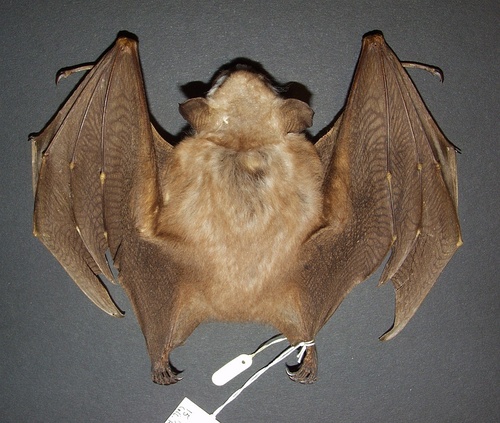
This bat has a brownish to grayish-brown fur coat, a short muzzle, and notably large eyes typical of fruit bats. Its wings are membranous and dark, contrasting with the lighter fur of the body.
Size
Forearm length approximately 45-50 mm; body length roughly 70-90 mm
Weight
Approximately 20-30 grams
Distinctive features
Distinguished from related species by its unusually short palate, reduced number of teeth, and a distinctive skull shape, which are key diagnostic features separating it from other Casinycteris species.
Differences between males and females
Minimal sexual dimorphism reported; males and females are similar in size and coloration.
Behaviour and diet of the Short-palated Fruit Bat
Believed to be solitary or found in small groups, though detailed social behavior data is lacking due to the species' rarity and elusive nature.
When it is active
Nocturnal, active primarily after dusk when it forages for fruit within the forest canopy.
Diet
Frugivorous, feeding on soft, pulpy fruits from various tropical forest trees; its specialized dentition suggests a preference for particular fruit types.
Communication
Likely uses echolocation-independent navigation typical of pteropodids relying on vision and olfaction, along with vocalizations for social communication, though specifics are undocumented.
Interactions with other species
Plays a role in the forest ecosystem as a fruit consumer; predators may include forest raptors and small carnivores, though specific interactions are not well recorded.
Role in its ecosystem
Functions as a seed disperser and potentially a pollinator within Central African rainforest ecosystems, contributing to forest regeneration and plant diversity.
Reproduction and lifecycle
Reproductive biology is not well documented; likely follows a pattern similar to other pteropodids with seasonal breeding tied to fruit availability and a single offspring per birth.
Raising the young
Presumed that females carry and nurse a single pup, as is typical in fruit bats, though specific parental behaviors have not been documented for this species.
Maturity and lifespan
Specific data unavailable; likely similar to related pteropodid species with sexual maturity around 6-12 months and a lifespan of several years in the wild.
Taxonomy and naming of the Short-palated Fruit Bat
Classification
Mammalia > Chiroptera > Pteropodidae > Casinycteris > argynnis
What research says
Recent studies
Recent taxonomic revisions have helped clarify the distinctiveness of Casinycteris argynnis from other members of its genus, though genetic and ecological studies remain limited.
Compared with similar species
Compared to other Casinycteris species like C. campomaanensis and C. ophiodon, C. argynnis has a more restricted known range and subtle differences in skull and dental morphology.
The Short-palated Fruit Bat and people
This bat's short palate is so distinctive that it gives the entire genus its scientific interest among bat taxonomists. It is one of the least studied bat species in Africa due to its rarity and remote habitat.
Where and how to see it
Best observed at dusk in undisturbed lowland rainforest within the Congo Basin, particularly near fruiting trees; specialized bat surveys with mist nets are typically required due to its rarity.
Risks to humans
No notable risk
Countries where the Short-palated Fruit Bat is recorded
The 4 countries named in the range description of its IUCN Red List assessment.
Questions about the Short-palated Fruit Bat
Where does the Short-palated Fruit Bat live?
The Short-palated Fruit Bat is recorded in Cameroon, Central African Republic, Democratic Republic of the Congo and Gabon across Africa. These countries come from the range description of its IUCN Red List assessment, and they are what place the species on the interactive map.
Is the Short-palated Fruit Bat endangered?
The IUCN Red List assesses the Short-palated Fruit Bat as Least Concern. The species is widespread and abundant enough not to qualify for any threatened category. It does not mean the species is safe forever, only that nothing in the current data raises an alarm.
How many are left in the wild?
No precise population estimate exists; considered uncommon but not rare within suitable habitat, with a presumed stable population trend. This figure comes from the species assessment on the IUCN Red List; population estimates for wild mammals are ranges, not counts, and are revised at each assessment.
What habitat does the Short-palated Fruit Bat live in?
Lowland and mid-altitude tropical rainforest, particularly primary and secondary forest with dense canopy cover.
What is the scientific name of the Short-palated Fruit Bat?
The Short-palated Fruit Bat is Casinycteris argynnis, in the family Pteropodidae, order Chiroptera.
Other species in the genus Casinycteris
Other species in the family Pteropodidae


Species that share its range


Sources
Conservation status, range description and population estimate come from the IUCN Red List assessment for Casinycteris argynnis. Countries are derived from that range description, not from a mapped country list. Last refreshed on .
The distribution map is drawn from the IUCN Red List spatial data compiled in 2008. IUCN (International Union for Conservation of Nature)