
Mindanao Pygmy Fruit Bat
Alionycteris paucidentata
Red List assessment
Least Concernon the IUCN Red List
- EXExtinct
- EWExtinct in the Wild
- CRCritically Endangered
- ENEndangered
- VUVulnerable
- NTNear Threatened
- LCLeast Concern
The Mindanao Pygmy Fruit Bat is recorded in one country, Philippines across Asia. The IUCN Red List assesses the Mindanao Pygmy Fruit Bat as Least Concern. No precise population estimate is available.
- Family
- Pteropodidae
- Order
- Chiroptera
- Genus
- Alionycteris
- Countries recorded
- 1
- Continents
- Asia
- Red List category
- Least Concern
- Data updated
- August 9, 2026
What is the Mindanao Pygmy Fruit Bat?
Alionycteris paucidentata is a very small, monotypic-genus fruit bat endemic to the island of Mindanao in the southern Philippines. It belongs to the family Pteropodidae (Old World fruit bats) and is remarkable for its reduced dental formula, reflected in the species epithet 'paucidentata' (Latin for 'few-toothed'). It inhabits montane forests and represents a unique evolutionary lineage among Philippine pteropodids. Its small size and specialized dentition distinguish it from all other fruit bat genera in the region.
Where does the Mindanao Pygmy Fruit Bat live?
Endemic to Mindanao Island, Philippines, primarily in montane forest zones
Strictly endemic to Mindanao, the second-largest island of the Philippines. Recorded localities include the slopes and forests around Mount Apo (the highest peak in the Philippines), the Mount Kitanglad Range, and other mountain massifs across Mindanao. It has not been confirmed from any of the smaller adjacent islands.
Altitude and depth
Predominantly recorded from elevations between approximately 1,000 and 2,500 meters above sea level, consistent with montane forest zones on Mindanao's major peaks.
Habitat of the Mindanao Pygmy Fruit Bat
Primary and old-growth montane tropical rainforest is the core habitat of this species. It is typically associated with mid- to high-elevation forest, often with dense canopy and rich fruiting understory vegetation. It appears less tolerant of heavily disturbed or degraded forest than some lowland bat species.
Adaptations to its environment
Its notably reduced number of teeth (paucidentata) compared to most pteropodids may reflect dietary specialization on soft, pulpy fruits or nectar in montane environments. Its small body size may be an adaptation to roosting and maneuvering within dense montane vegetation. Like other pteropodids, it likely relies on keen olfaction and vision rather than echolocation for foraging.
Conservation status and numbers
Least Concern (LC) on the IUCN Red List. Although it is a narrow endemic confined to one island, its range encompasses multiple protected mountain areas and it is not considered to be in rapid decline. Continued monitoring is advised given the ongoing pressure on Philippine forests.
Estimated population
No precise population estimate is available. The trend is presumed stable given current LC status, but data are sparse and long-term monitoring is lacking.
What threatens the Mindanao Pygmy Fruit Bat?
Deforestation and forest degradation due to agricultural expansion, logging, and human settlement are the primary threats. As a montane specialist, it has limited tolerance for habitat conversion, and climate-induced upward shifts in forest zones could reduce available habitat over the long term.
Diseases and parasites
No specific disease or parasite studies have been published for this species. Like other bats, it may harbor ectoparasites (mites, flies of family Nycteribiidae) and potentially internal parasites, but data are absent.
What is being done to protect it?
The species benefits indirectly from protected areas on Mindanao, including Mount Apo Natural Park and the Mount Kitanglad Range Natural Park, both of which are designated protected areas under Philippine law. The Philippines' Wildlife Resources Conservation and Protection Act (Republic Act 9147) provides general legal protection to native wildlife.
Recommended actions
Priority actions include systematic surveys to better characterize distribution and population size, long-term monitoring programs within protected areas, strict enforcement of protections against illegal logging in montane forests, and genetic studies to understand population connectivity and evolutionary distinctiveness.
What the Mindanao Pygmy Fruit Bat looks like
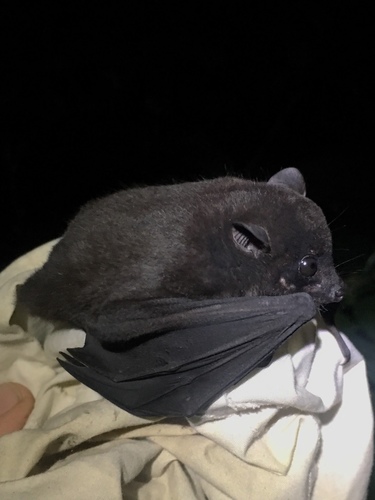
The fur is generally dark brown to blackish-brown dorsally, often slightly paler or buffy on the underside. The face is short and dog-like, as typical of pteropodids, with large eyes adapted to low-light foraging. The wings are dark and membranous, and the tail is vestigial or absent as in most Old World fruit bats.
Size
A very small pteropodid; forearm length approximately 40–47 mm. Total body length estimated around 65–80 mm; no wingspan data precisely published, but wingspan estimated at roughly 25–32 cm.
Weight
Estimated body weight approximately 10–18 grams; sex-specific weight data are not well documented.
Distinctive features
The most distinctive feature is its markedly reduced dental formula relative to other pteropodids, giving it fewer teeth than closely related genera such as Haplonycteris. Its small overall size combined with this dental reduction makes it unique among Philippine fruit bats. It lacks the specialized elongated snout seen in nectarivorous relatives.
Behaviour and diet of the Mindanao Pygmy Fruit Bat
Poorly documented; likely roosts in small groups or singly in forest vegetation, as is common among small Philippine pteropodids. No evidence of large colonial roosting has been reported.
When it is active
Nocturnal, consistent with all pteropodid fruit bats. Foraging presumably takes place at night when fruiting trees and flowering plants are visited.
Diet
Frugivorous, feeding primarily on soft fruits, pulp, and possibly nectar and pollen from montane forest plants. The reduced dentition may indicate a preference for particularly soft or juicy fruit that requires minimal mechanical processing.
How it feeds and hunts
Forages by flying through the forest canopy and understory, locating ripe fruits primarily by smell and vision. It likely hovers briefly to pluck fruit or lick nectar from flowers, then returns to a perch to consume food.
Communication
Probably uses high-pitched social vocalizations for communication with conspecifics at roost sites, as observed in related pteropodids. Scent may also play a role in social and reproductive signaling. Echolocation is rudimentary or absent as in most Pteropodidae.
Interactions with other species
Potential predators include owls (e.g., Philippine Eagle-Owl) and arboreal snakes active at night in montane forest. As a frugivore and possible nectar feeder, it may act as a seed disperser or pollinator for montane plant species, contributing to forest regeneration.
Role in its ecosystem
Likely plays a role as a seed disperser and potentially as a pollinator for montane forest plants in Mindanao, contributing to ecosystem function in high-elevation forests. Its specialized niche in montane zones makes it an indicator species for the health of these forest ecosystems.
Reproduction and lifecycle
Reproductive biology is poorly known. As with similar small Philippine pteropodids, it likely produces one offspring per reproductive event. Breeding seasonality in relation to fruiting peaks in Mindanao's montane forests has not been formally described.
Raising the young
Presumed similar to related species: the single pup is carried by the mother initially and later left at a roost site while she forages. Weaning duration is unknown but likely several weeks.
Maturity and lifespan
Age at sexual maturity and lifespan are undocumented for this species. By analogy with similar small pteropodids, sexual maturity likely occurs within the first year of life, and wild lifespan may range from 5 to 10 years.
Taxonomy and naming of the Mindanao Pygmy Fruit Bat
Classification
Mammalia > Chiroptera > Pteropodidae > Alionycteris > Alionycteris paucidentata
What research says
Recent studies
The species has received very limited research attention. It was originally described by Kock in 1969 and remains among the least-studied bats of the Philippines. Occasional specimen records from faunal surveys of Mindanao's mountain ranges contribute to knowledge of its distribution.
Genome and DNA
No published chromosome count or genomic study is available specifically for Alionycteris paucidentata. The genus represents a phylogenetically distinct lineage within Pteropodidae, and molecular work is needed to clarify its precise relationships.
Compared with similar species
Alionycteris paucidentata is most often compared to Haplonycteris fischeri (Fischer's Pygmy Fruit Bat), another very small Philippine endemic pteropodid, from which it differs by its even more reduced dentition and its confinement to Mindanao. Both belong to a clade of miniaturized Philippine pteropodids that have independently evolved small body size and specialized diets relative to their larger relatives.
The Mindanao Pygmy Fruit Bat and people
Alionycteris is a monotypic genus, meaning this single species is so morphologically unique it warranted its own genus name. Its scientific name literally means 'few-toothed' because it has a reduced number of teeth compared to nearly all other Old World fruit bats. Despite being discovered and described over 50 years ago, it remains one of the least-studied mammals in the entire Philippines, with almost no published field behavioral data.
Where and how to see it
The best opportunities for observing this species are in the old-growth montane forests of Mount Apo Natural Park or the Mount Kitanglad Range Natural Park on Mindanao, Philippines. Surveys using harp traps or mist nets set along forest trails at elevations above 1,000 m at night offer the highest probability of encounter. Given its rarity and poor documentation, observations should be reported to Philippine mammalogists or citizen science databases.
Risks to humans
No notable risk to humans. Like all wild bats, it could theoretically bite if handled, and appropriate precautions (gloves, vaccination for researchers) are advised when handling any wild bat specimen.
Countries where the Mindanao Pygmy Fruit Bat is recorded
The 1 countries named in the range description of its IUCN Red List assessment.
Questions about the Mindanao Pygmy Fruit Bat
Where does the Mindanao Pygmy Fruit Bat live?
The Mindanao Pygmy Fruit Bat is recorded in Philippines across Asia. These countries come from the range description of its IUCN Red List assessment, and they are what place the species on the interactive map.
Is the Mindanao Pygmy Fruit Bat endangered?
The IUCN Red List assesses the Mindanao Pygmy Fruit Bat as Least Concern. The species is widespread and abundant enough not to qualify for any threatened category. It does not mean the species is safe forever, only that nothing in the current data raises an alarm.
How many are left in the wild?
No precise population estimate is available. This figure comes from the species assessment on the IUCN Red List; population estimates for wild mammals are ranges, not counts, and are revised at each assessment.
What habitat does the Mindanao Pygmy Fruit Bat live in?
Primary and old-growth montane tropical rainforest is the core habitat of this species.
What is the scientific name of the Mindanao Pygmy Fruit Bat?
The Mindanao Pygmy Fruit Bat is Alionycteris paucidentata, in the family Pteropodidae, order Chiroptera.
Other species in the family Pteropodidae

Species that share its range


Sources
Conservation status, range description and population estimate come from the IUCN Red List assessment for Alionycteris paucidentata. Countries are derived from that range description, not from a mapped country list. Last refreshed on .
The distribution map is drawn from the IUCN Red List spatial data compiled in 2016. IUCN (International Union for Conservation of Nature)