
Large Flying-fox
Pteropus vampyrus
Red List assessment
Endangeredon the IUCN Red List
- EXExtinct
- EWExtinct in the Wild
- CRCritically Endangered
- ENEndangered
- VUVulnerable
- NTNear Threatened
- LCLeast Concern
The Large Flying-fox is recorded in 7 countries across Asia. The IUCN Red List assesses the Large Flying-fox as Endangered. Global population is unknown precisely but is estimated in the hundreds of thousands to low millions, with a declining trend across most of its range due to sustained hunting pressure and habitat loss.
- Family
- Pteropodidae
- Order
- Chiroptera
- Genus
- Pteropus
- Countries recorded
- 7
- Continents
- Asia
- Red List category
- Endangered
- Data updated
- August 9, 2026
What is the Large Flying-fox?
The Large Flying-fox is one of the largest bat species in the world, native to the forests and mangroves of Southeast Asia. It plays a crucial ecological role as a long-distance pollinator and seed disperser for numerous tropical plant species. Highly social, it roosts in large colonies called 'camps' that can number in the thousands, and is remarkable for its striking size with wingspans up to 1.5 meters. Unlike its name suggests, it is entirely frugivorous and poses no predatory threat to other animals.
Where does the Large Flying-fox live?
Southeast Asia, including Peninsular Malaysia, Indonesia, Philippines, Thailand, Singapore, Timor-Leste, and Brunei
Found across Southeast Asia including Peninsular Malaysia, Sumatra, Java, Borneo, the Philippines, southern Thailand, Singapore, and small islands of Indonesia and Timor-Leste. Historically more widespread, but populations have become fragmented due to habitat loss and hunting.
Altitude and depth
Typically found at low elevations from sea level up to approximately 1,200 meters, though most activity occurs below 500 meters in lowland forest and coastal habitats.
Seasonal movements
No true hibernation or long-distance migration occurs, but individuals make nightly foraging flights of up to 50 km and may shift camp locations seasonally in response to fruiting and flowering patterns of key food plants.
Habitat of the Large Flying-fox
Primarily inhabits lowland tropical rainforests, mangroves, coastal forests, and cultivated areas including orchards and plantations. Roosting sites (camps) are typically located in tall trees near rivers, coastlines, or forest edges, often in close proximity to fruiting trees used for foraging.
Adaptations to its environment
Possesses large eyes and a well-developed sense of smell adapted for locating fruit and nectar in darkness, unlike echolocating microbats. Strong wings enable long-distance flight for foraging and seed/pollen dispersal, while a keen sense of smell helps locate scattered fruiting trees across large home ranges.
Conservation status and numbers
Classified as Endangered (EN) by the IUCN due to an estimated population decline exceeding 50% over the past three generations, driven by hunting, habitat loss, and human persecution.
Estimated population
Global population is unknown precisely but is estimated in the hundreds of thousands to low millions, with a declining trend across most of its range due to sustained hunting pressure and habitat loss.
What threatens the Large Flying-fox?
Major threats include hunting for bushmeat and traditional medicine, habitat destruction from deforestation and agricultural expansion, persecution by farmers due to crop damage, and culling linked to fears of disease transmission (e.g., Nipah virus).
Diseases and parasites
Known to host various ectoparasites such as bat flies and mites, and is a natural reservoir for several viruses including Nipah virus and Hendra-related henipaviruses, which has led to conflict with human populations.
What is being done to protect it?
Listed on CITES Appendix II, with legal protections in some range countries such as Malaysia and Indonesia, though enforcement is often weak. Conservation organizations conduct camp monitoring, habitat protection initiatives, and community education programs to reduce hunting and conflict.
Recommended actions
Priority actions include strengthening and enforcing hunting bans, protecting key roosting and foraging habitats, promoting human-bat coexistence strategies for farmers, and conducting further population surveys to guide conservation planning.
What the Large Flying-fox looks like
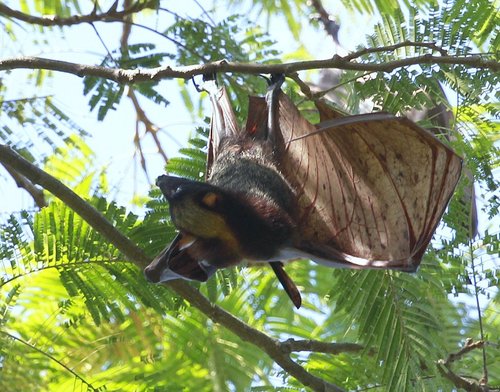
The fur is typically dark brown to black on the body with a mantle of golden, orange, or reddish fur around the neck and shoulders. It has a fox-like face with large eyes, small rounded ears, and no tail, with wing membranes that are dark brown to blackish.
Size
Body length ranges from 27 to 32 cm, with a wingspan reaching up to 1.5 meters (nearly 5 feet), making it one of the largest bat species in the world.
Weight
Adults typically weigh between 0.65 and 1.1 kg, with males generally slightly larger than females.
Distinctive features
Distinguished from other Pteropus species by its very large size, the extensive golden mantle around the neck, and wing membranes that attach along the midline of the back rather than the sides.
Differences between males and females
Minimal sexual dimorphism exists, with males being slightly larger and heavier than females, but coloration and general appearance are similar between sexes.
Behaviour and diet of the Large Flying-fox
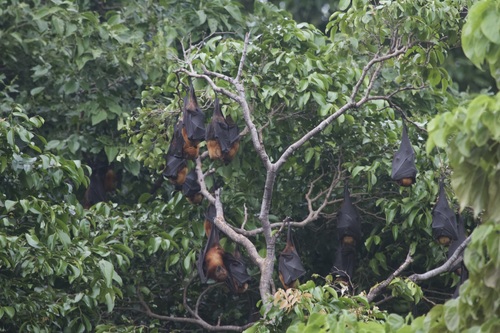
Highly social and forms large daytime roosting colonies called 'camps' that can range from a few hundred to over 100,000 individuals. Within camps, individuals establish loose social hierarchies and engage in frequent social interactions including grooming and vocal communication.
When it is active
Primarily nocturnal and crepuscular, with peak foraging activity occurring at dusk and continuing through the night, while daytime is spent resting in large tree roosts.
Diet
Strictly frugivorous and nectarivorous, feeding on a wide variety of fruits such as figs, mangoes, and durians, as well as flowers, nectar, and pollen from numerous tropical tree species.
Communication
Communicates through a range of vocalizations including chirps, screeches, and honks used for social bonding, mating displays, and territorial disputes within the camp. Body posturing and wing displays are also used in social and aggressive interactions.
Interactions with other species
Has few natural predators aside from large raptors and occasionally pythons preying on young or injured individuals. It plays a mutualistic role with numerous plant species through pollination and seed dispersal, supporting forest regeneration.
Role in its ecosystem
Serves as a keystone species in tropical forest ecosystems by acting as a primary pollinator and long-distance seed disperser for many economically and ecologically important plant species, including durian trees.
Reproduction and lifecycle
Breeding is seasonal, typically occurring once per year, with mating happening in the dry season and births in spring. Gestation lasts approximately 5-6 months, resulting in a single pup per litter, which is weaned after about 4-5 months.
Raising the young
Females provide sole parental care, carrying the pup while flying during its first weeks of life before leaving it at the roost during foraging trips. Maternal care includes nursing and protection until the young becomes independent at several months of age.
Maturity and lifespan
Sexual maturity is typically reached around 18-24 months of age. Lifespan in the wild is estimated at 15-20 years, while individuals in captivity have been recorded living slightly longer under good care.
Taxonomy and naming of the Large Flying-fox
Classification
Class Mammalia > Order Chiroptera > Family Pteropodidae > Genus Pteropus > Species Pteropus vampyrus
Subspecies
Several subspecies recognized including P. v. vampyrus (Java, Sumatra, Malay Peninsula), P. v. natunae (Natuna Islands), P. v. lanensis (Philippines), and P. v. malaccensis; taxonomy remains debated with some populations possibly warranting species status.
Scientific synonyms
Vespertilio vampyrus (original combination by Linnaeus, 1758); Pteropus edulis has been used historically as a synonym.
What research says
Recent studies
Recent research has focused on the species' role in Nipah virus transmission dynamics, its movement ecology using GPS tracking to understand foraging ranges, and population genetics to assess connectivity between fragmented camps.
Genome and DNA
The species has a diploid chromosome number of 2n=38, and genomic studies have been conducted partly due to its role as a reservoir host for zoonotic henipaviruses.
Compared with similar species
Similar to other large Pteropus species such as the Indian Flying-fox (Pteropus giganteus) and the Black Flying-fox (Pteropus alecto), but distinguished by its larger size and more prominent golden mantle coloring.
The Large Flying-fox and people
Despite its intimidating 'vampire' species name, it is entirely fruit- and nectar-eating and completely harmless in terms of predation. It has one of the largest wingspans of any bat species, comparable to some birds of prey, and can travel over 50 km in a single night while foraging.
Where and how to see it
Best observed at dusk near known roosting camps in countries like Malaysia, Indonesia, and the Philippines, particularly in coastal or riverine forest areas where camps often exist. Observing the mass evening exodus of thousands of bats leaving a roost is a particularly spectacular sight for wildlife watchers.
Risks to humans
While generally harmless in behavior, the species is a known natural reservoir for Nipah virus, posing a zoonotic disease risk if humans have direct contact with bodily fluids or consume contaminated fruit or date palm sap.
Human uses
Hunted extensively for bushmeat in parts of its range and used in some traditional medicine practices; it is also of interest to researchers studying zoonotic disease transmission and pollination ecology.
Myths and legends
In some Southeast Asian cultures, flying foxes are associated with folklore relating to spirits of the night due to their nocturnal habits and eerie silhouette in flight, though specific legends vary by region and are not extensively documented.
Countries where the Large Flying-fox is recorded
The 7 countries named in the range description of its IUCN Red List assessment.
Questions about the Large Flying-fox
Where does the Large Flying-fox live?
The Large Flying-fox is recorded in Brunei, Indonesia, Malaysia, Philippines and Singapore, among 7 countries in total across Asia. These countries come from the range description of its IUCN Red List assessment, and they are what place the species on the interactive map.
Is the Large Flying-fox endangered?
Yes. The IUCN Red List assesses the Large Flying-fox as Endangered, one of the three threatened categories. The species faces a very high risk of extinction in the wild — a step below Critically Endangered, but still on a trajectory that ends badly without intervention.
How many are left in the wild?
Global population is unknown precisely but is estimated in the hundreds of thousands to low millions, with a declining trend across most of its range due to sustained hunting pressure and habitat loss. This figure comes from the species assessment on the IUCN Red List; population estimates for wild mammals are ranges, not counts, and are revised at each assessment.
What habitat does the Large Flying-fox live in?
Primarily inhabits lowland tropical rainforests, mangroves, coastal forests, and cultivated areas including orchards and plantations.
What is the scientific name of the Large Flying-fox?
The Large Flying-fox is Pteropus vampyrus, in the family Pteropodidae, order Chiroptera.
Other species in the genus Pteropus


Other species in the family Pteropodidae


Sources
Conservation status, range description and population estimate come from the IUCN Red List assessment for Pteropus vampyrus. Countries are derived from that range description, not from a mapped country list. Last refreshed on .
The distribution map is drawn from the IUCN Red List spatial data compiled in 2022. IUCN (International Union for Conservation of Nature)