
Golden-capped Fruit Bat
Acerodon jubatus
Red List assessment
Endangeredon the IUCN Red List
- EXExtinct
- EWExtinct in the Wild
- CRCritically Endangered
- ENEndangered
- VUVulnerable
- NTNear Threatened
- LCLeast Concern
The Golden-capped Fruit Bat is recorded in one country, Philippines across Asia. The IUCN Red List assesses the Golden-capped Fruit Bat as Endangered. Estimated at fewer than 100,000 mature individuals, with a continuing declining trend.
- Family
- Pteropodidae
- Order
- Chiroptera
- Genus
- Acerodon
- Countries recorded
- 1
- Continents
- Asia
- Red List category
- Endangered
- Data updated
- August 9, 2026
What is the Golden-capped Fruit Bat?
The Golden-capped Fruit Bat is one of the largest bats in the world and is entirely endemic to the Philippine archipelago. It is instantly recognizable by its striking golden-orange mantle on the crown and nape, contrasting with a dark brown to black body. It inhabits old-growth tropical lowland and montane forests, roosting in enormous colonies often shared with the Large Flying Fox (Pteropus vampyrus). As an Endangered species, it faces severe pressure from hunting and rapid deforestation, making it one of the most threatened megabats on Earth.
Where does the Golden-capped Fruit Bat live?
Endemic to the Philippines, primarily on Luzon, Mindanao, Leyte, Samar, Bohol, and smaller surrounding islands.
Strictly endemic to the Philippines. Major populations occur on Luzon (notably Subic Bay, Calauit Island), Mindanao (Samal Island, Agusan Marsh), Leyte, Samar, and Bohol. The subspecies from Panay (A. j. lucifer) is likely extinct. Historically also present on Cebu, where it is now extremely rare or extirpated.
Altitude and depth
Primarily found from sea level up to approximately 1,100 m elevation, with the highest densities in lowland forests below 500 m where fruiting trees are most abundant.
Seasonal movements
No true hibernation or long-distance migration occurs. However, colonies may shift roost sites seasonally in response to local food availability and disturbance. Reproductive timing shows some seasonality tied to fruiting peaks.
Habitat of the Golden-capped Fruit Bat
Primary and secondary lowland tropical rainforests, including coastal and riverine forests. This species strongly prefers old-growth forest stands with large emergent trees suitable for communal roosting, and forages across a mosaic of forest and forest-edge habitats at night.
Adaptations to its environment
Large body size and a robust jaw allow the bat to process tough-skinned fruits and hard seeds. Its excellent vision and keen sense of smell are adapted for locating ripe fruit at night across large distances. Roosting communally in massive colonies provides thermoregulation benefits and predator detection. The golden mantle may aid in individual recognition within dense roosting aggregations.
Conservation status and numbers
Endangered (EN) on the IUCN Red List (assessed 2016). The species has undergone a population decline estimated at over 50% across three generations, driven primarily by unsustainable hunting and large-scale deforestation. The largest remaining colonies are highly concentrated, making the species especially vulnerable to localized threats.
Estimated population
Estimated at fewer than 100,000 mature individuals, with a continuing declining trend. The Monfort Cave colony on Samal Island (Mindanao) once held approximately 1.8 million bats (a Guinness World Record) but has declined dramatically in recent decades due to hunting pressure.
What threatens the Golden-capped Fruit Bat?
Hunting for bushmeat is the primary threat, as large aggregations at roost sites make individuals easy targets; entire colonies have been decimated by hunters. Massive deforestation driven by agricultural expansion (particularly palm oil and banana plantations) and logging has destroyed critical roosting and foraging habitat. Disturbance at roost sites causes colony abandonment, particularly during breeding season, leading to high pup mortality.
Diseases and parasites
Like other Pteropodidae, it may harbor coronaviruses and other zoonotic viruses asymptomatically, though no major outbreaks have been directly linked to this species. Ectoparasites including bat flies (Nycteribiidae) and mites have been recorded. Roost crowding can facilitate the spread of internal parasites.
What is being done to protect it?
The species is listed under CITES Appendix II, regulating international trade. It is legally protected under the Philippine Wildlife Resources Conservation and Protection Act (RA 9147). The Monfort Bat Cave Ecological Reserve in Samal Island and the Subic Bay Freeport Zone provide partial refuge. The Bat Conservation International and local NGOs conduct colony monitoring and community awareness campaigns.
Recommended actions
Strict enforcement of hunting bans and prosecution of poachers at major roost sites is the highest priority. Expansion and effective management of protected areas encompassing key roost colonies and foraging corridors is urgently needed. Community-based ecotourism programs to provide local economic alternatives to hunting, coupled with reforestation of native fruit tree species, are critical long-term measures.
What the Golden-capped Fruit Bat looks like
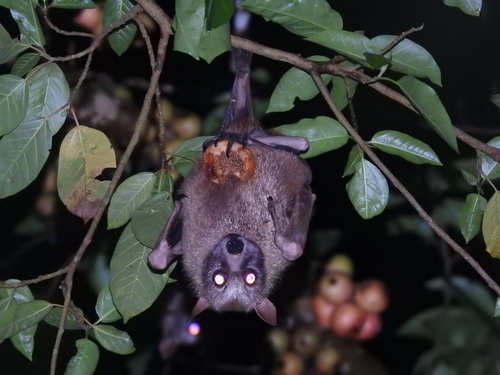
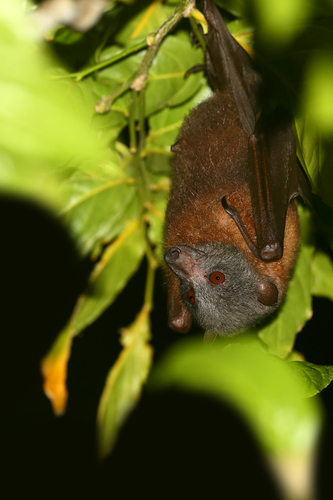
The body fur is predominantly dark brown to black on the back and underparts. The most distinctive feature is a vivid golden-yellow to rusty-orange mantle covering the crown, forehead, and nape of the neck. The face is elongated and dog-like with large dark eyes, reflecting its common designation as a 'flying fox.' The wings are leathery, dark, and attached along the body to the hind limbs.
Size
Head-body length: 26–30 cm. Wingspan: 1.2–1.5 m, making it one of the largest bats in the world. Forearm length: approximately 180–205 mm.
Weight
Typically 700 g to 1.2 kg. Males tend to be slightly larger than females, with some large males approaching or exceeding 1.2 kg.
Distinctive features
The brilliant golden crown is the single most distinguishing feature, shared with no other bat species in the Philippines. It can be distinguished from the co-roosting Large Flying Fox (Pteropus vampyrus) by this golden cap; P. vampyrus has a reddish-brown mantle extending across the entire chest and lacks the sharp golden-dark contrast seen in A. jubatus. Acerodon also lacks the small second claw on the index finger that is present in Pteropus.
Differences between males and females
Sexual dimorphism is modest. Males are generally slightly heavier and larger in forearm length than females. Males possess prominent lateral neck glands used in scent communication. Females have a single pair of pectoral mammary glands.
Behaviour and diet of the Golden-capped Fruit Bat
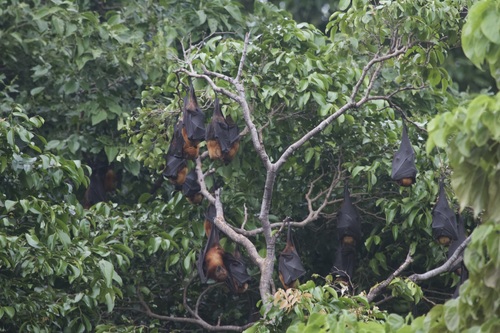
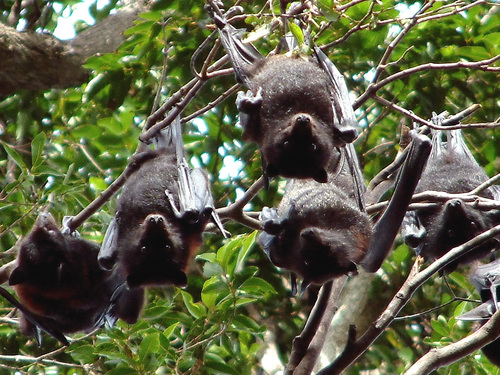
Highly gregarious, forming some of the largest roosting colonies of any bat species in the world. Colonies can range from a few thousand to hundreds of thousands of individuals. They frequently share roosts with the Large Flying Fox (Pteropus vampyrus) in mixed-species aggregations. Within the colony, individuals cluster tightly in trees during the day.
When it is active
Strictly nocturnal. The bats depart from communal roosts at dusk in large, dramatic flights to forage for fruit, often traveling considerable distances (up to 25–40 km per night). They return to the roost before dawn. During the day, they hang in roost trees, grooming, socializing, and resting.
Diet
Strictly frugivorous and nectarivorous. Diet consists primarily of soft, ripe fruits, figs (Ficus spp.), flowers, and nectar from a wide variety of native forest trees. Important food sources include durian (Durio spp.), rambutan, mangoes, and various native dipterocarp-associated fruiting trees. It uses its strong jaws to crush fruit and swallows pulp and juice while expelling fibrous material.
How it feeds and hunts
Forages by flying through the forest canopy using keen eyesight and olfaction to locate ripe fruit by scent and color. It plucks fruit in flight or lands briefly on branches to consume it. It does not use echolocation for navigation, relying instead on large eyes adapted for low-light vision.
Communication
Communicates through a range of vocalizations including loud, harsh screeching calls audible from a distance, used especially at roost sites during social interactions and disputes. Scent glands on the neck produce secretions used in social and reproductive signaling. Wing-spreading and body posturing are used in agonistic displays at roost sites.
Interactions with other species
Frequently co-roosts with Pteropus vampyrus, forming mixed colonies of potentially millions of bats. Natural predators include large raptors such as the Philippine Eagle (Pithecophaga jefferyi) and various large owls, as well as pythons that may raid roost trees. Humans are by far the most significant predator. The bat has a mutualistic relationship with many fruiting and flowering trees as a pollinator and seed disperser.
Role in its ecosystem
Plays an ecologically indispensable role as a long-distance seed disperser and pollinator for a vast array of Philippine forest trees. Seeds pass unharmed through its gut or are dropped while feeding, facilitating forest regeneration across large areas. Several commercially important trees, including durian, rely heavily on bats for pollination. The loss of this species would have severe cascading consequences for Philippine forest ecosystems.
Reproduction and lifecycle
Breeding is seasonal, with most births occurring between April and June, coinciding with peak fruit availability. Females give birth to a single pup per year after a gestation period of approximately 5–6 months. Mating appears to occur between October and December.
Raising the young
Females are the sole caregivers. Newborn pups are carried by the mother during foraging flights for the first few weeks of life. As pups grow heavier, they are left at the roost while the mother forages at night. Pups are nursed for approximately 5–6 months. The mother-pup bond relies on unique vocal and olfactory recognition.
Maturity and lifespan
Sexual maturity is reached at approximately 2 years of age. In the wild, lifespan is estimated at 15–20 years under favorable conditions. Captive lifespans for closely related megabats can exceed 20–25 years, though there is limited specific captive data for this species.
Taxonomy and naming of the Golden-capped Fruit Bat
Classification
Mammalia > Chiroptera > Pteropodidae > Acerodon > Acerodon jubatus
Subspecies
Acerodon jubatus jubatus (main Philippine islands); Acerodon jubatus mindanensis (Mindanao); Acerodon jubatus lucifer (Panay island — likely extinct since the 20th century).
Scientific synonyms
Pteropus jubatus Eschscholtz, 1831 (original basionym). Also sometimes listed as Acerodon jubatus lucifer (Elliot, 1896) for the Panay population.
What research says
Recent studies
Satellite telemetry studies have revealed that foraging individuals regularly travel 25–40 km from roost sites nightly, highlighting the importance of landscape-scale conservation planning beyond the immediate roost area. Recent population surveys at major roost sites, including Monfort Cave, have confirmed significant long-term declines, triggering urgent reassessments of conservation strategies.
Genome and DNA
Detailed genomic studies are limited for this species. Phylogenetic analyses based on mitochondrial DNA confirm the genus Acerodon as monophyletic within Pteropodidae, closely related to Pteropus. Karyotype data specific to A. jubatus is not well-documented in published literature.
Compared with similar species
Within its genus, A. jubatus is the largest and best-known of the five Acerodon species, which also include A. mackloti (Sulawesi), A. celebensis, A. humilis, and A. leucotis. It is closely related to the flying foxes of genus Pteropus, which it resembles strongly in morphology and ecology, though it differs in lacking a second wing-digit claw and in the more striking golden head coloration. Compared to Pteropus vampyrus, with which it often co-roosts, A. jubatus is generally slightly smaller and more distinctly patterned.
The Golden-capped Fruit Bat and people
The Monfort Bat Cave on Samal Island once held the largest recorded colony of a single bat species in the world, with approximately 1.8 million individuals — earning it a Guinness World Record. Despite its dramatic size and appearance, this bat is completely harmless to humans and is in fact a vital 'farmer of the forest,' dispersing seeds that regenerate Philippine rainforests. A single colony departing at dusk can darken the sky like a living storm cloud, a spectacle visible for miles.
Where and how to see it
The most reliable observation site is the Subic Bay Freeport Zone in Luzon, where a protected colony roosts in the forest; evening departure flights at dusk are spectacular. The Monfort Bat Cave Ecological Reserve on Samal Island near Davao City also allows guided visits. The best observation period is from March to October, with dusk providing the most dramatic viewing as thousands of bats depart in waves for nightly foraging.
Risks to humans
No notable direct risk. The species is non-aggressive, does not bite unless handled, and has no venom. As with all wild bats, it should not be handled directly due to the theoretical risk of zoonotic disease transmission. Observing from a respectful distance poses no risk.
Human uses
Historically and currently hunted extensively for bushmeat across its range, despite being legally protected; bat meat is considered a delicacy and is sold at local markets in rural Mindanao and other islands. The species has no significant role in traditional medicine or legal international trade. There is growing ecotourism value, with colonies attracting nature tourists and generating local revenue where conservation programs are active.
Myths and legends
In some Philippine indigenous communities, large fruit bats are associated with ancestral spirits and forest guardians, and their roosting sites are sometimes considered sacred ground. Conversely, in other communities, they are viewed primarily as a source of bushmeat, a cultural tradition that now poses one of the greatest threats to the species' survival.
Countries where the Golden-capped Fruit Bat is recorded
The 1 countries named in the range description of its IUCN Red List assessment.
Questions about the Golden-capped Fruit Bat
Where does the Golden-capped Fruit Bat live?
The Golden-capped Fruit Bat is recorded in Philippines across Asia. These countries come from the range description of its IUCN Red List assessment, and they are what place the species on the interactive map.
Is the Golden-capped Fruit Bat endangered?
Yes. The IUCN Red List assesses the Golden-capped Fruit Bat as Endangered, one of the three threatened categories. The species faces a very high risk of extinction in the wild — a step below Critically Endangered, but still on a trajectory that ends badly without intervention.
How many are left in the wild?
Estimated at fewer than 100,000 mature individuals, with a continuing declining trend. This figure comes from the species assessment on the IUCN Red List; population estimates for wild mammals are ranges, not counts, and are revised at each assessment.
What habitat does the Golden-capped Fruit Bat live in?
Primary and secondary lowland tropical rainforests, including coastal and riverine forests.
What is the scientific name of the Golden-capped Fruit Bat?
The Golden-capped Fruit Bat is Acerodon jubatus, in the family Pteropodidae, order Chiroptera.
Other species in the genus Acerodon
Other species in the family Pteropodidae


Species that share its range
Sources
Conservation status, range description and population estimate come from the IUCN Red List assessment for Acerodon jubatus. Countries are derived from that range description, not from a mapped country list. Last refreshed on .
The distribution map is drawn from the IUCN Red List spatial data compiled in 2008. IUCN (International Union for Conservation of Nature)