
Sao Paulo Grass Mouse
Akodon sanctipaulensis
Red List assessment
Data Deficienton the IUCN Red List
- EXExtinct
- EWExtinct in the Wild
- CRCritically Endangered
- ENEndangered
- VUVulnerable
- NTNear Threatened
- LCLeast Concern
Data Deficient has no position on the scale above — it records the absence of an assessment, not a degree of risk.
The Sao Paulo Grass Mouse is recorded in one country, Brazil across South America. The IUCN Red List records the Sao Paulo Grass Mouse as Data Deficient. No reliable population estimate exists; population trend is unknown due to data deficiency and taxonomic uncertainty.
- Family
- Cricetidae
- Order
- Rodentia
- Genus
- Akodon
- Countries recorded
- 1
- Continents
- South America
- Red List category
- Data Deficient
- Data updated
- August 9, 2026
What is the Sao Paulo Grass Mouse?
Akodon sanctipaulensis is a small terrestrial rodent endemic to the Atlantic Forest of southeastern Brazil, part of the diverse and taxonomically complex Akodon genus. It is a grass mouse adapted to humid forest and grassland edge habitats. The species is remarkable for its cryptic morphology, being distinguished from close relatives mainly through cytogenetic and molecular data rather than external appearance. Its restricted range and poorly studied ecology make it a species of scientific interest for understanding Atlantic Forest rodent diversification.
Where does the Sao Paulo Grass Mouse live?
Southeastern Brazil, primarily in the state of São Paulo and adjacent areas of the Atlantic Forest domain
Endemic to southeastern Brazil, with confirmed records concentrated in the state of São Paulo and possibly extending into neighboring states such as Minas Gerais and Paraná within the Atlantic Forest biome.
Altitude and depth
Typically found at low to mid elevations, roughly 0-1000 meters above sea level, consistent with Atlantic Forest lowland and submontane zones.
Seasonal movements
No strong evidence of migration; likely shows some seasonal variation in reproductive activity linked to wet and dry seasons typical of the Atlantic Forest.
Habitat of the Sao Paulo Grass Mouse
Found in Atlantic Forest habitats including dense and secondary forest, forest edges, and adjacent grassy or shrubby areas. Also occurs in disturbed habitats such as agricultural margins and pastures bordering forest fragments.
Adaptations to its environment
Possesses a compact body, strong hindlimbs, and generalist locomotor abilities suited for moving through dense leaf litter and low vegetation. Omnivorous feeding habits allow flexibility in food availability across seasons.
Conservation status and numbers
Listed as Data Deficient (DD) by the IUCN due to insufficient information on population size, distribution limits, and threats, largely because of taxonomic confusion within the Akodon cursor species group.
Estimated population
No reliable population estimate exists; population trend is unknown due to data deficiency and taxonomic uncertainty.
What threatens the Sao Paulo Grass Mouse?
Habitat loss and fragmentation due to deforestation, agricultural expansion, and urbanization within the highly threatened Atlantic Forest biome are presumed major threats.
Diseases and parasites
Specific data lacking, but like other Akodon species, may host ectoparasites (mites, fleas) and be a reservoir for hantaviruses common in the genus.
What is being done to protect it?
No species-specific conservation programs exist, but it may benefit indirectly from Atlantic Forest protected areas and reserves established for broader biodiversity conservation.
Recommended actions
Recommended actions include taxonomic clarification through genetic studies, systematic surveys to determine distribution and population status, and habitat protection within the Atlantic Forest remnants where it occurs.
What the Sao Paulo Grass Mouse looks like
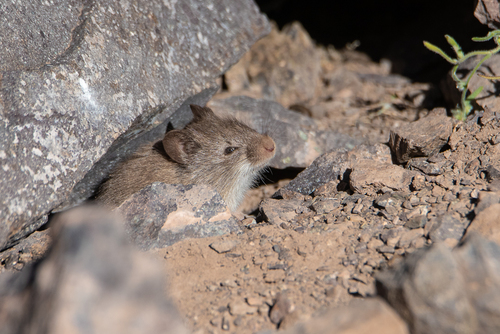
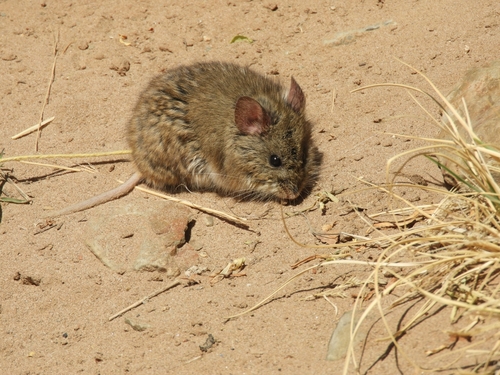
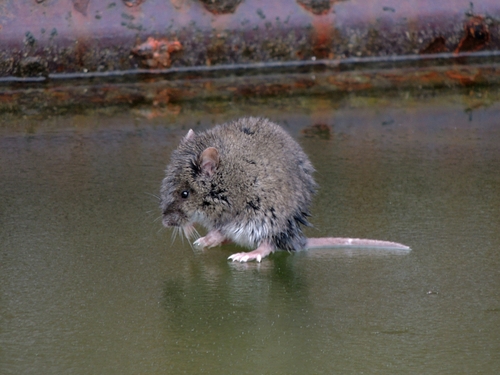
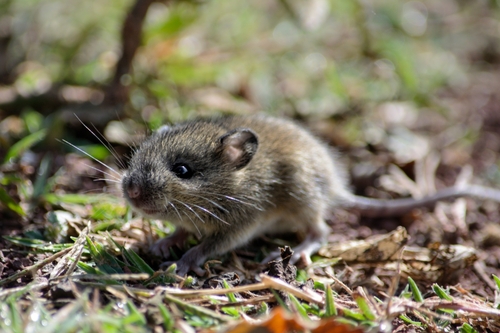
Fur is generally brownish to grayish-brown dorsally with paler, grayish underparts, typical of Akodon grass mice. The tail is moderately haired and darker above than below.
Size
Body length (head-body) approximately 70-100 mm, with a tail roughly equal to or slightly shorter than body length.
Weight
Estimated body weight ranges from 15 to 30 grams, typical for small Akodon species.
Distinctive features
Distinguished from closely related Akodon species primarily by karyotype (chromosome number) and molecular genetic markers rather than obvious external traits, making field identification difficult.
Differences between males and females
Minimal sexual dimorphism reported, with males and females showing similar size and coloration typical of the genus.
Behaviour and diet of the Sao Paulo Grass Mouse
Likely solitary or loosely social, consistent with other Akodon species, with limited territorial interactions outside of breeding contexts.
When it is active
Primarily nocturnal to crepuscular, foraging mainly during dusk and nighttime hours to avoid predators and diurnal heat.
Diet
Omnivorous diet including seeds, fruits, and invertebrates such as insects, typical of small terrestrial akodontine rodents.
How it feeds and hunts
Opportunistic foraging on the ground and in leaf litter, using olfactory and tactile cues to locate seeds and small invertebrates.
Communication
Communication likely involves olfactory cues such as scent marking and possibly ultrasonic vocalizations, as documented in related Akodon species.
Interactions with other species
Preyed upon by owls, small carnivorous mammals, and snakes; may compete with other sympatric small rodents for food and nesting resources.
Role in its ecosystem
Plays a role in seed dispersal and predation on invertebrates, contributing to nutrient cycling and food web dynamics within Atlantic Forest ecosystems.
Reproduction and lifecycle
Breeding likely occurs multiple times per year with gestation lasting approximately 21-25 days, producing litters of 2-6 young, similar to related Akodon species.
Raising the young
Maternal care is presumed, with females nursing and protecting young in nest sites until weaning, typical of small cricetid rodents.
Maturity and lifespan
Sexual maturity likely reached at 2-3 months; lifespan in the wild is probably short, around 1-2 years, consistent with small rodent life histories.
Taxonomy and naming of the Sao Paulo Grass Mouse
Classification
Class Mammalia > Order Rodentia > Family Cricetidae > Genus Akodon > Species Akodon sanctipaulensis
Scientific synonyms
Formerly considered a subspecies or synonym within the Akodon cursor/serrensis species complex; taxonomic status clarified through karyotypic and molecular studies
What research says
Recent studies
Recent taxonomic and phylogenetic studies using cytochrome b and karyotype analysis have helped clarify its status as a distinct species within the Akodon cursor-serrensis complex.
Genome and DNA
Distinguished cytogenetically by a specific diploid chromosome number within the Akodon cursor complex; molecular studies have been used to resolve its species status.
Compared with similar species
Closely resembles Akodon cursor and Akodon serrensis morphologically, but differs in chromosome number and genetic markers, historically causing taxonomic confusion.
The Sao Paulo Grass Mouse and people
This species was distinguished from its close relatives largely through chromosome studies rather than visible traits, highlighting the hidden diversity within Akodon rodents. It is one of many cryptic species within the Atlantic Forest's rich small mammal fauna.
Where and how to see it
Best observed through live-trapping surveys in Atlantic Forest fragments in São Paulo state during nighttime hours, though field identification requires genetic or cytogenetic confirmation.
Risks to humans
No notable risk to humans, though as with other rodents, potential exists for zoonotic disease transmission through contact with excreta.
Countries where the Sao Paulo Grass Mouse is recorded
The 1 countries named in the range description of its IUCN Red List assessment.
Questions about the Sao Paulo Grass Mouse
Where does the Sao Paulo Grass Mouse live?
The Sao Paulo Grass Mouse is recorded in Brazil across South America. These countries come from the range description of its IUCN Red List assessment, and they are what place the species on the interactive map.
Is the Sao Paulo Grass Mouse endangered?
The IUCN Red List assesses the Sao Paulo Grass Mouse as Data Deficient. There is not enough information to judge the risk of extinction, usually because the species is rarely seen or has never been surveyed. It is not a reassuring category: several species were Data Deficient right up to the point they were found to be Critically Endangered.
How many are left in the wild?
No reliable population estimate exists; population trend is unknown due to data deficiency and taxonomic uncertainty. This figure comes from the species assessment on the IUCN Red List; population estimates for wild mammals are ranges, not counts, and are revised at each assessment.
What habitat does the Sao Paulo Grass Mouse live in?
Found in Atlantic Forest habitats including dense and secondary forest, forest edges, and adjacent grassy or shrubby areas.
What is the scientific name of the Sao Paulo Grass Mouse?
The Sao Paulo Grass Mouse is Akodon sanctipaulensis, in the family Cricetidae, order Rodentia.
Other species in the genus Akodon

Other species in the family Cricetidae
Sources
Conservation status, range description and population estimate come from the IUCN Red List assessment for Akodon sanctipaulensis. Countries are derived from that range description, not from a mapped country list. Last refreshed on .
The distribution map is drawn from the IUCN Red List spatial data compiled in 2018. IUCN SSC Small Mammal Specialist Group