
Red-tailed Monkey
Cercopithecus ascanius
Red List assessment
Least Concernon the IUCN Red List
- EXExtinct
- EWExtinct in the Wild
- CRCritically Endangered
- ENEndangered
- VUVulnerable
- NTNear Threatened
- LCLeast Concern
The Red-tailed Monkey is recorded in 7 countries across Africa. The IUCN Red List assesses the Red-tailed Monkey as Least Concern. Population size is not precisely quantified but is considered large and stable overall, though declining in specific regions due to habitat degradation.
- Family
- Cercopithecidae
- Order
- Primates
- Genus
- Cercopithecus
- Countries recorded
- 7
- Continents
- Africa
- Red List category
- Least Concern
- Data updated
- August 9, 2026
What is the Red-tailed Monkey?
The Red-tailed Monkey is a small, agile guenon native to the tropical forests of Central Africa, easily recognized by its distinctive reddish tail and white nose spot. It is highly adaptable, occupying primary and secondary forests, and is often seen in mixed-species groups with other primates. This species plays an important ecological role as a seed disperser and is one of the more commonly studied African forest monkeys due to its abundance and visibility.
Where does the Red-tailed Monkey live?
Central Africa, primarily the Democratic Republic of Congo, Uganda, Rwanda, Burundi, Central African Republic, and parts of Kenya and Tanzania
Found across the Congo Basin including the Democratic Republic of Congo, Uganda, Rwanda, Burundi, Central African Republic, with populations extending into western Kenya and northwestern Tanzania.
Altitude and depth
Typically found from lowland forests up to around 2000 meters elevation, with most populations concentrated below 1500 meters.
Seasonal movements
No true migration or hibernation; activity and ranging patterns may shift slightly with fruit availability across wet and dry seasons.
Habitat of the Red-tailed Monkey
Primarily inhabits lowland tropical rainforest, gallery forest, and secondary forest with dense understory; also found in swamp forest and forest edges near agricultural areas.
Adaptations to its environment
Possesses excellent arboreal agility with strong limbs and a long prehensile-like tail for balance, cheek pouches for storing food while foraging, and cryptic yet distinctive coloration that aids in group recognition and camouflage in dappled forest light.
Conservation status and numbers
Listed as Least Concern by IUCN due to its wide distribution and relatively large population, though some local populations are declining due to habitat loss and hunting pressure.
Estimated population
Population size is not precisely quantified but is considered large and stable overall, though declining in specific regions due to habitat degradation.
What threatens the Red-tailed Monkey?
Main threats include deforestation for agriculture and logging, bushmeat hunting, and habitat fragmentation, particularly in areas of political instability within its range.
Diseases and parasites
Susceptible to various gastrointestinal parasites and can carry retroviruses studied in primate disease research, though specific major disease threats are not well documented.
What is being done to protect it?
Protected within numerous national parks and reserves across its range, including Kibale National Park (Uganda) and various protected areas in the DRC; benefits from CITES Appendix II listing regulating trade.
Recommended actions
Continued habitat protection, anti-poaching enforcement, and monitoring of population trends in fragmented forest areas are recommended to maintain stable populations.
What the Red-tailed Monkey looks like
Grayish to olive-brown fur covers the body, with a distinctive white heart-shaped nose patch, black face, and a reddish-orange tail that gives the species its name.
Size
Body length ranges from about 40-55 cm, with an additional tail length of 55-75 cm.
Weight
Males typically weigh 3.5-4.5 kg, while females are smaller at around 2.5-3.5 kg.
Distinctive features
The vivid red-orange tail combined with the white nose spot clearly distinguishes it from other guenon species like the blue monkey or vervet monkey.
Differences between males and females
Males are notably larger than females, with more pronounced canine teeth, though coloration is similar between sexes.
Behaviour and diet of the Red-tailed Monkey
Lives in multi-female social groups of 10-30 individuals typically led by a single dominant male, with strong female bonds and occasional mixed-species associations with other guenons.
When it is active
Diurnal, active throughout the day with peak foraging in early morning and late afternoon, resting during midday heat.
Diet
Omnivorous diet consisting mainly of fruits, young leaves, flowers, and invertebrates such as insects, supplemented occasionally with small vertebrates.
How it feeds and hunts
Forages opportunistically by searching foliage and bark for insects and using cheek pouches to store and process food while moving through the canopy.
Communication
Uses a range of vocalizations including alarm calls, contact calls, and male-specific loud calls for territory and group spacing, along with facial expressions and body postures.
Interactions with other species
Frequently associates with other guenon species like blue monkeys in mixed-species groups for predator defense; predators include eagles, leopards, and chimpanzees.
Role in its ecosystem
Acts as an important seed disperser in tropical forest ecosystems, contributing to forest regeneration and plant diversity through its fruit-based diet.
Reproduction and lifecycle
Breeding can occur year-round but often peaks with fruit abundance; gestation lasts about 5-6 months, typically resulting in a single offspring per birth.
Raising the young
Females provide primary care, nursing and carrying infants for several months; alloparenting by other females in the group is common, aiding infant survival.
Maturity and lifespan
Sexual maturity is reached around 4-5 years in females and slightly later in males; lifespan in the wild is typically 20-25 years, with captive individuals sometimes living longer.
Taxonomy and naming of the Red-tailed Monkey
Classification
Class Mammalia > Order Primates > Family Cercopithecidae > Genus Cercopithecus > Species Cercopithecus ascanius
Subspecies
Several recognized subspecies including C. a. ascanius (central DRC), C. a. schmidti (northeastern DRC, Uganda), C. a. whitesidei (western DRC), and C. a. katangae (southern DRC), each differing slightly in coloration and range.
Scientific synonyms
Cercopithecus erythrurus is sometimes considered a synonym or closely related form; taxonomic revisions have occasionally split or lumped it with other red-tailed guenons.
What research says
Recent studies
Recent research has focused on hybridization zones with other Cercopithecus species and vocal communication complexity, providing insight into primate speciation and social cognition.
Genome and DNA
Diploid chromosome number is 2n=72; the species has been used in comparative genomic studies within the Cercopithecus genus to understand guenon evolutionary relationships.
Compared with similar species
Similar in size to the blue monkey (Cercopithecus mitis) but distinguished by its red tail and white nose spot; often confused with other red-tailed guenon relatives in overlapping ranges.
The Red-tailed Monkey and people
The Red-tailed Monkey can leap several meters between tree branches with remarkable accuracy, and its cheek pouches allow it to store food equivalent to nearly half its stomach capacity for later consumption.
Where and how to see it
Best observed in protected forests such as Kibale National Park in Uganda during early morning hours when groups are actively foraging in the canopy.
Risks to humans
No notable risk to humans, though as with many primates, caution is advised regarding potential disease transmission through close contact.
Human uses
Occasionally hunted for bushmeat in parts of its range; not commonly used in traditional medicine or trade compared to other primate species.
Myths and legends
In some Central African folklore, monkeys like the Ascagne are featured as clever trickster figures in traditional stories, though specific legends about this species are not widely documented.
Countries where the Red-tailed Monkey is recorded
The 7 countries named in the range description of its IUCN Red List assessment.
Questions about the Red-tailed Monkey
Where does the Red-tailed Monkey live?
The Red-tailed Monkey is recorded in Burundi, Central African Republic, Democratic Republic of the Congo, Kenya and Rwanda, among 7 countries in total across Africa. These countries come from the range description of its IUCN Red List assessment, and they are what place the species on the interactive map.
Is the Red-tailed Monkey endangered?
The IUCN Red List assesses the Red-tailed Monkey as Least Concern. The species is widespread and abundant enough not to qualify for any threatened category. It does not mean the species is safe forever, only that nothing in the current data raises an alarm.
How many are left in the wild?
Population size is not precisely quantified but is considered large and stable overall, though declining in specific regions due to habitat degradation. This figure comes from the species assessment on the IUCN Red List; population estimates for wild mammals are ranges, not counts, and are revised at each assessment.
What habitat does the Red-tailed Monkey live in?
Primarily inhabits lowland tropical rainforest, gallery forest, and secondary forest with dense understory; also found in swamp forest and forest edges near agricultural areas.
What is the scientific name of the Red-tailed Monkey?
The Red-tailed Monkey is Cercopithecus ascanius, in the family Cercopithecidae, order Primates.
Other species in the genus Cercopithecus
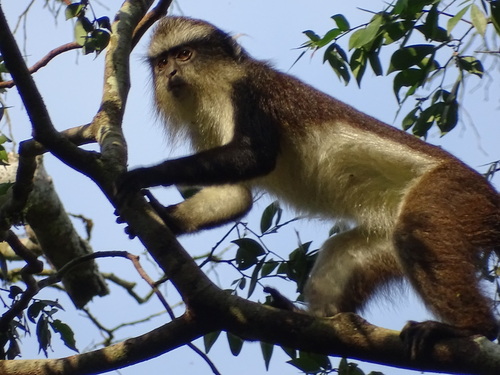
Other species in the family Cercopithecidae
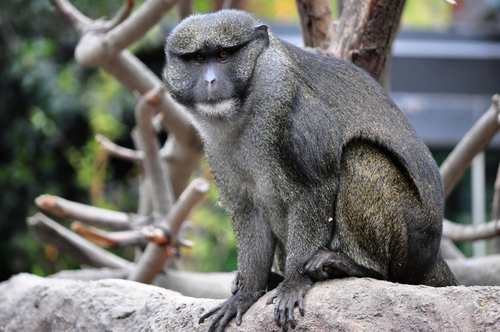
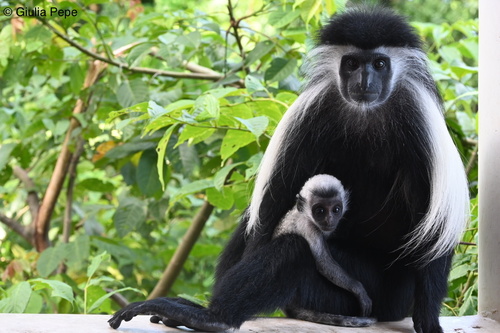
Sources
Conservation status, range description and population estimate come from the IUCN Red List assessment for Cercopithecus ascanius. Countries are derived from that range description, not from a mapped country list. Last refreshed on .
The distribution map is drawn from the IUCN Red List spatial data compiled in 2019. IUCN (International Union for Conservation of Nature)