
Binturong
Arctictis binturong
Red List assessment
Vulnerableon the IUCN Red List
- EXExtinct
- EWExtinct in the Wild
- CRCritically Endangered
- ENEndangered
- VUVulnerable
- NTNear Threatened
- LCLeast Concern
The Binturong is recorded in 10 countries across Asia. The IUCN Red List assesses the Binturong as Vulnerable. Exact numbers are unknown, but the population is considered to be declining across its range; some regional populations, especially in Palawan and parts of mainland Southeast Asia, are severely fragmented and small.
- Family
- Viverridae
- Order
- Carnivora
- Genus
- Arctictis
- Countries recorded
- 10
- Continents
- Asia
- Red List category
- Vulnerable
- Data updated
- August 9, 2026
What is the Binturong?
The binturong, also called the 'bearcat', is a large arboreal viverrid native to South and Southeast Asian rainforests. It is notable for being one of only two carnivoran species with a fully prehensile tail, used like a fifth limb for climbing. Its shaggy black fur and distinctive popcorn-like scent have made it a memorable and beloved species among naturalists.
Where does the Binturong live?
Southeast Asia, including parts of India, Bangladesh, Myanmar, Thailand, Laos, Vietnam, Cambodia, Malaysia, Indonesia, and the Philippines
Ranges from northeastern India and Bangladesh through Myanmar, Thailand, Laos, Cambodia, Vietnam, and Peninsular Malaysia, into the Indonesian islands of Sumatra, Java, and Borneo, as well as Palawan in the Philippines. Populations are increasingly fragmented due to deforestation.
Altitude and depth
Typically found from sea level up to around 1,100-1,500 meters elevation in forested hill regions.
Seasonal movements
No strict seasonal migration or hibernation; however, reproductive activity can show slight peaks correlated with fruiting seasons in some regions.
Habitat of the Binturong
Primarily found in dense tropical evergreen and semi-evergreen rainforests with continuous canopy cover, allowing arboreal movement. Also inhabits secondary forests, though less commonly, and requires large trees for denning and travel corridors.
Adaptations to its environment
Possesses a fully prehensile tail that acts as a fifth limb for balance and grip while navigating tree canopies, along with flexible ankles allowing rotation for climbing down trees head-first. Its slow, deliberate movements and strong grip are adaptations for an arboreal lifestyle in dense forest canopy.
Conservation status and numbers
Classified as Vulnerable (VU) by the IUCN due to an estimated population decline of over 30% over the past three generations, driven primarily by habitat loss and hunting pressure.
Estimated population
Exact numbers are unknown, but the population is considered to be declining across its range; some regional populations, especially in Palawan and parts of mainland Southeast Asia, are severely fragmented and small.
What threatens the Binturong?
Major threats include deforestation and habitat fragmentation from logging and agricultural expansion (especially palm oil), hunting for bushmeat and traditional medicine, and illegal wildlife trade for pets and exotic markets.
Diseases and parasites
Susceptible to common carnivoran parasites such as ticks, fleas, and intestinal worms; specific disease studies are limited, though captive individuals have been documented with dental and gastrointestinal issues.
What is being done to protect it?
Protected under national wildlife laws in most range countries and listed on CITES Appendix III (in some nations). It occurs in numerous protected areas and reserves, and some zoos participate in captive breeding and public awareness programs.
Recommended actions
Priority actions include strengthening anti-poaching enforcement, protecting and connecting remaining forest habitat, regulating illegal wildlife trade, and conducting more field research to better estimate population trends and ecological needs.
What the Binturong looks like
Covered in coarse, shaggy black fur often with grizzled gray tips, giving a frosted appearance; has small rounded ears with tufts of hair, a stocky bear-like body, and a long thick prehensile tail. Its face features long white whiskers and small eyes adapted for low-light conditions.
Size
Body length ranges from about 60-96 cm, with an additional prehensile tail of 50-90 cm, making total length up to nearly 1.8 meters in large individuals.
Weight
Typically weighs between 9-20 kg, with some large males reaching up to 25 kg; there is no strong sexual size dimorphism, though females can be slightly larger.
Distinctive features
Distinguished from other viverrids by its unusually large size, fully prehensile tail (rare among carnivorans), and its unique popcorn-like scent produced by specialized scent glands.
Differences between males and females
Minimal sexual dimorphism; females are sometimes slightly larger than males, which is unusual among carnivorans.
Behaviour and diet of the Binturong
Generally solitary, though sometimes found in small family groups consisting of a mother and her offspring; adults typically maintain individual home ranges that can overlap.
When it is active
Primarily nocturnal and crepuscular, though it can also show activity during daylight hours, especially in captivity or undisturbed habitats.
Diet
Omnivorous diet consisting mainly of fruits, especially figs, supplemented with small mammals, birds, eggs, insects, and carrion. Fruit consumption plays a key ecological role in seed dispersal.
How it feeds and hunts
Forages slowly and methodically through the canopy and forest floor, using keen smell to locate fruit and occasionally ambushing small prey such as rodents or birds opportunistically.
Communication
Communicates through scent marking using specialized perineal glands that produce a corn-chip-like odor, as well as vocalizations including hisses, growls, chuckles, and wails to express mood or warn of threats.
Interactions with other species
Has few natural predators due to its size and arboreal habits, though clouded leopards and large raptors may prey on young or vulnerable individuals; it plays an important role as a seed disperser for various fruiting trees, benefiting forest regeneration.
Role in its ecosystem
Functions as an important seed disperser in tropical forest ecosystems, particularly for fig trees, helping maintain forest biodiversity and structure through its frugivorous habits.
Reproduction and lifecycle
Breeding can occur year-round without a strict season; gestation lasts approximately 91 days, and litters typically consist of 1-3 cubs, born in tree hollows or dense vegetation.
Raising the young
Females provide most parental care, nursing and protecting cubs in a den until they are mobile; young binturongs are weaned at around 8 weeks but may stay with the mother for several months to learn foraging skills.
Maturity and lifespan
Reaches sexual maturity at around 2-2.5 years of age; lifespan in the wild is estimated at around 15 years, while captive individuals have lived up to 20-25 years.
Taxonomy and naming of the Binturong
Classification
Class Mammalia > Order Carnivora > Family Viverridae > Genus Arctictis > Species Arctictis binturong
Subspecies
Several subspecies recognized including A. b. binturong (Malay Peninsula, Sumatra), A. b. albifrons (Borneo), A. b. whitei (Palawan, Philippines), A. b. menglaensis (China/Vietnam border), and others across its fragmented range.
Scientific synonyms
Viverra binturong (original combination), Ictides ater, Arctictis penicillata
What research says
Recent studies
Recent camera-trap and genetic studies have focused on clarifying subspecies boundaries and population connectivity across fragmented Southeast Asian habitats, highlighting conservation priorities in Borneo and the Philippines.
Genome and DNA
Diploid chromosome number is reported as 2n=38; limited genomic studies exist, though some phylogenetic research has clarified its placement within Viverridae.
Compared with similar species
Similar in general body plan to other large viverrids like the binturong's relative, the masked palm civet, but distinguished by its much larger size and unique prehensile tail; often compared ecologically to primates due to its arboreal fruit-eating habits.
The Binturong and people
The binturong's fur and skin naturally produce a scent remarkably similar to buttered popcorn due to a compound called 2-acetyl-1-pyrroline. It is one of only two carnivoran species (the other being the kinkajou) known to have a fully prehensile tail.
Where and how to see it
Best observed in protected rainforest reserves in Borneo, Sumatra, or Thailand during nighttime guided tours, as the species is elusive and mostly active after dusk; patience and quiet movement through canopy-rich habitat increase chances of sighting.
Risks to humans
No notable risk to humans under normal circumstances, though like any wild carnivore, it may bite or scratch defensively if cornered or handled.
Human uses
Historically hunted for bushmeat and used in traditional medicine in parts of its range; also kept in captivity as an exotic pet and displayed in zoos, though wild capture for trade has contributed to population declines.
Myths and legends
In some Southeast Asian folklore, the binturong is considered a mysterious forest spirit due to its nocturnal habits and unusual appearance, though it lacks the widespread mythological prominence of larger predators.
Countries where the Binturong is recorded
The 10 countries named in the range description of its IUCN Red List assessment.
Questions about the Binturong
Where does the Binturong live?
The Binturong is recorded in Bangladesh, Cambodia, India, Indonesia and Laos, among 10 countries in total across Asia. These countries come from the range description of its IUCN Red List assessment, and they are what place the species on the interactive map.
Is the Binturong endangered?
Yes. The IUCN Red List assesses the Binturong as Vulnerable, one of the three threatened categories. The species faces a high risk of extinction in the wild. It is the first of the three threatened categories: numbers are falling, the range is shrinking, or the population is small enough that a single bad event could do lasting damage.
How many are left in the wild?
Exact numbers are unknown, but the population is considered to be declining across its range; some regional populations, especially in Palawan and parts of mainland Southeast Asia, are severely fragmented and small. This figure comes from the species assessment on the IUCN Red List; population estimates for wild mammals are ranges, not counts, and are revised at each assessment.
What habitat does the Binturong live in?
Primarily found in dense tropical evergreen and semi-evergreen rainforests with continuous canopy cover, allowing arboreal movement.
What is the scientific name of the Binturong?
The Binturong is Arctictis binturong, in the family Viverridae, order Carnivora.
Other species in the family Viverridae
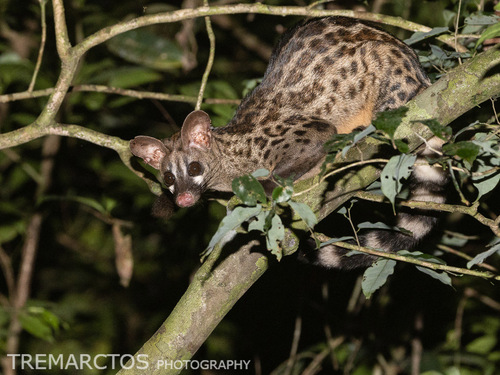
Species that share its range
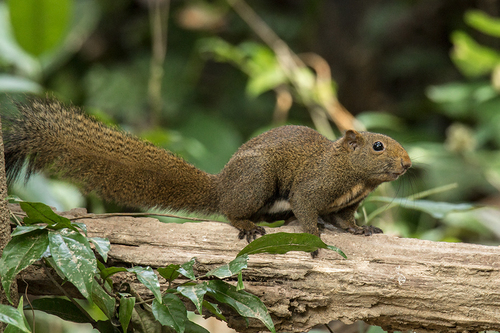
Sources
Conservation status, range description and population estimate come from the IUCN Red List assessment for Arctictis binturong. Countries are derived from that range description, not from a mapped country list. Last refreshed on .
The distribution map is drawn from the IUCN Red List spatial data compiled in 2016. IUCN (International Union for Conservation of Nature)