
Ogilby's Duiker
Cephalophus ogilbyi
Red List assessment
Least Concernon the IUCN Red List
- EXExtinct
- EWExtinct in the Wild
- CRCritically Endangered
- ENEndangered
- VUVulnerable
- NTNear Threatened
- LCLeast Concern
The Ogilby's Duiker is recorded in 3 countries across Africa. The IUCN Red List assesses the Ogilby's Duiker as Least Concern. No precise global population estimate exists, but the species is considered relatively common within suitable habitat in Cameroon; populations are believed to be declining overall due to hunting pressure
- Family
- Bovidae
- Order
- Artiodactyla
- Genus
- Cephalophus
- Countries recorded
- 3
- Continents
- Africa
- Red List category
- Least Concern
- Data updated
- August 9, 2026
What is the Ogilby's Duiker?
Ogilby's Duiker is a small forest antelope native to the lowland and montane forests of West-Central Africa. It is a shy, solitary or pair-living species known for its reddish-brown coat and secretive habits. This duiker plays an important ecological role as a seed disperser in dense tropical forest ecosystems. It is one of several duiker species facing pressure from bushmeat hunting despite its currently stable conservation status.
Where does the Ogilby's Duiker live?
Central West Africa, primarily Cameroon, Equatorial Guinea (Bioko Island), and Nigeria
Found in southeastern Nigeria, Cameroon (particularly the coastal and southern forest regions), and Bioko Island in Equatorial Guinea. The species has a relatively restricted range compared to other duiker species, concentrated in the Cross-Sanaga-Bioko coastal forests ecoregion.
Altitude and depth
Sea level up to approximately 2000 meters, with populations on Bioko Island found from lowland forest up to montane forest zones
Seasonal movements
No significant migratory behavior; the species remains resident in its forest territory year-round, though breeding activity may show slight seasonal peaks correlating with fruit availability
Habitat of the Ogilby's Duiker
Primarily inhabits primary and secondary lowland tropical rainforest, as well as montane forest up to moderate elevations. Prefers dense undergrowth providing cover from predators and ample browse. Also found in gallery forests and forest edges near agricultural land.
Adaptations to its environment
Compact, low-slung body shape allows efficient movement through dense undergrowth and thick vegetation. Strong hindquarters enable quick, low leaps to escape predators. Cryptic reddish-brown coloration provides camouflage in the dappled light of the forest floor.
Conservation status and numbers
Listed as Least Concern by IUCN, though populations are experiencing localized declines due to hunting pressure, particularly outside protected areas. The Bioko Island subspecies faces more significant threats than mainland populations.
Estimated population
No precise global population estimate exists, but the species is considered relatively common within suitable habitat in Cameroon; populations are believed to be declining overall due to hunting pressure
What threatens the Ogilby's Duiker?
Bushmeat hunting and snaring represent the primary threat, especially in accessible forest areas near human settlements. Habitat loss from logging, agricultural expansion, and infrastructure development also threatens populations, particularly on Bioko Island.
Diseases and parasites
Susceptible to various tick-borne diseases and internal parasites common to forest ungulates, though specific pathogen studies for this species remain limited
What is being done to protect it?
Protected within several national parks and reserves in Cameroon, including Korup National Park. Bioko Island populations receive some protection through the Bioko Biodiversity Protection Program. Hunting regulations exist but enforcement remains inconsistent.
Recommended actions
Strengthen anti-poaching enforcement in key forest reserves, expand protected area coverage in the Cross-Sanaga-Bioko region, and implement community-based conservation programs that provide alternatives to bushmeat hunting.
What the Ogilby's Duiker looks like
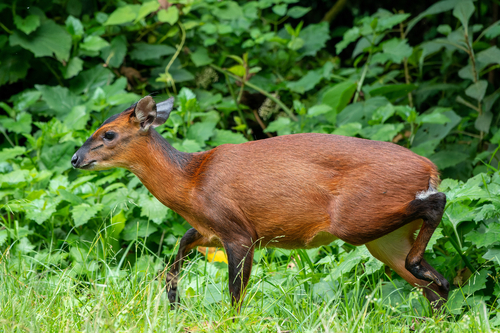
The coat is reddish-brown to chestnut colored, often darker along the back with a distinct dark dorsal stripe in some individuals. Legs may show lighter coloration, particularly in the crusalbum subspecies known for whitish lower legs. The face features the typical duiker crest of longer hair between the horns.
Size
Head-body length approximately 70-100 cm, with shoulder height ranging from 40-50 cm
Weight
Typically weighs between 14-20 kg, with limited significant difference between males and females
Distinctive features
Distinguished from similar duiker species by its specific reddish coloration pattern and, in the crusalbum subspecies, notably pale or white lower legs contrasting with the darker body. Bioko Island populations show some morphological differences from mainland relatives.
Differences between males and females
Both sexes possess short, straight horns, though males' horns are typically slightly longer and more robust; females are marginally smaller in body size overall
Behaviour and diet of the Ogilby's Duiker
Primarily solitary or found in monogamous pairs that maintain territories together. Some evidence suggests loose family groups may occur temporarily with dependent young present.
When it is active
Predominantly crepuscular and nocturnal, with peak activity during dawn and dusk hours, though some daytime activity occurs in undisturbed forest areas with minimal human presence
Diet
Herbivorous, feeding primarily on fallen fruits, leaves, shoots, and occasionally fungi found on the forest floor. Diet composition shifts seasonally based on fruit availability from various forest tree species.
Communication
Uses scent marking via preorbital glands to establish territory boundaries and communicate with potential mates. Alarm calls consist of sharp whistling snorts when startled, and body posturing signals social status between individuals.
Interactions with other species
Natural predators include leopards, African golden cats, large birds of prey, and pythons; on Bioko Island, historically hunted by native predators now largely absent, making human hunting the primary mortality source. Competes with other duiker species and forest ungulates for similar food resources.
Role in its ecosystem
Functions as an important seed disperser for numerous forest tree and shrub species by consuming fruits and depositing seeds throughout its territory, contributing to forest regeneration and plant diversity maintenance.
Reproduction and lifecycle
Breeding can occur year-round with possible peaks correlating to fruit abundance. Gestation lasts approximately 7-8 months, typically resulting in a single offspring, occasionally twins.
Raising the young
Females provide primary care for calves, which remain hidden in vegetation for the first weeks of life while the mother forages nearby. Weaning occurs gradually over several months, with young becoming independent by 4-6 months of age.
Maturity and lifespan
Sexual maturity typically reached around 9-12 months of age; wild lifespan estimated at 8-10 years, with captive individuals potentially living slightly longer under managed care
Taxonomy and naming of the Ogilby's Duiker
Classification
Mammalia > Artiodactyla > Bovidae > Cephalophus > Cephalophus ogilbyi
Subspecies
Two recognized subspecies: Cephalophus ogilbyi ogilbyi (Bioko Island, Equatorial Guinea) and Cephalophus ogilbyi crusalbum (mainland Cameroon and Nigeria border regions, sometimes called the White-legged Duiker)
Scientific synonyms
Cephalophus crusalbum (sometimes treated as separate species or subspecies)
What research says
Recent studies
Recent genetic and morphological studies have examined the taxonomic status of the Bioko Island population versus mainland populations, with some researchers suggesting further subspecies differentiation may be warranted based on isolation history
Compared with similar species
Similar in size and habits to other red duiker species like the Black-fronted Duiker and Red-flanked Duiker, but distinguished by specific coat coloration patterns and geographic range; generally smaller than the Yellow-backed Duiker but larger than the Blue Duiker.
The Ogilby's Duiker and people
Ogilby's Duiker can leap and dive into dense undergrowth with remarkable speed when startled, giving duikers their name from the Afrikaans word meaning 'diving buck.' The Bioko Island population has been geographically isolated for thousands of years, potentially representing a distinct evolutionary lineage.
Where and how to see it
Best observed during early morning or dusk hours in protected forest reserves such as Korup National Park in Cameroon, using quiet movement and patience given the species' shy, elusive nature. Camera trapping has proven more effective than direct observation in many research contexts.
Risks to humans
No notable risk to humans
Human uses
Hunted extensively for bushmeat throughout its range, representing a significant source of protein and income for local communities; also occasionally kept in captivity for conservation breeding programs and zoological display.
Countries where the Ogilby's Duiker is recorded
The 3 countries named in the range description of its IUCN Red List assessment.
Questions about the Ogilby's Duiker
Where does the Ogilby's Duiker live?
The Ogilby's Duiker is recorded in Cameroon, Equatorial Guinea and Nigeria across Africa. These countries come from the range description of its IUCN Red List assessment, and they are what place the species on the interactive map.
Is the Ogilby's Duiker endangered?
The IUCN Red List assesses the Ogilby's Duiker as Least Concern. The species is widespread and abundant enough not to qualify for any threatened category. It does not mean the species is safe forever, only that nothing in the current data raises an alarm.
How many are left in the wild?
No precise global population estimate exists, but the species is considered relatively common within suitable habitat in Cameroon; populations are believed to be declining overall due to hunting pressure This figure comes from the species assessment on the IUCN Red List; population estimates for wild mammals are ranges, not counts, and are revised at each assessment.
What habitat does the Ogilby's Duiker live in?
Primarily inhabits primary and secondary lowland tropical rainforest, as well as montane forest up to moderate elevations.
What is the scientific name of the Ogilby's Duiker?
The Ogilby's Duiker is Cephalophus ogilbyi, in the family Bovidae, order Artiodactyla.
Other species in the genus Cephalophus
Other species in the family Bovidae
Sources
Conservation status, range description and population estimate come from the IUCN Red List assessment for Cephalophus ogilbyi. Countries are derived from that range description, not from a mapped country list. Last refreshed on .
The distribution map is drawn from the IUCN Red List spatial data compiled in 2016. IUCN (International Union for Conservation of Nature)