
Northern Free-tailed Bat
Mops johorensis
Red List assessment
Vulnerableon the IUCN Red List
- EXExtinct
- EWExtinct in the Wild
- CRCritically Endangered
- ENEndangered
- VUVulnerable
- NTNear Threatened
- LCLeast Concern
The Northern Free-tailed Bat is recorded in 4 countries across Asia. The IUCN Red List assesses the Northern Free-tailed Bat as Vulnerable. Population size unknown; considered rare with a declining trend due to continued habitat degradation across its range
- Family
- Molossidae
- Order
- Chiroptera
- Genus
- Mops
- Countries recorded
- 4
- Continents
- Asia
- Red List category
- Vulnerable
- Data updated
- August 9, 2026
What is the Northern Free-tailed Bat?
Mops johorensis is a small insectivorous free-tailed bat native to lowland Southeast Asia, first described from Johor, Malaysia. It is a poorly studied species known from only a handful of specimens and localities across Peninsular Malaysia and Borneo. Its rarity and elusive roosting habits make it one of the least documented molossid bats in the region. It is notable for its taxonomic uncertainty and the conservation concern surrounding its restricted, fragmented range.
Where does the Northern Free-tailed Bat live?
Peninsular Malaysia, Singapore, and Borneo (Sarawak, Sabah, Kalimantan); possibly southern Thailand
Known from scattered localities in Peninsular Malaysia (Johor), Borneo (Sarawak, Sabah, Kalimantan), and possibly Singapore; distribution is patchy and poorly resolved due to limited survey effort.
Altitude and depth
Primarily lowland areas, from sea level up to approximately 300-500m elevation
Habitat of the Northern Free-tailed Bat
Lowland tropical rainforest and forest edges, often near limestone karst formations or mature forest with large trees providing roosting cavities. May also use forest fragments adjacent to agricultural or disturbed land.
Adaptations to its environment
Possesses narrow, pointed wings typical of molossids, enabling fast, sustained flight for aerial insect hunting in open spaces above forest canopy. The free tail extending beyond the uropatagium aids in maneuverability during flight. Echolocation calls are adapted for detecting small flying insects in cluttered and open airspace.
Conservation status and numbers
Classified as Vulnerable (VU) by IUCN due to a small, severely fragmented population and ongoing habitat loss from deforestation across its restricted range in Southeast Asia. Data are limited, but continuing declines in lowland forest cover are presumed to be driving population decreases.
Estimated population
Population size unknown; considered rare with a declining trend due to continued habitat degradation across its range
What threatens the Northern Free-tailed Bat?
Deforestation and land conversion for agriculture (oil palm plantations), logging, loss of roosting sites such as large hollow trees and caves, and general habitat fragmentation across its limited range.
What is being done to protect it?
Limited specific conservation programs target this species directly; it may benefit indirectly from protected areas and forest reserves within its range in Malaysia and Borneo. Further survey and monitoring efforts are needed to assess population status.
Recommended actions
Conduct comprehensive surveys to clarify distribution and abundance, protect remaining lowland forest habitat, safeguard roosting sites, and include the species in regional bat conservation and monitoring programs.
What the Northern Free-tailed Bat looks like
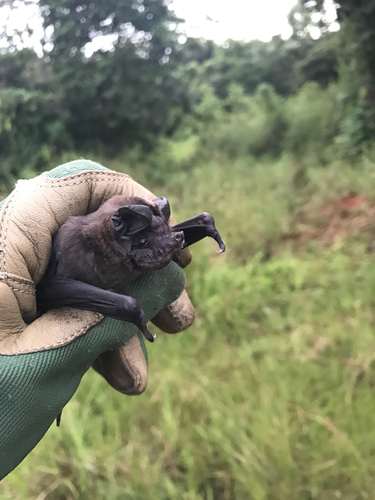
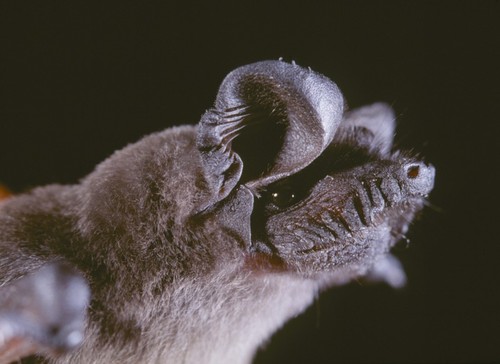
Dark brown to blackish dorsal fur with slightly paler underparts, short dense fur typical of free-tailed bats. Broad muzzle, small eyes, and rounded ears characteristic of the Molossidae family. Wings are long and narrow, adapted for fast flight.
Size
Forearm length approximately 38-42mm; total body length around 7-9 cm
Weight
Estimated 8-12 grams, typical for small molossid bats of this size class
Distinctive features
Distinguished from other Mops species by subtle differences in skull morphology, dental characteristics, and forearm length; identification often requires careful morphometric or genetic analysis due to similarity with congeners like Mops mops.
Behaviour and diet of the Northern Free-tailed Bat
Likely roosts in small to moderate colonies in tree hollows or crevices, consistent with social behavior observed in related Mops species, though specific data for this species is scarce.
When it is active
Nocturnal, emerging at dusk to forage for flying insects in open airspace above forest canopy and along forest edges.
Diet
Insectivorous, feeding primarily on small flying insects such as moths, beetles, and other aerial arthropods captured during flight.
How it feeds and hunts
Uses echolocation to detect and track flying insect prey during fast, direct flight in open or semi-open airspace above the forest canopy, typical of aerial-hawking molossid bats.
Communication
Uses ultrasonic echolocation calls for navigation and hunting; likely also employs social vocalizations within roosts, though specific communication behavior is undocumented for this species.
Interactions with other species
Likely preyed upon by nocturnal raptors and possibly snakes at roost sites; may compete with other insectivorous bat species for aerial insect prey in shared habitats.
Role in its ecosystem
Plays a role as an insectivorous predator, helping regulate populations of nocturnal flying insects within lowland tropical forest ecosystems.
Reproduction and lifecycle
Specific reproductive data for this species are lacking; related Mops species typically breed once or twice yearly with a single pup per litter after a gestation of approximately 2-3 months.
Raising the young
Presumed female-only care typical of bats, with mothers nursing and carrying or roosting with pups until they are capable of independent flight, likely around 6-8 weeks of age.
Maturity and lifespan
Data specific to this species are unavailable; related molossid bats typically reach sexual maturity within the first year and can live up to 10 years or more in the wild.
Taxonomy and naming of the Northern Free-tailed Bat
Classification
Mammalia > Chiroptera > Molossidae > Mops > Mops johorensis
Scientific synonyms
Formerly placed in genus Chaerephon; also referenced as Chaerephon johorensis in older literature
What research says
Recent studies
Recent taxonomic reviews of Southeast Asian Molossidae have used morphological and molecular data to clarify the status of Mops johorensis relative to closely related taxa, though comprehensive genetic studies remain limited.
Compared with similar species
Closely resembles other regional Mops species such as Mops mops and Mops sarasinorum, differing mainly in cranial measurements and dental features; field identification is challenging without specimen examination.
The Northern Free-tailed Bat and people
This bat is known from remarkably few museum specimens, making it one of the most enigmatic bats in Southeast Asia. Its free tail, extending beyond the tail membrane, is a hallmark trait shared across the Molossidae family that aids agile flight.
Where and how to see it
Best observed at dusk near forest edges or clearings in lowland forests of Peninsular Malaysia or Borneo using bat detectors to identify echolocation calls, as visual identification in flight is very difficult.
Risks to humans
No notable risk
Countries where the Northern Free-tailed Bat is recorded
The 4 countries named in the range description of its IUCN Red List assessment.
Questions about the Northern Free-tailed Bat
Where does the Northern Free-tailed Bat live?
The Northern Free-tailed Bat is recorded in Indonesia, Malaysia, Singapore and Thailand across Asia. These countries come from the range description of its IUCN Red List assessment, and they are what place the species on the interactive map.
Is the Northern Free-tailed Bat endangered?
Yes. The IUCN Red List assesses the Northern Free-tailed Bat as Vulnerable, one of the three threatened categories. The species faces a high risk of extinction in the wild. It is the first of the three threatened categories: numbers are falling, the range is shrinking, or the population is small enough that a single bad event could do lasting damage.
How many are left in the wild?
Population size unknown; considered rare with a declining trend due to continued habitat degradation across its range This figure comes from the species assessment on the IUCN Red List; population estimates for wild mammals are ranges, not counts, and are revised at each assessment.
What habitat does the Northern Free-tailed Bat live in?
Lowland tropical rainforest and forest edges, often near limestone karst formations or mature forest with large trees providing roosting cavities.
What is the scientific name of the Northern Free-tailed Bat?
The Northern Free-tailed Bat is Mops johorensis, in the family Molossidae, order Chiroptera.
Other species in the genus Mops

Other species in the family Molossidae

Sources
Conservation status, range description and population estimate come from the IUCN Red List assessment for Mops johorensis. Countries are derived from that range description, not from a mapped country list. Last refreshed on .
The distribution map is drawn from the IUCN Red List spatial data compiled in 2020. IUCN (International Union for Conservation of Nature)