
Namaqua Dune Mole Rat
Bathyergus janetta
Red List assessment
Least Concernon the IUCN Red List
- EXExtinct
- EWExtinct in the Wild
- CRCritically Endangered
- ENEndangered
- VUVulnerable
- NTNear Threatened
- LCLeast Concern
The Namaqua Dune Mole Rat is recorded in 2 countries across Africa. The IUCN Red List assesses the Namaqua Dune Mole Rat as Least Concern. No precise global population estimate exists, but the species is considered locally common within suitable habitat; overall population trend is believed to be stable.
- Family
- Bathyergidae
- Order
- Rodentia
- Genus
- Bathyergus
- Countries recorded
- 2
- Continents
- Africa
- Red List category
- Least Concern
- Data updated
- August 9, 2026
What is the Namaqua Dune Mole Rat?
The Namaqua dune mole rat is a fossorial rodent endemic to the sandy coastal plains of southwestern Africa, closely related to the larger Cape dune mole rat. It is remarkable for its highly specialized burrowing lifestyle in loose sandy soils, using its enlarged forefeet and claws to dig extensive tunnel systems. This species is a key ecosystem engineer, its burrowing activity aerating soil and influencing plant community structure in arid dune habitats.
Where does the Namaqua Dune Mole Rat live?
Western coastal regions of South Africa and southern Namibia, primarily in the Namaqualand and Northern Cape sandy coastal belts.
Endemic to a narrow coastal strip of western South Africa (Northern Cape and Western Cape provinces) extending into southern Namibia, generally within a few kilometers of the Atlantic coastline.
Altitude and depth
Occurs from sea level to roughly 200-300 m elevation; burrow systems typically extend 10-50 cm below the surface, though tunnels can reach deeper during dry periods for food storage.
Seasonal movements
No true hibernation; burrowing and surface foraging activity increase after rainfall when soil is softer and vegetation growth provides more food, with reduced activity during extreme dry heat.
Habitat of the Namaqua Dune Mole Rat
Inhabits coastal and near-coastal sandy soils, dunes, and sandy flats within the arid Succulent Karoo and Namaqualand biomes, often near vegetation with underground storage organs (bulbs, tubers) that serve as food sources.
Adaptations to its environment
Possesses powerful foreclaws and reduced eyes adapted for a subterranean lifestyle, along with a robust, cylindrical body shape for moving through narrow tunnels. Its incisors are used for digging in harder substrates, while sensitive facial vibrissae compensate for poor vision in the dark burrow environment.
Conservation status and numbers
Listed as Least Concern (LC) by the IUCN due to a relatively stable population and a range that, while restricted, does not show significant fragmentation or decline.
Estimated population
No precise global population estimate exists, but the species is considered locally common within suitable habitat; overall population trend is believed to be stable.
What threatens the Namaqua Dune Mole Rat?
Habitat loss from coastal development, mining (particularly diamond and mineral extraction along the Namaqualand coast), and agricultural expansion pose localized threats to populations.
Diseases and parasites
Specific disease data is limited, but like other subterranean rodents it likely hosts various ectoparasites such as mites and fleas adapted to burrow environments.
What is being done to protect it?
Some populations occur within protected areas such as Namaqua National Park; broader conservation relies on regulation of coastal mining and land development in the region.
Recommended actions
Continued monitoring of population trends in areas affected by mining, expansion of protected habitat along the coastal dune belt, and further ecological research on burrow density and food resource use.
What the Namaqua Dune Mole Rat looks like
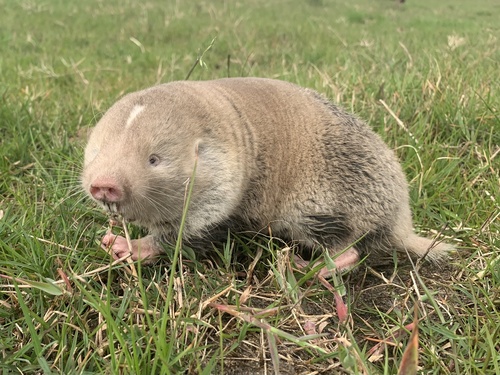
The fur is generally soft, dense, and pale sandy-brown to grayish in color, helping the animal blend with its dune habitat. It has a robust, cylindrical body, a blunt head, small eyes, and prominent, spade-like foreclaws.
Size
Body length typically ranges from 20 to 25 cm, with a short, stubby tail of about 3-5 cm.
Weight
Adults typically weigh between 150 and 250 grams, with some size variation between individuals but no strong sexual dimorphism in body size.
Distinctive features
Distinguished from the closely related Cape dune mole rat (Bathyergus suillus) by its smaller size and lighter coloration; it also has a more restricted, arid coastal range compared to its larger relative.
Differences between males and females
Sexual dimorphism is minimal, with males and females showing similar body size and coloration, though males may be marginally larger on average.
Behaviour and diet of the Namaqua Dune Mole Rat
Generally solitary, with individuals maintaining and defending their own burrow systems; encounters between unfamiliar individuals outside of breeding season are typically aggressive.
When it is active
Primarily active both day and night in short bursts underground, with surface activity such as pushing soil mounds occurring more frequently after rain or in cooler parts of the day.
Diet
Herbivorous, feeding mainly on underground plant parts such as bulbs, corms, tubers, and roots encountered while burrowing, as well as some above-ground vegetation pulled into the burrow.
Communication
Communication includes low-frequency vibrations and thumping sounds transmitted through burrow walls, as well as tactile and chemical (scent) cues used during encounters and to signal territory boundaries.
Interactions with other species
Preyed upon by mole snakes, birds of prey, and small carnivores when it surfaces or is exposed by burrow disturbance; its burrowing activity also creates microhabitats used by other invertebrates and small vertebrates.
Role in its ecosystem
Acts as an important ecosystem engineer in sandy coastal habitats, its digging aerates soil, redistributes nutrients, and promotes plant diversity by creating disturbance patches favorable to certain bulb and tuber species.
Reproduction and lifecycle
Breeding appears linked to rainfall patterns, with litters typically produced once per year; gestation lasts around 40-50 days, and litter size is usually small, often 1-3 pups.
Raising the young
Females raise the young alone within the burrow system, nursing and protecting pups until they are weaned and able to dig independently, after which juveniles disperse to establish their own burrows.
Maturity and lifespan
Sexual maturity is generally reached within the first year of life; lifespan in the wild is estimated at around 3-5 years, potentially longer in captivity.
Taxonomy and naming of the Namaqua Dune Mole Rat
Classification
Class Mammalia > Order Rodentia > Family Bathyergidae > Genus Bathyergus > Species Bathyergus janetta
Scientific synonyms
Georychus janetta (original combination); occasionally listed under Bathyergus suillus janetta in older literature.
What research says
Recent studies
Recent phylogenetic studies have helped clarify relationships within the Bathyergidae family, confirming the close relationship between Bathyergus janetta and B. suillus while highlighting genetic distinctiveness linked to their separate geographic ranges.
Compared with similar species
Compared to the Cape dune mole rat (Bathyergus suillus), the Namaqua dune mole rat is smaller, lighter in color, and restricted to more arid, northern coastal habitats rather than the wetter southwestern Cape regions.
The Namaqua Dune Mole Rat and people
Despite living almost entirely underground, this species can push up visible sand mounds several meters long as it excavates tunnels. It relies on subterranean bulbs and tubers so heavily that it rarely needs to drink free-standing water, obtaining most moisture from its food.
Where and how to see it
Direct observation is difficult due to its fossorial habits; the best chance of detecting its presence is spotting fresh sand mounds and burrow openings in coastal dune vegetation in Namaqualand, especially after rains in late winter to early spring.
Risks to humans
No notable risk to humans; it is not aggressive toward people and has no venom or significant disease transmission risk.
Human uses
Not commonly used by humans, though its burrowing can occasionally be considered a nuisance in agricultural or landscaped areas near its coastal range.
Countries where the Namaqua Dune Mole Rat is recorded
The 2 countries named in the range description of its IUCN Red List assessment.
Questions about the Namaqua Dune Mole Rat
Where does the Namaqua Dune Mole Rat live?
The Namaqua Dune Mole Rat is recorded in Namibia and South Africa across Africa. These countries come from the range description of its IUCN Red List assessment, and they are what place the species on the interactive map.
Is the Namaqua Dune Mole Rat endangered?
The IUCN Red List assesses the Namaqua Dune Mole Rat as Least Concern. The species is widespread and abundant enough not to qualify for any threatened category. It does not mean the species is safe forever, only that nothing in the current data raises an alarm.
How many are left in the wild?
No precise global population estimate exists, but the species is considered locally common within suitable habitat; overall population trend is believed to be stable. This figure comes from the species assessment on the IUCN Red List; population estimates for wild mammals are ranges, not counts, and are revised at each assessment.
What habitat does the Namaqua Dune Mole Rat live in?
Inhabits coastal and near-coastal sandy soils, dunes, and sandy flats within the arid Succulent Karoo and Namaqualand biomes, often near vegetation with underground storage organs (bulbs, tubers) that serve as food sources.
What is the scientific name of the Namaqua Dune Mole Rat?
The Namaqua Dune Mole Rat is Bathyergus janetta, in the family Bathyergidae, order Rodentia.
Other species in the genus Bathyergus
Other species in the family Bathyergidae
Species that share its range
Sources
Conservation status, range description and population estimate come from the IUCN Red List assessment for Bathyergus janetta. Countries are derived from that range description, not from a mapped country list. Last refreshed on .
The distribution map is drawn from the IUCN Red List spatial data compiled in 2008. IUCN (International Union for Conservation of Nature)