
Mechow's Mole Rat
Fukomys mechowii
Red List assessment
Least Concernon the IUCN Red List
- EXExtinct
- EWExtinct in the Wild
- CRCritically Endangered
- ENEndangered
- VUVulnerable
- NTNear Threatened
- LCLeast Concern
The Mechow's Mole Rat is recorded in 3 countries across Africa. The IUCN Red List assesses the Mechow's Mole Rat as Least Concern. No precise global population estimate exists, but the species is considered common within suitable habitat with a presumed stable population trend.
- Family
- Bathyergidae
- Order
- Rodentia
- Genus
- Fukomys
- Countries recorded
- 3
- Continents
- Africa
- Red List category
- Least Concern
- Data updated
- August 9, 2026
What is the Mechow's Mole Rat?
Mechow's mole rat is a large, strictly subterranean rodent native to the miombo woodlands of south-central Africa. It is one of the largest species in the African mole-rat family and is notable for its highly cooperative, eusocial colony structure similar to naked mole rats. This species spends nearly its entire life underground in extensive burrow systems, rarely surfacing except during dispersal events after rains.
Where does the Mechow's Mole Rat live?
Central Africa, primarily Angola, Democratic Republic of the Congo, and Zambia
Found across northern Zambia, southern Democratic Republic of the Congo, and northeastern Angola, within the broader Zambezian biogeographic region of south-central Africa.
Altitude and depth
Occurs at elevations of roughly 1000-1500m above sea level; burrows typically extend 20-50cm below the surface, with deeper nest chambers reaching up to 1-2m.
Seasonal movements
Burrowing and dispersal activity increases during and after the rainy season when soil is softer, facilitating tunnel excavation and colony founding by dispersing individuals.
Habitat of the Mechow's Mole Rat
Inhabits miombo woodland and savanna with sandy or loamy soils suitable for digging extensive tunnel systems. Prefers areas with sufficient rainfall to soften soil for burrowing and support geophyte (underground tuber) growth, its main food source.
Adaptations to its environment
Possesses powerful incisors and forelimbs adapted for chisel-tooth digging, reduced eyesight, and a cylindrical body suited to tunnel life. Its eusocial behavior allows efficient colony-based foraging and defense in resource-patchy underground environments.
Conservation status and numbers
Listed as Least Concern (LC) by the IUCN due to its relatively wide distribution and presumed stable population, though localized declines can occur from habitat conversion.
Estimated population
No precise global population estimate exists, but the species is considered common within suitable habitat with a presumed stable population trend.
What threatens the Mechow's Mole Rat?
Main threats include agricultural expansion, deforestation of miombo woodland, and occasional hunting for bushmeat or as agricultural pests damaging crops and tubers.
Diseases and parasites
Specific parasite and disease data are limited, but like other subterranean rodents it can host ectoparasites such as mites and fleas within burrow systems.
What is being done to protect it?
No species-specific conservation programs exist; it benefits indirectly from protected miombo woodland areas and national parks within its range countries.
Recommended actions
Recommended actions include habitat monitoring in miombo ecosystems, research into population genetics and distribution limits, and inclusion in broader woodland conservation planning.
What the Mechow's Mole Rat looks like
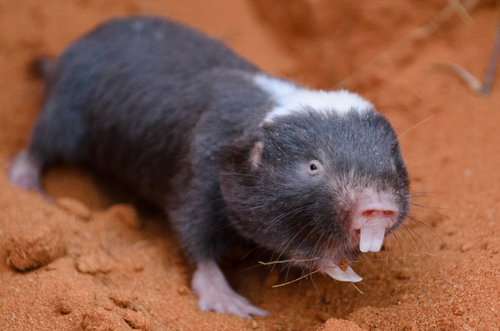
Has short, dense fur ranging from dark brown to grayish-black, a robust cylindrical body, small eyes, reduced external ears, and large protruding incisors used for digging.
Size
Body length typically ranges from 18-30 cm, making it one of the largest African mole-rat species.
Weight
Adults typically weigh between 150-350 grams, with breeding individuals (especially queens) sometimes larger than non-breeders.
Distinctive features
Distinguished from related Fukomys species by its notably larger body size and specific chromosomal number; coloration and cranial morphology also differ subtly among congeners.
Differences between males and females
Minimal external sexual dimorphism, though breeding females (queens) tend to be somewhat larger and heavier than non-breeding colony members and males.
Behaviour and diet of the Mechow's Mole Rat
Highly eusocial, living in cooperative colonies of up to 20-40 individuals (sometimes more) with a reproductive division of labor resembling naked mole rat societies, including a dominant breeding pair and non-reproductive helpers.
When it is active
Primarily active underground at various times of day and night, with activity patterns driven by foraging needs and tunnel maintenance rather than strict diurnal or nocturnal cycles.
Diet
Herbivorous, feeding mainly on underground geophytes such as tubers, bulbs, roots, and rhizomes encountered while tunneling.
Communication
Communicates through soft vocalizations, chirps, and squeaks within the colony, along with tactile and chemical (scent) signals used in social bonding and colony recognition.
Interactions with other species
Predators include snakes, birds of prey, and mongooses when individuals surface during dispersal; underground, they have few direct competitors due to their specialized fossorial niche.
Role in its ecosystem
Plays an ecological role as a soil engineer, aerating soil and influencing plant tuber distribution through its extensive burrowing activity in miombo woodland ecosystems.
Reproduction and lifecycle
Breeding is largely restricted to a single dominant pair per colony; gestation lasts approximately 3 months, with litters typically of 1-6 pups born in underground nest chambers.
Raising the young
Pups are cared for cooperatively by non-breeding colony members as well as the parents, receiving food, grooming, and protection until they mature and either stay as helpers or disperse.
Maturity and lifespan
Sexual maturity is delayed in non-breeding colony members due to reproductive suppression; captive individuals can live over 10 years, though wild lifespan data are less well documented.
Taxonomy and naming of the Mechow's Mole Rat
Classification
Class Mammalia > Order Rodentia > Family Bathyergidae > Genus Fukomys > Species Fukomys mechowii
Scientific synonyms
Cryptomys mechowii (former genus placement before Bathyergidae taxonomy revision)
What research says
Recent studies
Recent research has focused on this species as a model for studying eusociality, reproductive suppression mechanisms, and aging biology in mole-rats, given parallels with naked mole rats.
Genome and DNA
Fukomys species are notable in genetic research for variable chromosome numbers among closely related taxa; F. mechowii has been used in comparative studies of eusocial mammal genomics.
Compared with similar species
Compared to the smaller common mole-rat (Fukomys damarensis), Mechow's mole rat is notably larger and inhabits wetter miombo woodland rather than arid savanna; it is less studied than the naked mole rat but shares similar social complexity.
The Mechow's Mole Rat and people
Mechow's mole rats can live in colonies where only one female breeds for years, similar to insect queens; they rarely ever see daylight, spending virtually their whole lives underground; and they are among the largest of Africa's social mole-rat species.
Where and how to see it
Extremely difficult to observe due to fully subterranean lifestyle; best chances involve visiting research sites in Zambian miombo woodlands during rainy-season dispersal when individuals occasionally surface.
Risks to humans
No notable risk to humans; they are not aggressive toward people, though they can damage crops and root vegetables through burrowing.
Human uses
Occasionally used as bushmeat in local communities and studied scientifically as a model organism for eusociality and longevity research.
Countries where the Mechow's Mole Rat is recorded
The 3 countries named in the range description of its IUCN Red List assessment.
Questions about the Mechow's Mole Rat
Where does the Mechow's Mole Rat live?
The Mechow's Mole Rat is recorded in Angola, Democratic Republic of the Congo and Zambia across Africa. These countries come from the range description of its IUCN Red List assessment, and they are what place the species on the interactive map.
Is the Mechow's Mole Rat endangered?
The IUCN Red List assesses the Mechow's Mole Rat as Least Concern. The species is widespread and abundant enough not to qualify for any threatened category. It does not mean the species is safe forever, only that nothing in the current data raises an alarm.
How many are left in the wild?
No precise global population estimate exists, but the species is considered common within suitable habitat with a presumed stable population trend. This figure comes from the species assessment on the IUCN Red List; population estimates for wild mammals are ranges, not counts, and are revised at each assessment.
What habitat does the Mechow's Mole Rat live in?
Inhabits miombo woodland and savanna with sandy or loamy soils suitable for digging extensive tunnel systems.
What is the scientific name of the Mechow's Mole Rat?
The Mechow's Mole Rat is Fukomys mechowii, in the family Bathyergidae, order Rodentia.
Other species in the genus Fukomys
Other species in the family Bathyergidae
Species that share its range

Sources
Conservation status, range description and population estimate come from the IUCN Red List assessment for Fukomys mechowii. Countries are derived from that range description, not from a mapped country list. Last refreshed on .
The distribution map is drawn from the IUCN Red List spatial data compiled in 2008. IUCN (International Union for Conservation of Nature)