
Ochre Mole Rat
Fukomys ochraceocinereus
Red List assessment
Least Concernon the IUCN Red List
- EXExtinct
- EWExtinct in the Wild
- CRCritically Endangered
- ENEndangered
- VUVulnerable
- NTNear Threatened
- LCLeast Concern
The Ochre Mole Rat is recorded in 3 countries across Africa. The IUCN Red List assesses the Ochre Mole Rat as Least Concern. No precise population estimates exist; presumed to have a stable population given its Least Concern status and lack of major habitat loss reports.
- Family
- Bathyergidae
- Order
- Rodentia
- Genus
- Fukomys
- Countries recorded
- 3
- Continents
- Africa
- Red List category
- Least Concern
- Data updated
- August 9, 2026
What is the Ochre Mole Rat?
The Ochre Mole Rat is a small, strictly subterranean rodent native to the grasslands of South Sudan. Like other Fukomys species, it lives in cooperative family groups within extensive burrow systems and rarely surfaces. It is notable for its social structure, which is intermediate between solitary bathyergids and the eusocial naked mole rat.
Where does the Ochre Mole Rat live?
South Sudan and possibly adjacent areas of Sudan and Central African Republic, in the Nile Basin region of northeastern Africa.
Endemic to South Sudan, with its range centered on the Nile Basin grasslands; distribution poorly documented due to limited fieldwork in the region.
Altitude and depth
Burrows typically found at shallow to moderate depths of 20-50 cm below the surface, in lowland areas below 1000m altitude.
Seasonal movements
Burrowing and foraging activity likely increases during and after the rainy season when soil is softer and more workable.
Habitat of the Ochre Mole Rat
Inhabits savanna grasslands and semi-arid areas with friable, workable soils suitable for burrowing. Often found in areas with seasonal rainfall that softens soil for digging.
Adaptations to its environment
Possesses reduced eyes, powerful incisors for digging, and a cylindrical body shape adapted for tunnel life. Fur is short and dense to minimize resistance while moving through burrows.
Conservation status and numbers
Listed as Least Concern by IUCN due to presumed stable population and lack of significant identified threats, though data on this species remains limited.
Estimated population
No precise population estimates exist; presumed to have a stable population given its Least Concern status and lack of major habitat loss reports.
What threatens the Ochre Mole Rat?
Potential threats include habitat conversion to agriculture and human population pressure in South Sudan, though specific data is scarce.
Diseases and parasites
Specific pathogens are not well documented, though mole-rats in general can host ectoparasites such as mites and fleas within their burrow systems.
What is being done to protect it?
No specific conservation programs target this species; it may benefit indirectly from general habitat protection in its range.
Recommended actions
Increased field surveys to establish accurate distribution and population data, along with monitoring of habitat changes in South Sudan's grasslands.
What the Ochre Mole Rat looks like
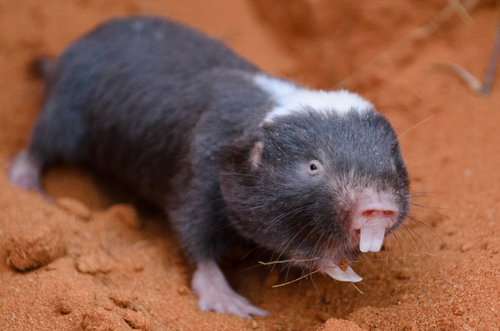
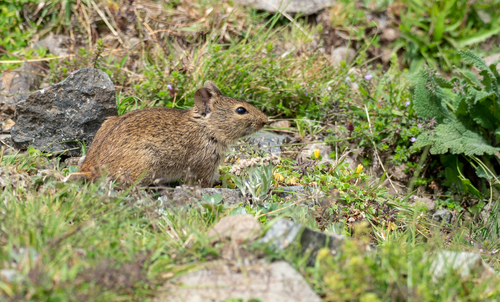
Ochre to grayish-brown fur covering a cylindrical, robust body; small eyes and ears nearly hidden in fur; large protruding incisors used for digging.
Size
Body length approximately 12-16 cm, with a short, stubby tail typical of mole-rats.
Weight
Estimated weight range of 60-120 grams, similar to related Fukomys species.
Distinctive features
Distinguished from related Fukomys species primarily by its ochre-tinged coloration and specific geographic range in South Sudan, along with subtle cranial and dental characteristics.
Differences between males and females
Minimal sexual dimorphism reported, consistent with other Fukomys species where breeding females may be slightly larger.
Behaviour and diet of the Ochre Mole Rat
Lives in cooperative family groups within burrow systems, likely with a reproductive pair and non-breeding helper offspring, similar to other social mole-rats.
When it is active
Primarily active underground at various times of day, since photoperiod has little relevance to a fully subterranean lifestyle.
Diet
Herbivorous, feeding on underground plant parts such as roots, tubers, and bulbs encountered while excavating tunnels.
Communication
Communication likely includes tactile cues, low-frequency vocalizations, and seismic signals such as tooth-drumming or foot-thumping used by related subterranean rodents.
Interactions with other species
Predators may include snakes and burrowing carnivores that can access tunnel systems; limited direct competition due to its specialized underground niche.
Role in its ecosystem
Plays a role in soil aeration and turnover through extensive burrowing, and its feeding activity can influence underground plant root systems in its habitat.
Reproduction and lifecycle
Reproduction is likely restricted to a single breeding pair per colony, with litters born after a gestation period estimated around 60-90 days based on related species.
Raising the young
Young are cared for cooperatively by the family group, including non-breeding siblings who help provision and protect pups, typical of cooperatively breeding mole-rats.
Maturity and lifespan
Sexual maturity likely reached around 6-12 months as in related species; lifespan in the wild is poorly documented but captive Fukomys species can live 5-10 years.
Taxonomy and naming of the Ochre Mole Rat
Classification
Class Mammalia > Order Rodentia > Family Bathyergidae > Genus Fukomys > Species Fukomys ochraceocinereus
Scientific synonyms
Previously classified under Cryptomys ochraceocinereus before genus Fukomys was split from Cryptomys based on molecular studies.
What research says
Recent studies
Recent taxonomic revisions using mitochondrial DNA have helped clarify the placement of this species within the Fukomys genus, separate from the broader Cryptomys group.
Genome and DNA
Genus Fukomys has been subject to molecular phylogenetic studies to clarify species boundaries within Bathyergidae, though species-specific genomic data for F. ochraceocinereus is limited.
Compared with similar species
Similar in ecology and morphology to other Fukomys species like Fukomys anselli and Fukomys mechowii, but distinguished by geographic isolation in South Sudan and coloration differences.
The Ochre Mole Rat and people
This mole-rat spends virtually its entire life underground and rarely if ever surfaces voluntarily; its common name references its distinctive ochre-gray fur coloration.
Where and how to see it
Extremely difficult to observe in the wild due to its subterranean lifestyle; best chances involve examining fresh burrow mounds in South Sudanese grasslands during the wet season.
Risks to humans
No notable risk to humans.
Countries where the Ochre Mole Rat is recorded
The 3 countries named in the range description of its IUCN Red List assessment.
Questions about the Ochre Mole Rat
Where does the Ochre Mole Rat live?
The Ochre Mole Rat is recorded in Central African Republic, South Sudan and Sudan across Africa. These countries come from the range description of its IUCN Red List assessment, and they are what place the species on the interactive map.
Is the Ochre Mole Rat endangered?
The IUCN Red List assesses the Ochre Mole Rat as Least Concern. The species is widespread and abundant enough not to qualify for any threatened category. It does not mean the species is safe forever, only that nothing in the current data raises an alarm.
How many are left in the wild?
No precise population estimates exist; presumed to have a stable population given its Least Concern status and lack of major habitat loss reports. This figure comes from the species assessment on the IUCN Red List; population estimates for wild mammals are ranges, not counts, and are revised at each assessment.
What habitat does the Ochre Mole Rat live in?
Inhabits savanna grasslands and semi-arid areas with friable, workable soils suitable for burrowing.
What is the scientific name of the Ochre Mole Rat?
The Ochre Mole Rat is Fukomys ochraceocinereus, in the family Bathyergidae, order Rodentia.
Other species in the genus Fukomys
Other species in the family Bathyergidae
Species that share its range
Sources
Conservation status, range description and population estimate come from the IUCN Red List assessment for Fukomys ochraceocinereus. Countries are derived from that range description, not from a mapped country list. Last refreshed on .
The distribution map is drawn from the IUCN Red List spatial data compiled in 2008. IUCN (International Union for Conservation of Nature)