
Nigerian Mole Rat
Fukomys foxi
Red List assessment
Data Deficienton the IUCN Red List
- EXExtinct
- EWExtinct in the Wild
- CRCritically Endangered
- ENEndangered
- VUVulnerable
- NTNear Threatened
- LCLeast Concern
Data Deficient has no position on the scale above — it records the absence of an assessment, not a degree of risk.
The Nigerian Mole Rat is recorded in 2 countries across Africa. The IUCN Red List records the Nigerian Mole Rat as Data Deficient. No reliable population estimate exists; population trend is unknown due to lack of dedicated surveys and monitoring programs.
- Family
- Bathyergidae
- Order
- Rodentia
- Genus
- Fukomys
- Countries recorded
- 2
- Continents
- Africa
- Red List category
- Data Deficient
- Data updated
- August 9, 2026
What is the Nigerian Mole Rat?
Fukomys foxi is a small subterranean African mole rat native to savanna and woodland regions of Nigeria and Cameroon. It is a social, burrowing rodent belonging to the family Bathyergidae, known for its highly adapted underground lifestyle. Like other Fukomys species, it lives in cooperative family groups and rarely surfaces. It remains poorly studied, and its ecology and population status are largely unknown, reflected in its Data Deficient IUCN status.
Where does the Nigerian Mole Rat live?
Nigeria and Cameroon (West-Central Africa)
Restricted range in West-Central Africa, primarily documented from central Nigeria with possible extension into adjacent parts of Cameroon. Its full distribution remains poorly mapped due to limited survey data.
Altitude and depth
Occurs at lowland to mid-elevation areas, generally below 1000m; burrows typically span from near-surface to about 1-2m deep depending on soil and food availability.
Seasonal movements
No strong evidence of migration; burrowing activity may increase during rainy seasons when soil is easier to excavate and root/tuber food is more abundant.
Habitat of the Nigerian Mole Rat
Inhabits savanna, grassland, and woodland habitats with soft, workable soils suitable for extensive burrow systems. Found in areas with sufficient underground tuber and root density to sustain colonies.
Adaptations to its environment
Exhibits classic subterranean rodent adaptations: reduced eyesight, powerful incisors for digging, cylindrical body shape for moving through tunnels, and short limbs. Highly efficient thermoregulation and low metabolic rate suited to enclosed burrow environments.
Conservation status and numbers
Listed as Data Deficient (DD) by the IUCN due to insufficient information on population size, distribution, and trends. Further taxonomic and ecological research is needed to properly assess its conservation status.
Estimated population
No reliable population estimate exists; population trend is unknown due to lack of dedicated surveys and monitoring programs.
What threatens the Nigerian Mole Rat?
Potential threats include habitat conversion for agriculture, urban expansion, and soil degradation in its native range. Specific threat data is lacking due to limited research on the species.
What is being done to protect it?
No specific conservation programs target this species; it may occur incidentally within protected areas in Nigeria and Cameroon, but this has not been confirmed through targeted study.
Recommended actions
Priority actions include field surveys to clarify distribution and abundance, genetic studies to confirm taxonomic boundaries, and habitat assessments to identify potential threats from land-use change.
What the Nigerian Mole Rat looks like
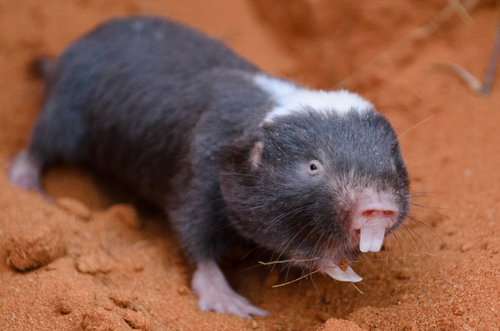
Has soft, dense fur typically brownish-gray to sandy in color, a cylindrical body, small eyes, reduced external ears, and large protruding incisors used for digging. The tail is short and sparsely haired.
Size
Body length typically ranges from 10 to 16 cm, excluding a short tail of 2-3 cm, consistent with other small Fukomys mole rat species.
Weight
Estimated body weight ranges from 40 to 100 grams, similar to related Fukomys species, though exact data for this species specifically is limited.
Distinctive features
Distinguished from closely related Fukomys species mainly through subtle cranial and molecular differences rather than obvious external morphology, making genetic analysis important for species identification.
Differences between males and females
Minimal sexual dimorphism has been documented; as in other Fukomys species, breeding females may show slightly greater body mass than non-breeding colony members.
Behaviour and diet of the Nigerian Mole Rat
Likely lives in cooperative, family-based colonies similar to other Fukomys mole rats, with a reproductive pair and non-breeding helpers contributing to burrow maintenance and foraging.
When it is active
Primarily active underground, with activity patterns likely continuing both day and night since they are largely independent of surface light cues, focused on digging and foraging within tunnel systems.
Diet
Herbivorous, feeding mainly on underground plant structures such as roots, bulbs, and tubers encountered while burrowing.
Communication
Presumed to use vocalizations, tactile signals, and possibly seismic or tooth-chattering communication within burrows, as documented in other Fukomys species, though specific studies for this species are lacking.
Interactions with other species
Likely predated upon by subterranean and surface predators such as snakes and birds of prey when occasionally exposed; ecological interactions with other species remain largely undocumented.
Role in its ecosystem
Plays a role in soil aeration and nutrient cycling through its burrowing activity, and its foraging may influence local plant root distribution and vegetation structure.
Reproduction and lifecycle
Reproductive biology is not well documented for this species specifically, but related Fukomys species show cooperative breeding with a single dominant breeding pair per colony and litters of 1-4 pups after a gestation of about 2-3 months.
Raising the young
In related Fukomys species, offspring are cared for communally by the breeding pair and non-reproductive colony members, who help provision and protect the young within the burrow system.
Maturity and lifespan
Specific data unavailable, but related Fukomys species reach sexual maturity around 1 year of age and can live 4-10 years in the wild, with longer lifespans possible in captivity.
Taxonomy and naming of the Nigerian Mole Rat
Classification
Class Mammalia > Order Rodentia > Family Bathyergidae > Genus Fukomys > Species Fukomys foxi
Scientific synonyms
Previously classified within Cryptomys foxi before genus revision placed it in Fukomys
What research says
Recent studies
Recent taxonomic revisions using molecular phylogenetics have helped clarify the placement of foxi within Fukomys, separating it from the broader Cryptomys complex, though ecological field studies remain sparse.
Genome and DNA
Genetic studies have been used primarily for taxonomic classification within the Fukomys genus; specific chromosome counts for foxi have not been definitively published in accessible literature.
Compared with similar species
Similar in general body plan and social structure to other Fukomys and Cryptomys mole rats, but distinguished by geographic range and subtle genetic markers rather than obvious morphological traits.
The Nigerian Mole Rat and people
Despite living almost entirely underground and rarely being seen, this mole rat is part of a genus known for some of the most complex social structures among rodents, resembling insect-like cooperative societies. It was only formally described relatively recently, highlighting how much remains unknown about African subterranean mammals.
Where and how to see it
Due to its subterranean lifestyle and Data Deficient status, direct observation in the wild is extremely difficult; researchers typically detect presence through burrow mounds or live-trapping during targeted surveys in Nigeria's savanna regions.
Risks to humans
No notable risk to humans.
Countries where the Nigerian Mole Rat is recorded
The 2 countries named in the range description of its IUCN Red List assessment.
Questions about the Nigerian Mole Rat
Where does the Nigerian Mole Rat live?
The Nigerian Mole Rat is recorded in Cameroon and Nigeria across Africa. These countries come from the range description of its IUCN Red List assessment, and they are what place the species on the interactive map.
Is the Nigerian Mole Rat endangered?
The IUCN Red List assesses the Nigerian Mole Rat as Data Deficient. There is not enough information to judge the risk of extinction, usually because the species is rarely seen or has never been surveyed. It is not a reassuring category: several species were Data Deficient right up to the point they were found to be Critically Endangered.
How many are left in the wild?
No reliable population estimate exists; population trend is unknown due to lack of dedicated surveys and monitoring programs. This figure comes from the species assessment on the IUCN Red List; population estimates for wild mammals are ranges, not counts, and are revised at each assessment.
What habitat does the Nigerian Mole Rat live in?
Inhabits savanna, grassland, and woodland habitats with soft, workable soils suitable for extensive burrow systems.
What is the scientific name of the Nigerian Mole Rat?
The Nigerian Mole Rat is Fukomys foxi, in the family Bathyergidae, order Rodentia.
Other species in the genus Fukomys
Other species in the family Bathyergidae
Species that share its range

Sources
Conservation status, range description and population estimate come from the IUCN Red List assessment for Fukomys foxi. Countries are derived from that range description, not from a mapped country list. Last refreshed on .
The distribution map is drawn from the IUCN Red List spatial data compiled in 2018. IUCN SSC Small Mammal Specialist Group