
Ghana Mole Rat
Fukomys zechi
Red List assessment
Least Concernon the IUCN Red List
- EXExtinct
- EWExtinct in the Wild
- CRCritically Endangered
- ENEndangered
- VUVulnerable
- NTNear Threatened
- LCLeast Concern
The Ghana Mole Rat is recorded in one country, Ghana across Africa. The IUCN Red List assesses the Ghana Mole Rat as Least Concern. No precise population estimate exists, but the species is considered locally common within its restricted Ghanaian range; overall trend is presumed stable.
- Family
- Bathyergidae
- Order
- Rodentia
- Genus
- Fukomys
- Countries recorded
- 1
- Continents
- Africa
- Red List category
- Least Concern
- Data updated
- August 9, 2026
What is the Ghana Mole Rat?
The Ghana mole rat is a small, subterranean rodent endemic to central Ghana, belonging to the African mole-rat family Bathyergidae. It lives almost entirely underground in extensive burrow systems and is notable for its highly social, cooperative breeding lifestyle similar to naked mole rats. This species is of particular scientific interest due to its eusocial-like colony structure and adaptations to a fully subterranean existence.
Where does the Ghana Mole Rat live?
Central Ghana, primarily in the Ashanti and Brong-Ahafo regions of West Africa
Endemic to central Ghana in West Africa, with records concentrated around the Ashanti and Brong-Ahafo regions. Its range is relatively restricted compared to other Fukomys species found across sub-Saharan Africa.
Altitude and depth
Occurs at low to moderate altitudes typical of the Ghanaian interior, roughly 100-300m above sea level; burrows can extend up to 1-2m below the surface.
Seasonal movements
Breeding and foraging activity may increase during and after the rainy season when soil is easier to excavate and food resources (roots, tubers) are more abundant.
Habitat of the Ghana Mole Rat
Inhabits savanna and transitional forest-savanna mosaic zones with friable, well-drained soils suitable for burrowing. Found in agricultural fields, grasslands, and areas with sandy-loam soils that allow extensive tunnel construction.
Adaptations to its environment
Possesses powerful incisors and forelimbs adapted for digging extensive tunnel systems, along with reduced eyesight and small external ears suited to a dark underground environment. Its social burrowing behavior allows cooperative excavation and defense against predators, and its body shape is fusiform for efficient movement through narrow tunnels.
Conservation status and numbers
Listed as Least Concern (LC) by the IUCN due to a presumably stable population and lack of major immediate threats, though its restricted range warrants monitoring.
Estimated population
No precise population estimate exists, but the species is considered locally common within its restricted Ghanaian range; overall trend is presumed stable.
What threatens the Ghana Mole Rat?
Potential threats include habitat conversion for agriculture, urban expansion in central Ghana, and localized soil disturbance from farming activities that could fragment burrow systems.
Diseases and parasites
Specific studies on diseases or parasites in this species are limited, but like other mole-rats it may host various ectoparasites and endoparasites typical of burrowing rodents.
What is being done to protect it?
No specific targeted conservation programs exist for this species; it may incidentally benefit from general habitat protections in parts of its range, but dedicated monitoring is minimal.
Recommended actions
Recommended actions include range-wide population surveys, habitat monitoring in agricultural zones, and further ecological research to better understand population trends and any emerging threats.
What the Ghana Mole Rat looks like
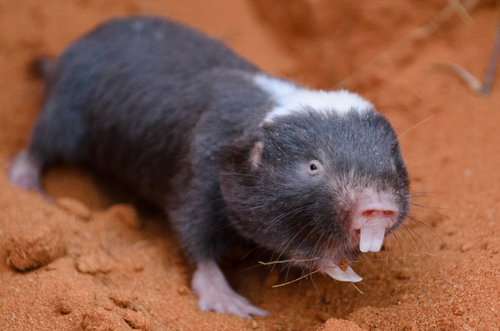
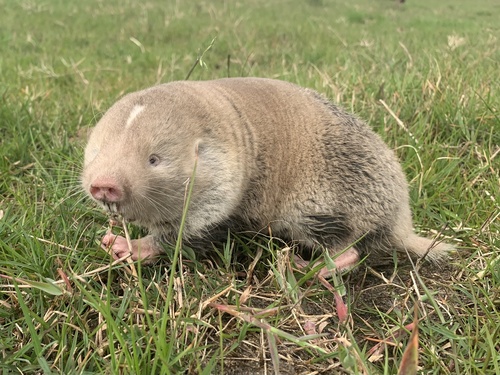
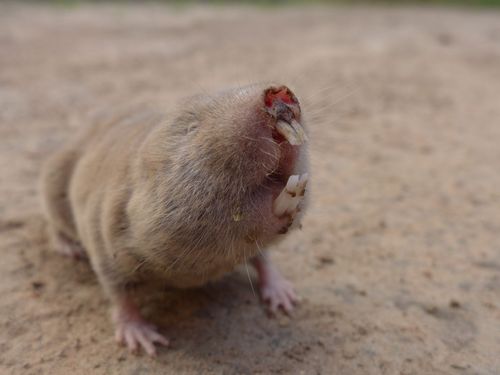
Has short, dense fur that is typically grayish-brown to dark brown, a cylindrical body shape, small eyes, reduced external ears, and large, protruding incisors used for digging. The limbs are short and robust, adapted for burrowing rather than surface locomotion.
Size
Body length typically ranges from about 12 to 18 cm, not including a short tail of a few centimeters.
Weight
Adults generally weigh between 50 and 150 grams, with breeding individuals sometimes slightly heavier.
Distinctive features
Distinguished from closely related Fukomys species by subtle differences in skull morphology, fur coloration, and genetic markers, as many Fukomys species are cryptic and best differentiated through molecular analysis.
Differences between males and females
Sexual dimorphism is minimal, though breeding females (queens) in some Fukomys species may show slight size differences compared to non-breeding colony members.
Behaviour and diet of the Ghana Mole Rat
Highly social and cooperative, living in family groups or colonies that can range from a few individuals to over a dozen, typically centered around a single breeding pair with non-breeding helpers assisting in colony maintenance.
When it is active
Primarily active underground and can show activity at various times of day, though direct diel patterns are difficult to observe due to its subterranean lifestyle; likely shows bursts of activity for foraging and tunnel maintenance.
Diet
Herbivorous, feeding mainly on underground plant material such as roots, tubers, bulbs, and rhizomes encountered while burrowing.
Communication
Communication likely involves vocalizations such as soft squeaks and chirps, along with tactile and scent cues used within the confined burrow environment to coordinate colony activities.
Interactions with other species
Predators may include snakes and birds of prey that can access burrow entrances, though its subterranean lifestyle offers significant protection; it may also compete indirectly with other burrowing rodents for soil resources.
Role in its ecosystem
Plays a role in soil aeration and turnover through its extensive burrowing activity, which can influence local plant root systems and soil structure in its savanna habitat.
Reproduction and lifecycle
Breeding is typically restricted to a single dominant pair within the colony, with reproduction occurring somewhat opportunistically, often linked to favorable soil moisture conditions; gestation is estimated around 2-3 months with litters of a few pups.
Raising the young
Young are raised communally within the colony, with non-breeding colony members assisting in care, burrow maintenance, and protection of pups until they mature.
Maturity and lifespan
Sexual maturity is likely reached within the first year or two of life, with lifespan estimated at several years in the wild, potentially longer in captivity, though exact figures are not well documented.
Taxonomy and naming of the Ghana Mole Rat
Classification
Class Mammalia > Order Rodentia > Family Bathyergidae > Genus Fukomys > Species Fukomys zechi
Scientific synonyms
Cryptomys zechi (former genus placement before Bathyergidae taxonomy revision)
What research says
Recent studies
Recent taxonomic and molecular studies on the Bathyergidae family have helped clarify the phylogenetic placement of Fukomys zechi within the broader mole-rat radiation in West Africa.
Genome and DNA
Genus Fukomys has been used in comparative genomic studies related to social evolution and longevity in rodents, though species-specific genomic data for F. zechi is limited.
Compared with similar species
Similar to other Fukomys species such as Fukomys mechowii or Fukomys anselli, but distinguished by its restricted Ghanaian range and specific genetic lineage, whereas many congeners occur further east and south in Africa.
The Ghana Mole Rat and people
Ghana mole rats live almost their entire lives underground, rarely if ever surfacing; they belong to one of the few mammal groups exhibiting a social structure comparable to insect colonies, with cooperative breeding and division of labor.
Where and how to see it
Due to its strictly subterranean lifestyle, direct observation in the wild is extremely difficult; researchers typically study this species through live-trapping in agricultural areas of central Ghana or by excavating burrow systems.
Risks to humans
No notable risk to humans.
Human uses
Not commonly used by humans, though as with other mole-rats it may occasionally be considered an agricultural pest in cultivated fields due to root and tuber consumption.
Countries where the Ghana Mole Rat is recorded
The 1 countries named in the range description of its IUCN Red List assessment.
Questions about the Ghana Mole Rat
Where does the Ghana Mole Rat live?
The Ghana Mole Rat is recorded in Ghana across Africa. These countries come from the range description of its IUCN Red List assessment, and they are what place the species on the interactive map.
Is the Ghana Mole Rat endangered?
The IUCN Red List assesses the Ghana Mole Rat as Least Concern. The species is widespread and abundant enough not to qualify for any threatened category. It does not mean the species is safe forever, only that nothing in the current data raises an alarm.
How many are left in the wild?
No precise population estimate exists, but the species is considered locally common within its restricted Ghanaian range; overall trend is presumed stable. This figure comes from the species assessment on the IUCN Red List; population estimates for wild mammals are ranges, not counts, and are revised at each assessment.
What habitat does the Ghana Mole Rat live in?
Inhabits savanna and transitional forest-savanna mosaic zones with friable, well-drained soils suitable for burrowing.
What is the scientific name of the Ghana Mole Rat?
The Ghana Mole Rat is Fukomys zechi, in the family Bathyergidae, order Rodentia.
Other species in the genus Fukomys
Other species in the family Bathyergidae
Species that share its range

Sources
Conservation status, range description and population estimate come from the IUCN Red List assessment for Fukomys zechi. Countries are derived from that range description, not from a mapped country list. Last refreshed on .
The distribution map is drawn from the IUCN Red List spatial data compiled in 2008. IUCN (International Union for Conservation of Nature)