
Molina's Grass Mouse
Akodon molinae
Red List assessment
Least Concernon the IUCN Red List
- EXExtinct
- EWExtinct in the Wild
- CRCritically Endangered
- ENEndangered
- VUVulnerable
- NTNear Threatened
- LCLeast Concern
The Molina's Grass Mouse is recorded in one country, Argentina across South America. The IUCN Red List assesses the Molina's Grass Mouse as Least Concern. No precise global population estimate is available.
- Family
- Cricetidae
- Order
- Rodentia
- Genus
- Akodon
- Countries recorded
- 1
- Continents
- South America
- Red List category
- Least Concern
- Data updated
- August 9, 2026
What is the Molina's Grass Mouse?
Molina's Grass Mouse is a small, ground-dwelling sigmodontine rodent endemic to Argentina. It inhabits open grasslands, shrublands, and Monte desert ecotones in central and southern Argentina. Like other members of the Akodon genus, it is a generalist omnivore well-adapted to arid and semi-arid open habitats. It was first described by Contreras in 1968 and is named in honor of the Argentine naturalist tradition.
Where does the Molina's Grass Mouse live?
Central and southern Argentina, primarily in the provinces of Buenos Aires, La Pampa, Río Negro, Neuquén, and Mendoza
Endemic to Argentina; range spans the provinces of Buenos Aires (southern portions), La Pampa, Río Negro, Neuquén, and parts of Mendoza. Its distribution corresponds broadly to the Monte desert and Patagonian transition zones of central-western Argentina.
Altitude and depth
Typically found at low to moderate altitudes, roughly 0–1500 m above sea level, primarily across lowland plains and piedmont zones of central Argentina.
Seasonal movements
No documented long-distance migration or true hibernation. Activity and reproduction may be seasonally modulated, with higher breeding intensity during spring and summer when food resources are more abundant.
Habitat of the Molina's Grass Mouse
Primarily occupies open grasslands (pampas), Monte desert shrublands, and transitional ecotones between humid pampas and Patagonian steppe. It favors areas with dense ground cover such as tussock grasses and low shrubs that provide shelter and foraging opportunities.
Adaptations to its environment
Its compact body form and relatively short tail help minimize heat loss in exposed arid environments. Dense, countershaded pelage provides camouflage against predators in open grassland settings. Its generalist diet allows it to exploit variable food availability characteristic of semi-arid ecosystems.
Conservation status and numbers
Least Concern (LC) on the IUCN Red List. The species has a reasonably wide distribution within Argentina and is not considered to be undergoing rapid population decline. No major range-wide threats currently meet the threshold for a higher threat category.
Estimated population
No precise global population estimate is available. The population trend is considered stable, with no evidence of significant decline at a range-wide scale.
What threatens the Molina's Grass Mouse?
Agricultural expansion and intensification of land use in the pampas region pose the primary threats through habitat loss and degradation. Pesticide and rodenticide use in farming areas may reduce local populations. Overgrazing by livestock can degrade grassland structure and reduce suitable cover.
Diseases and parasites
May carry hantaviruses (as documented for several South American Akodon species), making it of potential public health interest. Ectoparasites including fleas (Siphonaptera), mites (Acari), and lice (Phthiraptera) have been documented on congeners and are likely present on this species as well.
What is being done to protect it?
The species occurs within several provincial protected areas in Argentina. It benefits from general Argentine wildlife protection legislation. No dedicated conservation program specifically targets this species.
Recommended actions
Monitoring of population trends in areas subject to agricultural intensification is advisable. Reducing indiscriminate rodenticide use in its range would benefit this and other non-target small mammals. Maintaining native grassland corridors within farmland would help sustain connectivity between populations.
What the Molina's Grass Mouse looks like
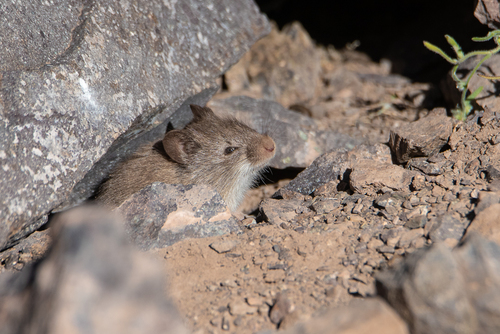
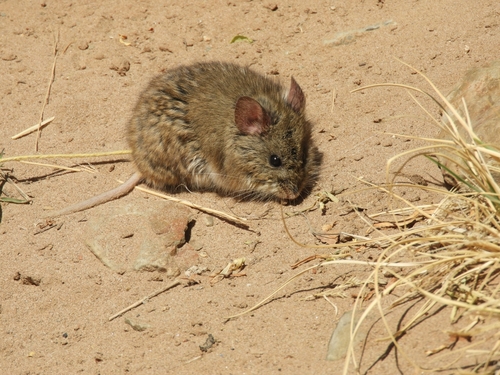
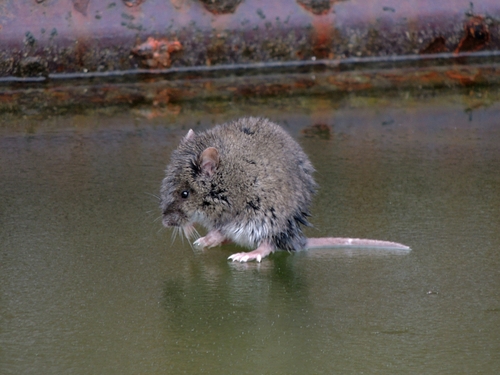
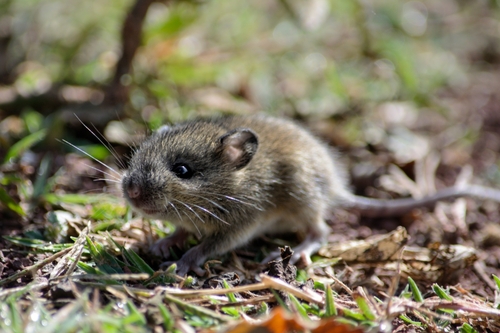
Dorsal fur is brownish-gray to ochraceous-brown, often with darker guard hairs giving a slightly grizzled appearance. The ventral surface is paler, grayish-white to creamy. The tail is bicolored (darker above, paler below) and moderately haired. Eyes are small and black; ears are rounded and moderately sized.
Size
Head-body length approximately 85–120 mm; tail length approximately 60–90 mm (shorter than head-body, typical for Akodon). Hindfoot length approximately 18–22 mm.
Weight
Typically 15–35 g; no strong documented sexual dimorphism in mass, though males may average slightly larger.
Distinctive features
Distinguished from closely related Akodon species by its relatively robust build, specific karyotypic characteristics, and geographic range in central-southern Argentina. Compared to Akodon azarae (which overlaps marginally), A. molinae tends to occupy drier, more arid habitats and may show subtle cranial morphological differences.
Differences between males and females
Sexual dimorphism is minimal in this species. Males may be marginally heavier on average, but external morphology is nearly identical between sexes. Like several Akodon species, XY sex-reversed females have been documented in the genus, a phenomenon potentially relevant to this species.
Behaviour and diet of the Molina's Grass Mouse
Primarily solitary outside of the breeding season. Individuals maintain small home ranges within grassland patches. Mild agonistic interactions occur between individuals sharing overlapping territories, particularly among males.
When it is active
Mainly nocturnal and crepuscular, with peak activity shortly after dusk and before dawn. Daytime activity is limited and mostly confined to covered microhabitats such as dense grass tussocks or burrow systems.
Diet
Omnivorous; diet includes seeds (particularly grass seeds), green plant material, invertebrates (beetles, orthopterans, larvae), and occasionally fungi or detritus. The proportion of animal versus plant material may shift seasonally depending on availability.
How it feeds and hunts
Forages on the ground by actively searching through leaf litter and soil for invertebrates, and gathering seeds from grass stems and the soil surface. Uses olfaction heavily to locate food items under substrate.
Communication
Uses ultrasonic vocalizations for communication, particularly between mother and offspring. Scent marking via urine and glandular secretions is used to delineate home ranges and signal reproductive status. Body postures and tail movements convey agonistic or submissive signals.
Interactions with other species
Preyed upon by raptors (e.g., barn owl Tyto alba, Swainson's hawk), snakes, and small carnivorous mammals such as weasels and the Patagonian weasel. Competes with other small rodents (Calomys, Oligoryzomys spp.) for seeds and invertebrate resources. May serve as a host for ectoparasites shared with livestock.
Role in its ecosystem
Functions as an important prey item supporting local raptor and carnivore populations. Contributes to seed dispersal and soil disturbance through burrowing and caching behavior. As an invertebrate consumer, it plays a minor role in regulating arthropod populations in grassland ecosystems.
Reproduction and lifecycle
Breeding occurs mainly in spring and summer (October–March in the Southern Hemisphere). Gestation lasts approximately 21–23 days (as typical for Akodon). Litter size ranges from 2 to 6 pups, with an average of around 3–4.
Raising the young
Altricial young are born blind and hairless. The female provides primary parental care, nursing and thermoregulating pups in a grass-lined nest within a burrow or dense vegetation. Young become independent within 3–4 weeks.
Maturity and lifespan
Sexual maturity is reached at approximately 2–3 months of age. Wild lifespan is typically 1–2 years due to high predation pressure; maximum lifespan in captivity for related Akodon species can reach 3–4 years.
Taxonomy and naming of the Molina's Grass Mouse
Classification
Mammalia > Rodentia > Cricetidae > Akodon > Akodon molinae
Scientific synonyms
Sometimes listed historically under broader Akodon groupings; no widely recognized synonyms established in recent literature.
What research says
Recent studies
Phylogeographic studies of southern South American Akodon have refined the species boundaries and population structure of A. molinae in relation to its congeners. Molecular analyses have helped clarify its distinction from Akodon iniscatus and related forms. No major behavioral or ecological studies specifically focused on this species have been published recently.
Genome and DNA
Diploid chromosome number for Akodon molinae is reported as 2n = 38 in some studies, though karyotypic variation is common in the genus. The Akodon genus is notable for the occurrence of XY females (sex reversal) linked to a Y-chromosome deletion, a phenomenon studied across multiple species in this group.
Compared with similar species
Akodon molinae is most closely related to Akodon iniscatus (the dark-snouted grass mouse), with which it shares overlapping range in some areas but differs in karyotype and subtle morphological traits. It is also similar to Akodon azarae but tends to occupy drier habitats and has a more southern and western distribution.
The Molina's Grass Mouse and people
Like several of its relatives, Akodon molinae belongs to a genus notorious among mammalogists for 'sex-reversed' females that carry a Y chromosome yet develop as phenotypic females — a remarkable quirk of genetics. Despite being a small and inconspicuous rodent, it is a cornerstone prey species for iconic Argentine raptors like the barn owl. The Akodon genus is one of the most species-rich rodent genera in South America, with over 40 recognized species, making it a key group for understanding Neotropical mammal diversification.
Where and how to see it
Best observed at night in open grasslands and shrublands of central Patagonia and the Monte desert region, particularly in Río Negro and La Pampa provinces of Argentina. Small mammal live-trapping studies at research stations in these areas offer the best chance of encountering this species. Owl pellet analysis near barn owl roosts is another effective indirect method for detecting its presence.
Risks to humans
Potential carrier of hantavirus, as documented for related Akodon species in South America; direct contact with wild individuals or their excreta should be avoided. No significant bite risk under normal circumstances. Generally considered low risk to humans.
Countries where the Molina's Grass Mouse is recorded
The 1 countries named in the range description of its IUCN Red List assessment.
Questions about the Molina's Grass Mouse
Where does the Molina's Grass Mouse live?
The Molina's Grass Mouse is recorded in Argentina across South America. These countries come from the range description of its IUCN Red List assessment, and they are what place the species on the interactive map.
Is the Molina's Grass Mouse endangered?
The IUCN Red List assesses the Molina's Grass Mouse as Least Concern. The species is widespread and abundant enough not to qualify for any threatened category. It does not mean the species is safe forever, only that nothing in the current data raises an alarm.
How many are left in the wild?
No precise global population estimate is available. This figure comes from the species assessment on the IUCN Red List; population estimates for wild mammals are ranges, not counts, and are revised at each assessment.
What habitat does the Molina's Grass Mouse live in?
Primarily occupies open grasslands (pampas), Monte desert shrublands, and transitional ecotones between humid pampas and Patagonian steppe.
What is the scientific name of the Molina's Grass Mouse?
The Molina's Grass Mouse is Akodon molinae, in the family Cricetidae, order Rodentia.
Other species in the genus Akodon

Other species in the family Cricetidae
Sources
Conservation status, range description and population estimate come from the IUCN Red List assessment for Akodon molinae. Countries are derived from that range description, not from a mapped country list. Last refreshed on .
The distribution map is drawn from the IUCN Red List spatial data compiled in 2008. IUCN (International Union for Conservation of Nature)