
Blazed Luzon Chrotomys
Chrotomys silaceus
Red List assessment
Least Concernon the IUCN Red List
- EXExtinct
- EWExtinct in the Wild
- CRCritically Endangered
- ENEndangered
- VUVulnerable
- NTNear Threatened
- LCLeast Concern
The Blazed Luzon Chrotomys is recorded in one country, Philippines across Asia. The IUCN Red List assesses the Blazed Luzon Chrotomys as Least Concern. No precise population estimate exists, but the species is considered locally common within suitable habitat; overall trend is presumed stable due to persistence in protected mountain forests.
- Family
- Muridae
- Order
- Rodentia
- Genus
- Chrotomys
- Countries recorded
- 1
- Continents
- Asia
- Red List category
- Least Concern
- Data updated
- August 9, 2026
What is the Blazed Luzon Chrotomys?
Chrotomys silaceus, known as the Blazed Luzon Chrotomys, is a distinctive shrew-rat endemic to the montane forests of Luzon Island in the Philippines. It belongs to a unique group of Philippine murine rodents adapted to a specialized earthworm-eating diet, unusual among rodents. The species is notable for its striking facial and dorsal stripe pattern, which gives it a 'blazed' appearance. It is remarkable as part of the highly endemic and ecologically specialized Philippine old-endemic rodent fauna.
Where does the Blazed Luzon Chrotomys live?
Endemic to the island of Luzon, Philippines, primarily known from mountainous regions of the Bicol Peninsula and central-southern Luzon.
Restricted to the island of Luzon in the Philippines, with confirmed populations recorded on mountains such as Mt. Isarog and other peaks in the Bicol Peninsula region of southern Luzon.
Altitude and depth
Typically found at elevations between 1000 and 2000 meters above sea level in montane forest zones.
Seasonal movements
No significant migratory behavior is known; activity may fluctuate slightly with the wet and dry seasons affecting earthworm abundance in the leaf litter.
Habitat of the Blazed Luzon Chrotomys
Primarily inhabits primary and secondary montane and mossy tropical forests with thick leaf litter and moist soil, which support the earthworms that form its main food source. It is also found in disturbed forest edges but prefers undisturbed, humid forest floor habitats.
Adaptations to its environment
Possesses elongated snout and specialized dentition adapted for probing soil and leaf litter to locate earthworms. Its cryptic striped coloration provides camouflage against the forest floor, while strong claws aid in digging through moist substrate.
Conservation status and numbers
Listed as Least Concern (LC) by the IUCN, reflecting its relatively stable population and occurrence within protected montane forest habitats, though it has a naturally restricted range.
Estimated population
No precise population estimate exists, but the species is considered locally common within suitable habitat; overall trend is presumed stable due to persistence in protected mountain forests.
What threatens the Blazed Luzon Chrotomys?
Primary threats include habitat loss from deforestation, agricultural encroachment, and logging in lowland and montane forests of Luzon, which could fragment its restricted range over time.
Diseases and parasites
Specific disease and parasite data for this species are not well documented, though like other rodents it likely hosts various ectoparasites such as mites and fleas.
What is being done to protect it?
Benefits indirectly from protection within Mt. Isarog Natural Park and other protected areas on Luzon that conserve montane forest ecosystems.
Recommended actions
Continued protection and expansion of montane forest reserves, monitoring of population trends, and prevention of further deforestation in Luzon's highland ecosystems are recommended.
What the Blazed Luzon Chrotomys looks like
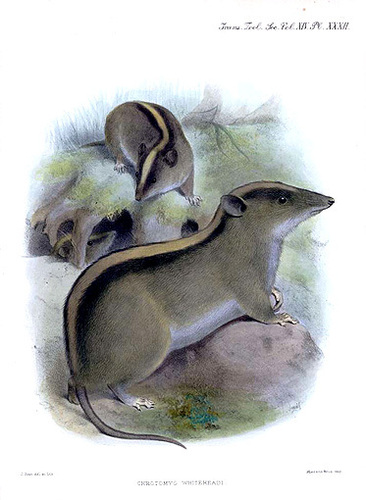
The species has soft, dense fur that is generally brownish or grayish, with a distinctive pale or 'blazed' stripe running along the head and back, contrasting with darker surrounding fur. The tail is typically dark and sparsely haired.
Size
Body length (head and body) typically ranges from 140 to 180 mm, with a tail roughly equal to or slightly shorter than body length.
Weight
Adults typically weigh between 80 and 150 grams.
Distinctive features
Distinguished from related Chrotomys species by the specific pattern and width of its dorsal blaze stripe, as well as subtle differences in skull and dental morphology used by taxonomists for species identification.
Differences between males and females
Minimal sexual dimorphism has been documented; males and females are similar in size and coloration.
Behaviour and diet of the Blazed Luzon Chrotomys
Generally considered solitary or living in low-density populations, with limited direct observation of social structure in the wild.
When it is active
Primarily nocturnal or crepuscular, foraging on the forest floor during low-light hours to search for earthworms and other soil invertebrates.
Diet
Highly specialized diet centered on earthworms, supplemented by other soil invertebrates such as insect larvae; considered a vermivore among the specialized 'earthworm mice' of the Philippines.
How it feeds and hunts
Uses its elongated snout and sensitive whiskers to probe leaf litter and soft soil, detecting earthworms likely through scent and tactile cues before extracting and consuming them.
Communication
Communication likely involves scent marking and tactile cues typical of nocturnal forest rodents; vocalizations are not well documented for this species.
Interactions with other species
Likely preyed upon by forest raptors, snakes, and small carnivores; may compete with other small mammals for invertebrate food resources in the leaf litter ecosystem.
Role in its ecosystem
Plays an ecological role as a specialized invertebrate predator, helping regulate earthworm and soil invertebrate populations while itself serving as prey within the montane forest food web.
Reproduction and lifecycle
Specific breeding season data is limited, but like related Chrotomys species, reproduction likely occurs opportunistically with small litters given the low reproductive rate typical of montane forest rodents.
Raising the young
Presumed maternal care similar to other murine rodents, with females nursing and protecting altricial young in nest sites within burrows or dense leaf litter until weaning.
Maturity and lifespan
Exact age of sexual maturity is unknown; wild lifespan is presumed to be relatively short, likely 1-3 years, consistent with similarly sized murine rodents.
Taxonomy and naming of the Blazed Luzon Chrotomys
Classification
Class Mammalia > Order Rodentia > Family Muridae > Genus Chrotomys > Species Chrotomys silaceus
Scientific synonyms
Previously classified under broader Chrotomys whiteheadi complex before being recognized as a distinct species; some older literature may list it as Chrotomys sp. from Isarog.
What research says
Recent studies
Recent taxonomic and phylogenetic studies on Philippine Chrotomys species have helped clarify species boundaries and evolutionary relationships within this endemic earthworm-eating rodent radiation.
Compared with similar species
Compared to its close relative Chrotomys whiteheadi, C. silaceus differs in the extent and shape of its dorsal blaze stripe and in cranial measurements, while both share the specialized vermivorous ecology unique to the genus.
The Blazed Luzon Chrotomys and people
This species belongs to one of the few rodent lineages worldwide that has evolved a specialized diet of earthworms, essentially filling a niche similar to shrews despite being a true rodent. Its striking facial 'blaze' stripe gives it a unique and easily recognizable appearance among Philippine forest rodents.
Where and how to see it
Best observed at night in undisturbed montane forest areas such as Mt. Isarog Natural Park, using careful trapping or camera-trap surveys, as the species is elusive and rarely seen during daylight.
Risks to humans
No notable risk to humans; it is a small, non-aggressive forest rodent.
Countries where the Blazed Luzon Chrotomys is recorded
The 1 countries named in the range description of its IUCN Red List assessment.
Questions about the Blazed Luzon Chrotomys
Where does the Blazed Luzon Chrotomys live?
The Blazed Luzon Chrotomys is recorded in Philippines across Asia. These countries come from the range description of its IUCN Red List assessment, and they are what place the species on the interactive map.
Is the Blazed Luzon Chrotomys endangered?
The IUCN Red List assesses the Blazed Luzon Chrotomys as Least Concern. The species is widespread and abundant enough not to qualify for any threatened category. It does not mean the species is safe forever, only that nothing in the current data raises an alarm.
How many are left in the wild?
No precise population estimate exists, but the species is considered locally common within suitable habitat; overall trend is presumed stable due to persistence in protected mountain forests. This figure comes from the species assessment on the IUCN Red List; population estimates for wild mammals are ranges, not counts, and are revised at each assessment.
What habitat does the Blazed Luzon Chrotomys live in?
Primarily inhabits primary and secondary montane and mossy tropical forests with thick leaf litter and moist soil, which support the earthworms that form its main food source.
What is the scientific name of the Blazed Luzon Chrotomys?
The Blazed Luzon Chrotomys is Chrotomys silaceus, in the family Muridae, order Rodentia.
Other species in the genus Chrotomys



Other species in the family Muridae
Species that share its range
Sources
Conservation status, range description and population estimate come from the IUCN Red List assessment for Chrotomys silaceus. Countries are derived from that range description, not from a mapped country list. Last refreshed on .
The distribution map is drawn from the IUCN Red List spatial data compiled in 2008. IUCN (International Union for Conservation of Nature)