
Dinagat Bushy-tailed Cloud Rat
Crateromys australis
Red List assessment
Endangeredon the IUCN Red List
- EXExtinct
- EWExtinct in the Wild
- CRCritically Endangered
- ENEndangered
- VUVulnerable
- NTNear Threatened
- LCLeast Concern
The Dinagat Bushy-tailed Cloud Rat is recorded in one country, Philippines across Asia. The IUCN Red List assesses the Dinagat Bushy-tailed Cloud Rat as Endangered. No reliable population estimate exists; the species is considered extremely rare with a presumed declining trend due to continued habitat degradation.
- Family
- Muridae
- Order
- Rodentia
- Genus
- Crateromys
- Countries recorded
- 1
- Continents
- Asia
- Red List category
- Endangered
- Data updated
- August 9, 2026
What is the Dinagat Bushy-tailed Cloud Rat?
The Dinagat Bushy-tailed Cloud Rat is a large arboreal rodent endemic to Dinagat Island in the Philippines, known for its long bushy tail and dense soft fur. It is one of the rarest and least-studied members of the cloud rat group, with very few confirmed specimens ever recorded. Its restricted range and dependence on old-growth forest make it a flagship species for Philippine island conservation.
Where does the Dinagat Bushy-tailed Cloud Rat live?
Dinagat Island, Surigao del Norte province, Philippines
Endemic to Dinagat Island, part of the Caraga region in the southern Philippines, within the Philippine biodiversity hotspot. Its range is extremely limited, likely covering only remaining forest fragments on the island.
Altitude and depth
Approximately 0-800 meters above sea level, mainly in lowland to lower montane forest zones.
Seasonal movements
No known migratory behavior; likely maintains year-round activity within its forest home range, though breeding may peak with fruiting seasons.
Habitat of the Dinagat Bushy-tailed Cloud Rat
It inhabits lowland and lower montane tropical rainforest, particularly areas with tall trees offering hollows and dense canopy cover. It is strongly associated with primary or minimally disturbed forest, as it depends on large trees for nesting and foraging.
Adaptations to its environment
Its prehensile-like bushy tail aids balance while moving through tree branches, and strong claws allow secure climbing. Nocturnal habits and cryptic coloration help it avoid predators in a dense forest environment.
Conservation status and numbers
Classified as Endangered (EN) by the IUCN due to its extremely restricted range, ongoing habitat loss, and very small, poorly documented population. The species is known from only a handful of specimens, raising concern about its true rarity and vulnerability.
Estimated population
No reliable population estimate exists; the species is considered extremely rare with a presumed declining trend due to continued habitat degradation.
What threatens the Dinagat Bushy-tailed Cloud Rat?
Primary threats include deforestation from logging and mining operations on Dinagat Island, habitat conversion for agriculture, and small-scale hunting. Mining concessions in particular threaten remaining forest patches critical to its survival.
What is being done to protect it?
Some forest areas on Dinagat Island have protected status under Philippine biodiversity laws, and the island has been the focus of conservation advocacy due to mining conflicts. However, specific programs targeting this species are minimal or nonexistent.
Recommended actions
Priority actions include conducting updated field surveys to confirm population status, protecting remaining primary forest from mining and logging, and establishing community-based conservation initiatives on Dinagat Island.
What the Dinagat Bushy-tailed Cloud Rat looks like
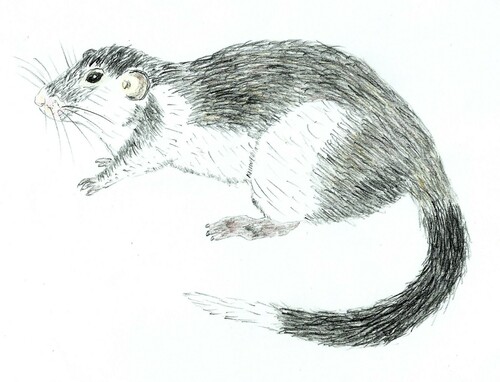
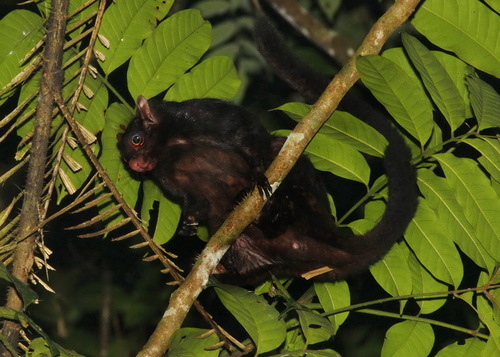
It has soft, dense fur typically in brown to grayish tones, with a notably long, bushy tail covered in longer hairs. Its body is robust with a rounded head and large eyes suited to nocturnal vision.
Size
Body length is estimated around 30-40 cm, with a bushy tail of similar or greater length, though exact measurements are poorly documented due to scarcity of specimens.
Weight
Estimated weight likely falls between 500-900 grams, based on comparisons with related Crateromys species, though precise data is lacking.
Distinctive features
Distinguished from other cloud rats by subtle differences in skull morphology, fur coloration, and tail bushiness, along with its strict endemism to Dinagat Island.
Behaviour and diet of the Dinagat Bushy-tailed Cloud Rat
Believed to be largely solitary or living in small family groups, consistent with other arboreal cloud rats, though direct behavioral observations are extremely limited.
When it is active
Nocturnal, spending daylight hours resting in tree hollows or dense vegetation and becoming active after dusk to forage.
Diet
Herbivorous, feeding primarily on leaves, fruits, seeds, and bark found in the forest canopy and understory.
Communication
Likely uses vocalizations, scent marking, and tactile cues typical of nocturnal rodents, though specific studies on this species are lacking.
Interactions with other species
Potential predators include large snakes, raptors, and possibly introduced carnivores; it may compete with other arboreal mammals for food and nesting sites.
Role in its ecosystem
As a forest-dwelling herbivore, it likely contributes to seed dispersal and vegetation dynamics within its limited island ecosystem.
Reproduction and lifecycle
Reproductive biology is poorly documented, but likely involves small litters of one to two offspring, consistent with other cloud rat species, possibly timed with fruiting seasons.
Raising the young
Presumed maternal care similar to related species, with the mother nursing and protecting young in a tree hollow nest until independence.
Maturity and lifespan
Specific data unavailable; related cloud rat species reach maturity within one year and may live several years in the wild, though captive lifespan data does not exist for this species.
Taxonomy and naming of the Dinagat Bushy-tailed Cloud Rat
Classification
Mammalia > Rodentia > Muridae > Crateromys > Crateromys australis
What research says
Recent studies
Recent conservation reports have highlighted concerns over mining impacts on Dinagat Island's forests, indirectly emphasizing the urgent need for further research on this poorly known species.
Compared with similar species
Compared to the more widely known Northern Luzon Giant Cloud Rat (Phloeomys pallidus), this species is smaller and far more range-restricted, with almost no ecological data available.
The Dinagat Bushy-tailed Cloud Rat and people
It is one of the rarest rodents in the world, known from very few museum specimens. Its entire known range is confined to a single small Philippine island threatened by mining activity.
Where and how to see it
Observation is extremely difficult due to its rarity and nocturnal, arboreal habits; any sightings would require guided expeditions into remaining primary forest on Dinagat Island at night.
Risks to humans
No notable risk to humans.
Countries where the Dinagat Bushy-tailed Cloud Rat is recorded
The 1 countries named in the range description of its IUCN Red List assessment.
Questions about the Dinagat Bushy-tailed Cloud Rat
Where does the Dinagat Bushy-tailed Cloud Rat live?
The Dinagat Bushy-tailed Cloud Rat is recorded in Philippines across Asia. These countries come from the range description of its IUCN Red List assessment, and they are what place the species on the interactive map.
Is the Dinagat Bushy-tailed Cloud Rat endangered?
Yes. The IUCN Red List assesses the Dinagat Bushy-tailed Cloud Rat as Endangered, one of the three threatened categories. The species faces a very high risk of extinction in the wild — a step below Critically Endangered, but still on a trajectory that ends badly without intervention.
How many are left in the wild?
No reliable population estimate exists; the species is considered extremely rare with a presumed declining trend due to continued habitat degradation. This figure comes from the species assessment on the IUCN Red List; population estimates for wild mammals are ranges, not counts, and are revised at each assessment.
What habitat does the Dinagat Bushy-tailed Cloud Rat live in?
It inhabits lowland and lower montane tropical rainforest, particularly areas with tall trees offering hollows and dense canopy cover.
What is the scientific name of the Dinagat Bushy-tailed Cloud Rat?
The Dinagat Bushy-tailed Cloud Rat is Crateromys australis, in the family Muridae, order Rodentia.
Other species in the genus Crateromys
Other species in the family Muridae
Species that share its range
Sources
Conservation status, range description and population estimate come from the IUCN Red List assessment for Crateromys australis. Countries are derived from that range description, not from a mapped country list. Last refreshed on .
The distribution map is drawn from the IUCN Red List spatial data compiled in 2024. IUCN SSC Small Mammal Specialist Group