
Linné's Two-toed Sloth
Choloepus didactylus
Red List assessment
Least Concernon the IUCN Red List
- EXExtinct
- EWExtinct in the Wild
- CRCritically Endangered
- ENEndangered
- VUVulnerable
- NTNear Threatened
- LCLeast Concern
The Linné's Two-toed Sloth is recorded in 8 countries across South America. The IUCN Red List assesses the Linné's Two-toed Sloth as Least Concern. No precise global population figure exists, but the species is considered common and widespread within suitable habitat; overall trend is believed to be stable to slightly declining due to habitat loss.
- Family
- Megalonychidae
- Order
- Pilosa
- Genus
- Choloepus
- Countries recorded
- 8
- Continents
- South America
- Red List category
- Least Concern
- Data updated
- August 9, 2026
What is the Linné's Two-toed Sloth?
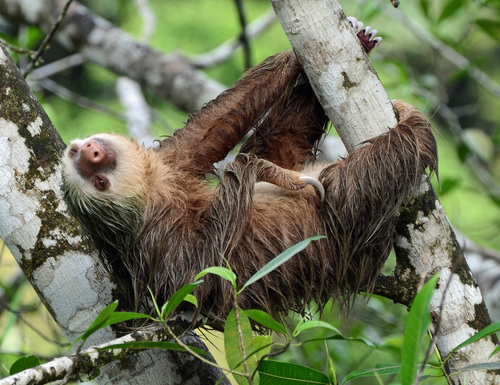
Linné's Two-toed Sloth is a slow-moving arboreal mammal native to the tropical rainforests of northern South America. It spends the vast majority of its life hanging upside down in trees, using its long limbs and curved claws for locomotion and feeding. Remarkable for its extremely low metabolic rate and cryptic, algae-covered fur, it is one of the few mammals adapted almost entirely to an inverted lifestyle in the forest canopy.
Where does the Linné's Two-toed Sloth live?
Northern South America, primarily the Amazon Basin region including Venezuela, Guyana, Suriname, French Guiana, Brazil, Ecuador, Peru, and Colombia.
Found throughout the Amazon Basin and Guiana Shield, spanning Venezuela, Guyana, Suriname, French Guiana, northern Brazil, eastern Ecuador, eastern Peru, and southern Colombia.
Altitude and depth
Typically found from sea level up to around 1,500 meters elevation, though most populations occur in lowland tropical forest below 1,000 m.
Seasonal movements
No true migration or hibernation; however, activity levels can fluctuate slightly with rainfall patterns and food availability during wet versus dry seasons.
Habitat of the Linné's Two-toed Sloth
Primarily found in tropical rainforests, including lowland and montane forest, as well as secondary forest and forest edges near rivers. It prefers dense canopy cover that provides continuous access to foliage without needing to descend to the ground.
Adaptations to its environment
Exceptionally low metabolic rate and body temperature conserve energy on a nutrient-poor leaf diet. Long forelimbs, curved claws, and specialized tendons allow permanent suspension from branches with minimal muscular effort, while symbiotic algae growing in its fur provide camouflage against predators.
Conservation status and numbers
Listed as Least Concern (LC) by the IUCN due to its wide distribution and relatively stable population across much of the Amazon Basin, though localized declines occur from habitat loss.
Estimated population
No precise global population figure exists, but the species is considered common and widespread within suitable habitat; overall trend is believed to be stable to slightly declining due to habitat loss.
What threatens the Linné's Two-toed Sloth?
Main threats include deforestation for agriculture and logging, habitat fragmentation, road mortality, and illegal pet trade capture. Climate change-driven forest degradation is an emerging concern.
Diseases and parasites
Known to host specific sloth moths, mites, and ticks, as well as susceptibility to certain gastrointestinal parasites; some individuals in captivity have been documented with respiratory infections.
What is being done to protect it?
Protected in numerous national parks and reserves across its range, including areas in the Amazon and Guiana Shield. It is also the focus of rehabilitation and rescue centers, particularly in Suriname and Guyana, that treat orphaned or injured individuals.
Recommended actions
Continued protection of contiguous rainforest habitat, stricter enforcement against illegal wildlife trade, and expanded research on population density and health monitoring are recommended priorities.
What the Linné's Two-toed Sloth looks like
Its fur is coarse, long, and grayish-brown to blondish, often tinged green from symbiotic algae growth. It has a rounded head, small eyes, no visible external ears, and two long claws on each forelimb versus three on the hindlimb.
Size
Body length typically ranges from 54 to 74 cm, not including the vestigial tail which is nearly absent.
Weight
Adults typically weigh between 4 and 8 kg, with no marked size difference between males and females.
Distinctive features
Distinguished from three-toed sloths by having only two claws on the forelimbs (versus three), a more elongated snout, and generally larger body size. It also lacks the facial mask pattern typical of three-toed sloth species.
Behaviour and diet of the Linné's Two-toed Sloth
Largely solitary, coming together only briefly for mating; overlapping home ranges may occur but with minimal social interaction between individuals.
When it is active
Primarily nocturnal to crepuscular, spending 15-18 hours a day resting or sleeping in trees and being active mainly during nighttime hours for feeding and movement.
Diet
Herbivorous, feeding mainly on leaves, buds, shoots, and occasionally fruit and flowers from a variety of canopy tree species. It has a specialized multi-chambered stomach for slow fermentation of tough plant fiber.
Communication
Communication is generally limited, relying on soft vocalizations, scent marking through urine/feces at specific latrine sites, and occasional distress calls when threatened.
Interactions with other species
Natural predators include harpy eagles, jaguars, ocelots, and large snakes; the species also hosts a unique ecosystem of algae, fungi, and moths within its fur, forming a mutualistic microhabitat.
Role in its ecosystem
Plays a minor but notable ecological role as a folivore that recycles nutrients through descending to defecate at the base of trees, indirectly supporting soil fertility and supporting specialized moth species that breed in its fur.
Reproduction and lifecycle
Breeding can occur year-round without a strict defined season; gestation lasts approximately 6 months (about 183 days), longer than in three-toed sloths, and females give birth to a single offspring.
Raising the young
The mother carries and nurses the single infant continuously on her belly for several months, teaching it which plants to eat before gradual independence around 6-9 months of age.
Maturity and lifespan
Sexual maturity is typically reached around 3-5 years of age; lifespan in the wild is estimated at 20-30 years, while captive individuals have been recorded living over 40 years.
Taxonomy and naming of the Linné's Two-toed Sloth
Classification
Class Mammalia > Order Pilosa > Family Megalonychidae > Genus Choloepus > Species Choloepus didactylus
Scientific synonyms
Bradypus didactylus (original Linnaean classification)
What research says
Recent studies
Recent research has focused on sloth fur microbiomes, thermoregulation strategies, and movement ecology using GPS tracking to better understand home range size and canopy connectivity needs.
Genome and DNA
The species has a diploid chromosome number of 2n=64latitude; genomic studies remain limited compared to more heavily studied mammals, though some sequencing work has aided comparative Xenarthran phylogenetics.
Compared with similar species
Compared to the three-toed sloth genus Bradypus, Choloepus didactylus is larger, lacks a fixed number of neck vertebrae limiting head rotation, and has only two forelimb claws versus three, along with generally faster movement capability.
The Linné's Two-toed Sloth and people
Its fur hosts a miniature ecosystem including algae, moths, and fungi found nowhere else in nature. Despite being famously slow, it can rotate its head nearly 180 degrees and is a surprisingly capable swimmer.
Where and how to see it
Best observed at night in the rainforest canopy of Guyana, Suriname, or the Ecuadorian Amazon using guided eco-tours with spotlighting techniques, as daytime sightings are rare due to camouflage and stillness.
Risks to humans
No notable risk to humans under normal circumstances, though they can deliver a defensive bite or scratch with their claws if handled or threatened.
Human uses
Occasionally kept as exotic pets or used in wildlife tourism/education programs; historically hunted in some areas for meat, though this practice has significantly declined.
Countries where the Linné's Two-toed Sloth is recorded
The 8 countries named in the range description of its IUCN Red List assessment.
Questions about the Linné's Two-toed Sloth
Where does the Linné's Two-toed Sloth live?
The Linné's Two-toed Sloth is recorded in Brazil, Colombia, Ecuador, French Guiana and Guyana, among 8 countries in total across South America. These countries come from the range description of its IUCN Red List assessment, and they are what place the species on the interactive map.
Is the Linné's Two-toed Sloth endangered?
The IUCN Red List assesses the Linné's Two-toed Sloth as Least Concern. The species is widespread and abundant enough not to qualify for any threatened category. It does not mean the species is safe forever, only that nothing in the current data raises an alarm.
How many are left in the wild?
No precise global population figure exists, but the species is considered common and widespread within suitable habitat; overall trend is believed to be stable to slightly declining due to habitat loss. This figure comes from the species assessment on the IUCN Red List; population estimates for wild mammals are ranges, not counts, and are revised at each assessment.
What habitat does the Linné's Two-toed Sloth live in?
Primarily found in tropical rainforests, including lowland and montane forest, as well as secondary forest and forest edges near rivers.
What is the scientific name of the Linné's Two-toed Sloth?
The Linné's Two-toed Sloth is Choloepus didactylus, in the family Megalonychidae, order Pilosa.
Other species in the genus Choloepus
Species that share its range


Sources
Conservation status, range description and population estimate come from the IUCN Red List assessment for Choloepus didactylus. Countries are derived from that range description, not from a mapped country list. Last refreshed on .
The distribution map is drawn from the IUCN Red List spatial data compiled in 2011. IUCN (International Union for Conservation of Nature)