
Koford's Grass Mouse
Akodon kofordi
Red List assessment
Least Concernon the IUCN Red List
- EXExtinct
- EWExtinct in the Wild
- CRCritically Endangered
- ENEndangered
- VUVulnerable
- NTNear Threatened
- LCLeast Concern
The Koford's Grass Mouse is recorded in 2 countries across South America. The IUCN Red List assesses the Koford's Grass Mouse as Least Concern. No precise global population estimate exists.
- Family
- Cricetidae
- Order
- Rodentia
- Genus
- Akodon
- Countries recorded
- 2
- Continents
- South America
- Red List category
- Least Concern
- Data updated
- August 9, 2026
What is the Koford's Grass Mouse?
Koford's Grass Mouse is a small, ground-dwelling rodent of the family Cricetidae endemic to the high-altitude puna grasslands of the southern Peruvian and northwestern Bolivian Andes. It belongs to the highly diverse genus Akodon, which contains over 40 species across South America. The species was formally described in 1989 and named in honor of the American biologist Carl B. Koford. It is well adapted to the cold, open grassland environments characteristic of Andean altiplano zones.
Where does the Koford's Grass Mouse live?
Southern Peru (Departments of Puno, Cusco, Arequipa) and northwestern Bolivia (Department of La Paz); restricted to the high Andes puna zone.
Known from southern Peru, particularly the Department of Puno around the Lake Titicaca basin and surrounding highlands, extending into Cusco and possibly Arequipa. Its range extends into northwestern Bolivia in the La Paz Department. Distribution is patchy and tied to suitable puna grassland habitats.
Altitude and depth
Typically found between 3,500 and 5,000 meters above sea level, with most records concentrated between 3,800 and 4,500 m in the puna zone of the Andes.
Seasonal movements
No documented large-scale seasonal migrations. Activity patterns may shift subtly between wet and dry seasons in response to food availability and temperature extremes, but the species appears to be a year-round resident of its range. No hibernation has been recorded.
Habitat of the Koford's Grass Mouse
Primarily inhabits puna grassland, a high-altitude tropical grassland and shrubland biome dominated by bunch grasses such as Festuca and Stipa. It is also found in rocky areas, moist grass-sedge meadows (bofedales), and scrubby transition zones near forest edges. This species tolerates cold, semi-arid to moist conditions typical of the Andean plateau.
Adaptations to its environment
Like other high-Andean Akodon, it likely has physiological adaptations for living at altitude including increased blood oxygen-carrying capacity. Its dense, relatively thick fur provides insulation against cold temperatures. Burrowing and use of grass tussocks for cover help it survive harsh Andean winters and avoid predators.
Conservation status and numbers
Listed as Least Concern (LC) by the IUCN. The species has a reasonably wide distribution across suitable puna habitat, and no dramatic population decline has been detected. Its occurrence in relatively remote high-altitude terrain affords it some protection from direct human disturbance.
Estimated population
No precise global population estimate exists. Population trend is presumed stable, as there is no evidence of significant decline. Local densities are typical for small Andean rodents and likely fluctuate with seasonal resource availability.
What threatens the Koford's Grass Mouse?
The primary threats include overgrazing by livestock (cattle, sheep, and camelids) which degrades puna grassland habitats, agricultural expansion at high altitudes, and climate change which is altering the distribution and quality of high Andean ecosystems. Mining activities in the Andes also pose localized threats to habitat integrity.
Diseases and parasites
Like other South American rodents, it is likely host to a range of ectoparasites (fleas, mites, ticks) and endoparasites (helminths, protozoa). Some Akodon species serve as reservoir hosts for hantaviruses and other zoonotic pathogens, though specific data for A. kofordi are lacking.
What is being done to protect it?
Protected indirectly within several Peruvian and Bolivian protected areas that encompass puna habitat, including the Titicaca National Reserve and various regional reserves. National biodiversity laws in Peru and Bolivia provide broad legal protection to native fauna. No species-specific conservation program exists.
Recommended actions
Continued monitoring of population status and distribution using live-trapping surveys. Improved management of grazing pressure in key puna habitats. Broader assessment of the impacts of climate change on high-Andean small mammal communities. Taxonomic and phylogeographic studies to clarify the species' boundaries and genetic diversity.
What the Koford's Grass Mouse looks like
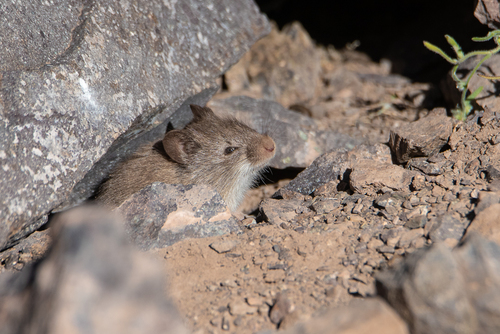
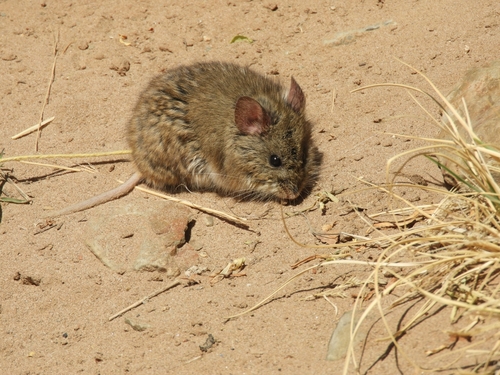
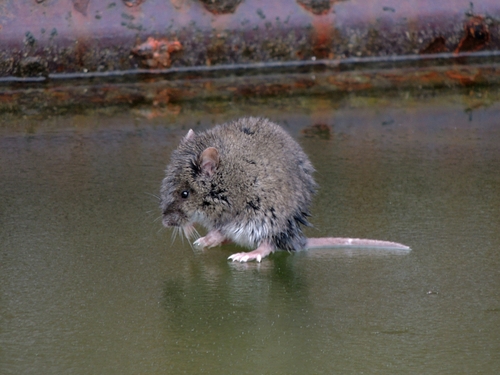
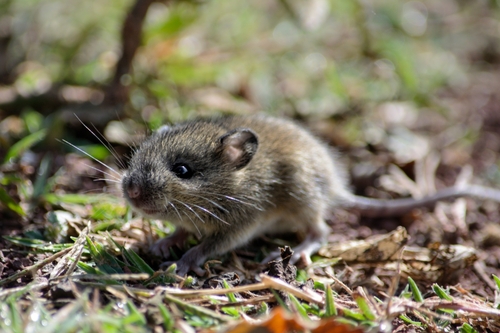
Dorsal fur is medium to dark brownish, often with a slightly grizzled appearance due to black-tipped guard hairs. Ventral fur is grayish-white to pale buff. The tail is bicolored, darker above and paler below. Eyes are small and dark; ears are moderate in size and rounded.
Size
Total body length approximately 95–125 mm; tail length approximately 60–85 mm; hindfoot approximately 18–22 mm. A typical small Akodon of moderate size for the genus.
Weight
Estimated body mass approximately 15–30 grams; sexual dimorphism in weight is minimal. No precise sex-specific weight data published.
Distinctive features
Distinguished from closely related species such as Akodon boliviensis and Akodon subfuscus by subtle differences in cranial morphology, particularly in the shape of the interparietal bone and zygomatic arch, as well as by karyotype and molecular characters. External morphology alone is insufficient for definitive identification in the field.
Differences between males and females
Sexual dimorphism is minimal; males and females are similar in size and coloration. As in many Akodon species, males may be very slightly larger on average than females.
Behaviour and diet of the Koford's Grass Mouse
Presumed to be largely solitary outside of the breeding season, as is typical for most Akodon species. Individuals likely maintain small home ranges and display some territorial behavior. No evidence of permanent pair bonding or complex social groups.
When it is active
Primarily nocturnal to crepuscular, with peak activity occurring at dusk, dawn, and during the night. This pattern helps avoid diurnal avian predators such as raptors common in Andean grasslands.
Diet
Omnivorous, with a diet consisting primarily of seeds, green plant material, and invertebrates such as insects and earthworms. Like other Akodon, it likely opportunistically exploits available food resources according to season. Arthropods may constitute a higher proportion of the diet during warmer, wetter months.
How it feeds and hunts
Forages on the ground among grass tussocks and under rocks, using its sensitive vibrissae and olfactory senses to locate food items. Invertebrates are likely caught by quick pursuit or gleaning from vegetation and soil surfaces. No specialized hunting techniques are documented.
Communication
Likely communicates via ultrasonic vocalizations used especially during social encounters and reproduction, as documented in related Akodon species. Scent marking with urine and glandular secretions is probable and may play a role in territory advertisement and mate attraction.
Interactions with other species
Likely prey for Andean raptors (Geranoaetus melanoleucus, Buteo species), owls (Tyto alba, Bubo virginianus), and terrestrial predators such as the Andean fox (Lycalopex culpaeus) and Pampas cat (Leopardus colocolo). Potential competition exists with sympatric small rodents such as Phyllotis and other Akodon species.
Role in its ecosystem
Functions as a secondary consumer and seed disperser within the puna ecosystem. As a prey item for numerous predators, it forms an important link in Andean food webs. Its burrowing and foraging activities contribute to soil turnover and plant community dynamics.
Reproduction and lifecycle
Breeding biology is not precisely documented for this species. By analogy with congeners in comparable habitats, reproduction likely peaks during the wet season (October–March). Gestation is estimated at approximately 21–23 days, with litter sizes of 2–6 young, typical for the genus.
Raising the young
Maternal care is primary, as in other Akodon. The female nurses and protects the altricial young in a grass-lined nest within a burrow or dense tussock. Young are weaned at approximately 2–3 weeks of age and reach independence shortly thereafter.
Maturity and lifespan
Sexual maturity is likely reached at approximately 2–3 months of age, consistent with other Akodon. Wild lifespan is estimated at 1–2 years; captive individuals of related species may survive up to 3 years.
Taxonomy and naming of the Koford's Grass Mouse
Classification
Mammalia > Rodentia > Cricetidae > Akodon > Akodon kofordi
Scientific synonyms
No widely recognized synonyms; originally described as Akodon kofordi by Myers and Patton (1989). Sometimes placed near the Akodon boliviensis species group in older literature.
What research says
Recent studies
Molecular phylogenetic studies of the genus Akodon (e.g., Pardiñas et al., Jayat et al.) have helped clarify the position of A. kofordi within the boliviensis species group and confirmed its validity as a distinct species based on genetic data. Distributional surveys in southern Peru continue to refine its known range.
Genome and DNA
Karyotype has not been definitively published for this species. Related members of the Akodon boliviensis group typically have diploid numbers around 2n=40. The genus Akodon is notable for high karyotypic variability, including sex chromosome polymorphisms with XY females occurring in some species.
Compared with similar species
Akodon kofordi is most closely related to Akodon boliviensis (Bolivian Grass Mouse) and Akodon subfuscus (Puno Grass Mouse), with which it is broadly sympatric. It differs from these species primarily in cranial dimensions and molecular markers. All three inhabit similar high-altitude puna habitats and are morphologically very similar.
The Koford's Grass Mouse and people
Koford's Grass Mouse survives at altitudes above 4,000 meters where nighttime temperatures can drop well below freezing, making it one of the hardiest small mammals on Earth. The genus Akodon includes species with XY females — a rare mammalian phenomenon where genetic males develop as females — though this has not been confirmed in A. kofordi specifically. Despite being named after a prominent biologist, this mouse went largely unstudied for decades after its formal description in 1989.
Where and how to see it
Best observed at night using spotlighting or live-trapping methods along grass-sedge meadows and rocky puna grasslands near the Lake Titicaca basin in Puno, Peru. The dry season (April–September) may offer better trapping success as vegetation cover is reduced. The area around the Titicaca National Reserve and Desaguadero corridor is a recommended survey site.
Risks to humans
No notable direct risk to humans. As with all wild rodents in South America, there is a theoretical risk of zoonotic disease transmission (e.g., hantavirus) through contact with urine or droppings; standard precautions are recommended when handling wild-caught specimens.
Countries where the Koford's Grass Mouse is recorded
The 2 countries named in the range description of its IUCN Red List assessment.
Questions about the Koford's Grass Mouse
Where does the Koford's Grass Mouse live?
The Koford's Grass Mouse is recorded in Bolivia and Peru across South America. These countries come from the range description of its IUCN Red List assessment, and they are what place the species on the interactive map.
Is the Koford's Grass Mouse endangered?
The IUCN Red List assesses the Koford's Grass Mouse as Least Concern. The species is widespread and abundant enough not to qualify for any threatened category. It does not mean the species is safe forever, only that nothing in the current data raises an alarm.
How many are left in the wild?
No precise global population estimate exists. This figure comes from the species assessment on the IUCN Red List; population estimates for wild mammals are ranges, not counts, and are revised at each assessment.
What habitat does the Koford's Grass Mouse live in?
Primarily inhabits puna grassland, a high-altitude tropical grassland and shrubland biome dominated by bunch grasses such as Festuca and Stipa.
What is the scientific name of the Koford's Grass Mouse?
The Koford's Grass Mouse is Akodon kofordi, in the family Cricetidae, order Rodentia.
Other species in the genus Akodon

Other species in the family Cricetidae
Sources
Conservation status, range description and population estimate come from the IUCN Red List assessment for Akodon kofordi. Countries are derived from that range description, not from a mapped country list. Last refreshed on .
The distribution map is drawn from the IUCN Red List spatial data compiled in 2008. IUCN (International Union for Conservation of Nature)