
Junin Grass Mouse
Akodon juninensis
Red List assessment
Least Concernon the IUCN Red List
- EXExtinct
- EWExtinct in the Wild
- CRCritically Endangered
- ENEndangered
- VUVulnerable
- NTNear Threatened
- LCLeast Concern
The Junin Grass Mouse is recorded in one country, Peru across South America. The IUCN Red List assesses the Junin Grass Mouse as Least Concern. No precise global population estimate is available.
- Family
- Cricetidae
- Order
- Rodentia
- Genus
- Akodon
- Countries recorded
- 1
- Continents
- South America
- Red List category
- Least Concern
- Data updated
- August 9, 2026
What is the Junin Grass Mouse?
Akodon juninensis is a small, ground-dwelling sigmodontine rodent endemic to the high puna grasslands of central Peru. It was formally described by Myers, Patton & Smith in 1990 from specimens collected in the Junín department. Like other members of the genus Akodon, it is a fossorial-tendential small mouse adapted to cold, open Andean habitats. It is remarkable for surviving in one of the most climatically demanding highland environments in South America, the altiplano puna above 3,500 meters.
Where does the Junin Grass Mouse live?
Central Andes of Peru, primarily in the Junín department and adjacent highland regions
Endemic to Peru; known from the central Andean highlands, principally the Junín plateau (including areas around Lago Chinchaycocha/Lake Junín), and likely extending into adjacent portions of the Pasco and Huancavelica departments. Its full range is not completely mapped, but appears restricted to central Peru's high Andes.
Altitude and depth
Typically found between 3,500 and 4,800 meters above sea level, within the puna biome. It is most frequently recorded in the core puna zone around 3,800–4,400 m.
Seasonal movements
No documented long-distance migrations or hibernation. Activity patterns may shift seasonally in response to the distinct wet season (October–April) and dry season (May–September) of the Andean puna, with potential changes in food availability and reproductive timing.
Habitat of the Junin Grass Mouse
Primarily inhabits puna grasslands (wet and dry), including tussock grass (ichu) meadows and the margins of bofedales (high-altitude wetlands). It also uses rocky outcrops, shrubby patches, and disturbed agricultural borders at high elevation. This species is strongly associated with open, herbaceous highland habitats rather than forested or shrub-dominated zones.
Adaptations to its environment
Has physiological adaptations typical of high-altitude small mammals, including increased lung capacity and blood oxygen-carrying efficiency. Dense, insulating fur provides protection against the extreme cold and diurnal temperature fluctuations of the puna. Fossorial and semi-fossorial burrowing behavior helps avoid temperature extremes and predators.
Conservation status and numbers
Listed as Least Concern (LC) by the IUCN, indicating the species does not currently meet criteria for a threatened category. The population is assumed to be relatively stable, with no documented severe declines, though monitoring data are limited.
Estimated population
No precise global population estimate is available. Trend is assumed stable under current LC assessment, but quantitative data are lacking for this poorly studied species.
What threatens the Junin Grass Mouse?
Primary threats include overgrazing by livestock (cattle, sheep, and llamas), which degrades puna grassland habitat. Agricultural expansion into highland zones, burning of grasslands for pasture renewal, and potential long-term impacts of climate change on Andean ecosystems pose additional risks. Water management around Lake Junín and associated wetlands may affect local habitat quality.
Diseases and parasites
Likely hosts fleas (Siphonaptera), mites (Acarina), and internal helminths typical of Andean sigmodontine rodents. May carry hantaviruses, as several South American Akodon species are known reservoir hosts, though specific data for A. juninensis are lacking.
What is being done to protect it?
The species benefits indirectly from the Reserva Nacional de Junín, a protected area surrounding Lake Junín that encompasses part of its habitat. Peru's national wildlife legislation provides general protection. No species-specific conservation programs are known to be in place.
Recommended actions
Conduct systematic population surveys to establish baseline abundance and distribution data. Strengthen enforcement and habitat management within the Reserva Nacional de Junín. Assess impacts of livestock grazing and implement rotational grazing practices. Monitor for climate-driven habitat shifts in puna ecosystems.
What the Junin Grass Mouse looks like
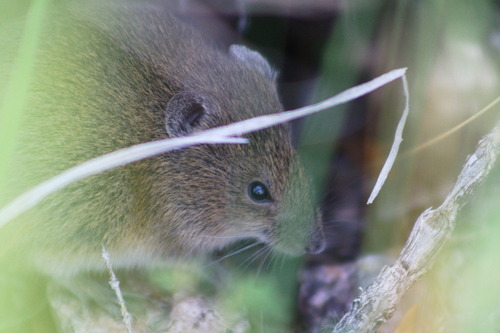
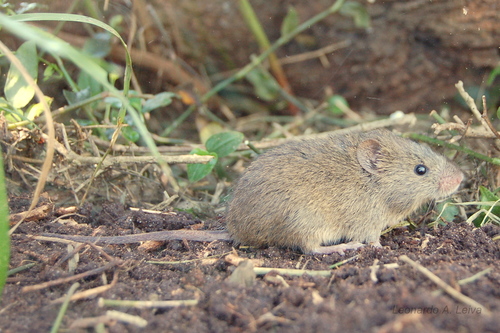
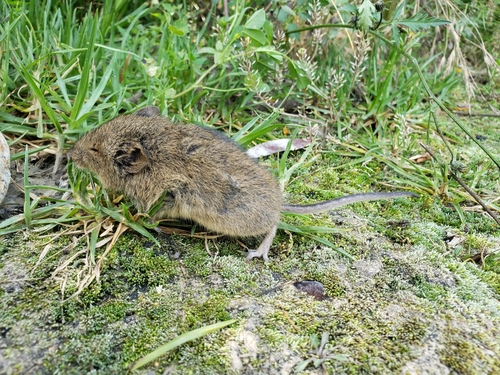
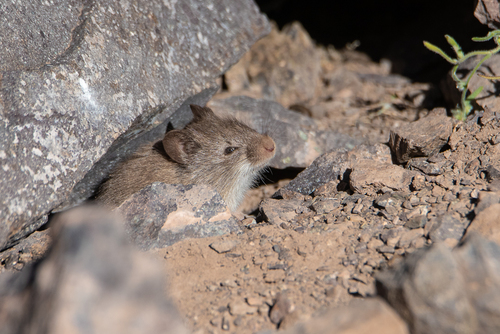
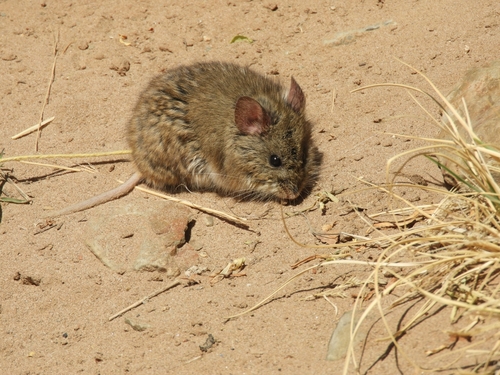
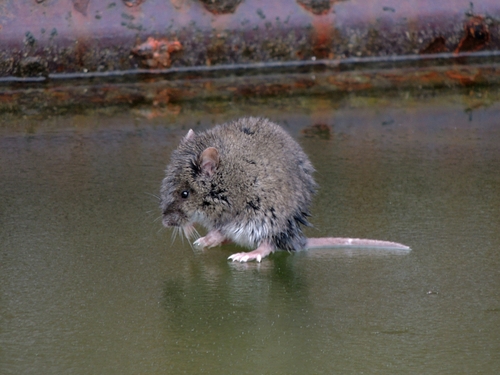
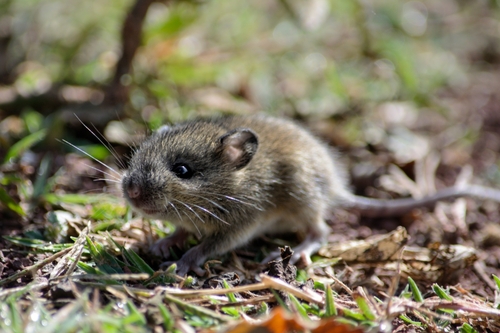
Dorsal pelage is brownish to grayish-brown, often with a somewhat darker mid-dorsal stripe. The ventral surface is paler, typically grayish-white to ochraceous. The tail is bicolored (darker above, paler below) and relatively short. Eyes are small and ears are moderately sized, partially hidden by fur.
Size
Head-body length approximately 85–115 mm; tail length approximately 60–90 mm; hind foot approximately 19–23 mm. A small mouse, typical in size for the Akodon genus.
Weight
Approximately 20–40 grams; sexual size dimorphism is minimal, with males and females of similar weight.
Distinctive features
Distinguished from closely related species such as Akodon boliviensis and Akodon subfuscus by subtle differences in cranial morphology (notably braincase shape and zygomatic structure), karyotype, and geographic range. Molecular characters are the most reliable distinguishing tool at the species level within this complex group.
Differences between males and females
Sexual dimorphism is minimal. Males and females are similar in body size and coloration, as is typical for the Akodon genus.
Behaviour and diet of the Junin Grass Mouse
Likely solitary or loosely social outside the breeding season, as is typical for most Akodon species. Males may maintain overlapping home ranges with females. No documented complex social hierarchy.
When it is active
Primarily nocturnal and crepuscular, with peak activity during the night to avoid diurnal avian predators. May show some daytime activity during overcast conditions or during the breeding season.
Diet
Omnivorous, consuming seeds, green plant material (grasses, forbs), roots, and invertebrates such as insects and worms. The proportion of animal versus plant matter in the diet may vary seasonally with resource availability in the puna.
How it feeds and hunts
Forages on the ground and through grass tussocks, using its sensitive vibrissae to detect invertebrate prey. Seeds and plant matter are gathered by direct harvesting from stems or from the soil surface. Occasional digging to access roots or subterranean invertebrates.
Communication
Uses ultrasonic vocalizations for communication, especially between mother and offspring. Scent marking via urine and specialized glands likely plays a role in territorial and mate-recognition signaling. Whisker (vibrissae) use is important for tactile communication and navigation in dense grass.
Interactions with other species
Predated upon by Andean foxes (Lycalopex culpaeus), Pampas cats, and various raptors including the Aplomado Falcon and American Kestrel. Competes for resources with other sympatric small rodents such as Akodon subfuscus and Phyllotis species. May serve as an intermediate host for Andean ectoparasites and helminths.
Role in its ecosystem
Plays an important role as a prey item in the puna food web, supporting populations of foxes and raptors. Acts as a seed disperser and soil aerator through burrowing and foraging activity. Contributes to invertebrate population control through predation.
Reproduction and lifecycle
Breeding is likely to occur during or shortly after the wet season (October–April) when food resources are most abundant, though opportunistic breeding may occur year-round. Gestation period is estimated at approximately 20–23 days, typical for the genus. Litter size is generally 2–5 young.
Raising the young
Altricial young are born in a grass-lined nest within a burrow or dense vegetation. The female provides primary parental care, nursing young through a weaning period of approximately 2–3 weeks. Males do not appear to play a significant role in direct offspring care.
Maturity and lifespan
Sexual maturity is likely reached at approximately 2–3 months of age, consistent with related Akodon species. Wild lifespan is estimated at 1–2 years; captive individuals may live up to 3 years under optimal conditions.
Taxonomy and naming of the Junin Grass Mouse
Classification
Mammalia > Rodentia > Cricetidae > Akodon > Akodon juninensis
Scientific synonyms
Previously considered potentially synonymous with Akodon boliviensis by some authors before formal description; no widely accepted synonyms post-1990 description.
What research says
Recent studies
The species was formally described relatively recently (1990) and remains poorly studied. Research on the Akodon boliviensis group using molecular systematics has helped clarify species boundaries and evolutionary relationships within this complex. No major recent studies focused exclusively on A. juninensis are known.
Genome and DNA
The genus Akodon is notable for extreme karyotypic diversity; diploid chromosome numbers range from 2n=10 to 2n=44 across the genus. The specific karyotype of A. juninensis has not been definitively published in widely available literature. Molecular phylogenetic studies place it within the Akodon boliviensis species group.
Compared with similar species
Most closely related to Akodon boliviensis and Akodon subfuscus within the Andean Akodon complex. Compared to A. boliviensis, A. juninensis is restricted to a narrower geographic range in central Peru. It differs from A. subfuscus in cranial dimensions and occurs at slightly different elevational ranges. All three species share generalist omnivorous diets and puna grassland habitats.
The Junin Grass Mouse and people
The Junín region of Peru, from which this mouse takes its name, hosts one of the highest navigable lakes in the world, Lake Junín, located at about 4,100 m — sharing its landscape with this tiny rodent. Despite its small size, Akodon grass mice are among the most speciose mammalian genera in South America, with over 40 recognized species. The genus Akodon holds a world record of sorts for karyotypic diversity among mammals, making genetic studies of this group particularly fascinating.
Where and how to see it
Best observed in the puna grasslands around the Reserva Nacional de Junín in central Peru, particularly in areas of tussock grass and near bofedal wetland margins. Night surveys using small live-traps (Sherman traps) baited with oats or peanut butter are the most effective method. The dry season (May–September) may offer better trapping success due to reduced vegetation density.
Risks to humans
No notable direct risk to humans. As with all wild rodents, handling should be avoided due to the potential, though unconfirmed for this species, of carrying hantavirus or other zoonotic pathogens.
Countries where the Junin Grass Mouse is recorded
The 1 countries named in the range description of its IUCN Red List assessment.
Questions about the Junin Grass Mouse
Where does the Junin Grass Mouse live?
The Junin Grass Mouse is recorded in Peru across South America. These countries come from the range description of its IUCN Red List assessment, and they are what place the species on the interactive map.
Is the Junin Grass Mouse endangered?
The IUCN Red List assesses the Junin Grass Mouse as Least Concern. The species is widespread and abundant enough not to qualify for any threatened category. It does not mean the species is safe forever, only that nothing in the current data raises an alarm.
How many are left in the wild?
No precise global population estimate is available. This figure comes from the species assessment on the IUCN Red List; population estimates for wild mammals are ranges, not counts, and are revised at each assessment.
What habitat does the Junin Grass Mouse live in?
Primarily inhabits puna grasslands (wet and dry), including tussock grass (ichu) meadows and the margins of bofedales (high-altitude wetlands).
What is the scientific name of the Junin Grass Mouse?
The Junin Grass Mouse is Akodon juninensis, in the family Cricetidae, order Rodentia.
Other species in the genus Akodon

Other species in the family Cricetidae
Sources
Conservation status, range description and population estimate come from the IUCN Red List assessment for Akodon juninensis. Countries are derived from that range description, not from a mapped country list. Last refreshed on .
The distribution map is drawn from the IUCN Red List spatial data compiled in 2008. IUCN (International Union for Conservation of Nature)