
Intelligent Grass Mouse
Akodon iniscatus
Red List assessment
Least Concernon the IUCN Red List
- EXExtinct
- EWExtinct in the Wild
- CRCritically Endangered
- ENEndangered
- VUVulnerable
- NTNear Threatened
- LCLeast Concern
The Intelligent Grass Mouse is recorded in one country, Argentina across South America. The IUCN Red List assesses the Intelligent Grass Mouse as Least Concern. No precise global population estimate exists; the population is considered stable overall, though local densities may fluctuate significantly with rainfall and vegetation productivity.
- Family
- Cricetidae
- Order
- Rodentia
- Genus
- Akodon
- Countries recorded
- 1
- Continents
- South America
- Red List category
- Least Concern
- Data updated
- August 9, 2026
What is the Intelligent Grass Mouse?
Akodon iniscatus, the Intelligent Grass Mouse, is a small South American rodent belonging to the diverse and ecologically successful genus Akodon. It inhabits the arid and semi-arid shrublands and steppes of northern Patagonia and the Monte desert in Argentina. Its common name derives from its scientific epithet 'iniscatus,' rooted in Latin meaning roughly 'not foolish' or shrewd. Like other grass mice, it plays an important role in ecosystem functioning as both a consumer of plant material and a prey item for numerous predators.
Where does the Intelligent Grass Mouse live?
Argentina (Patagonia and Monte desert regions, primarily Río Negro, Neuquén, Chubut, and La Pampa provinces)
Endemic to Argentina; its range spans the northern Patagonian steppe and Monte desert ecoregions, including the provinces of Río Negro, Neuquén, Chubut, and La Pampa, with possible occurrences in southwestern Buenos Aires province.
Altitude and depth
Typically found from near sea level up to approximately 1,500 m elevation, depending on the terrain of the Monte and Patagonian steppe regions.
Seasonal movements
No long-distance migrations are known. Activity and reproductive output may be seasonally influenced by temperature and food availability, with reduced surface activity during the coldest Patagonian winter months.
Habitat of the Intelligent Grass Mouse
This species primarily occupies arid and semi-arid shrublands (Monte desert scrub), Patagonian steppe grasslands, and transitional zones between these habitats. It is associated with low, sparse shrub cover, tussock grasses, and sandy or rocky soils that offer shelter and foraging opportunities.
Adaptations to its environment
Adapted to arid conditions through efficient water metabolism and the ability to exploit sparse, patchy vegetation. Its cryptic brownish-gray coloration provides camouflage against dry steppe soils, and it shelters in burrows or dense shrub root systems to avoid temperature extremes and predators.
Conservation status and numbers
Listed as Least Concern (LC) by the IUCN. The species has a sufficiently wide distribution within its Argentine range and tolerates a variety of arid habitat types, and no evidence of rapid population decline has been documented.
Estimated population
No precise global population estimate exists; the population is considered stable overall, though local densities may fluctuate significantly with rainfall and vegetation productivity.
What threatens the Intelligent Grass Mouse?
Habitat degradation from overgrazing by sheep and goats, agricultural expansion into shrubland margins, invasive plant species altering native vegetation structure, and secondary poisoning from rodenticide campaigns targeting pest rodents in agricultural areas.
Diseases and parasites
Like other sigmodontine rodents, it may harbor hantaviruses, ectoparasites (fleas, mites, ticks), and intestinal helminths, though specific parasite records for this species are limited in the literature.
What is being done to protect it?
The species occurs within several protected areas in Patagonia, including national parks and provincial reserves. Argentine national biodiversity legislation offers general protection. No species-specific conservation program is known.
Recommended actions
Monitoring of population trends in areas subject to intensive livestock grazing; restriction of broad-spectrum rodenticide use in agricultural zones; further taxonomic and ecological research to clarify range boundaries and population structure.
What the Intelligent Grass Mouse looks like
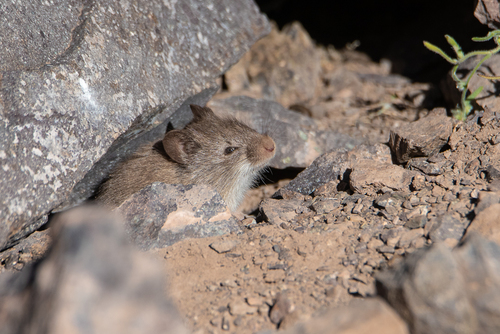
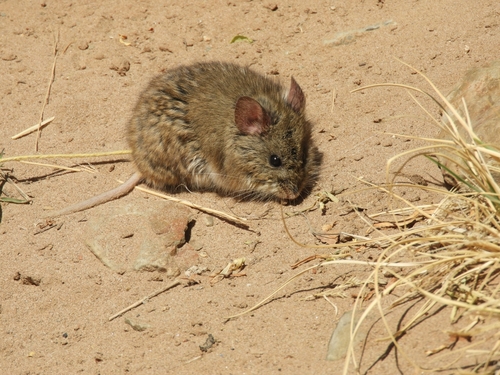
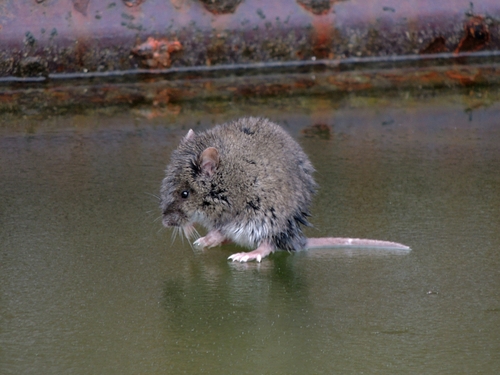
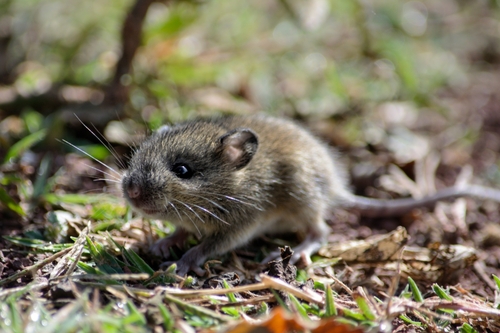
Dorsal fur is grayish-brown to olive-brown, providing effective camouflage in dry steppe environments. The ventral surface is paler gray or whitish. The tail is relatively short compared to body length, sparsely haired, and bicolored (darker above, paler below). The ears are moderate in size and the eyes are small and dark.
Size
Head-body length approximately 80–115 mm; tail length approximately 60–90 mm.
Weight
Typically 15–30 g; sexual size dimorphism is minimal.
Distinctive features
Distinguished from sympatric Akodon species such as A. dolores and A. molinae by subtle differences in skull morphology, molar structure, and fur coloration; precise identification often requires craniodental measurements or molecular analysis.
Differences between males and females
Sexual dimorphism is minimal; males and females are similar in size and coloration, though males may average very slightly larger.
Behaviour and diet of the Intelligent Grass Mouse
Generally solitary outside of breeding season, as is typical for most Akodon grass mice. Individual home ranges overlap minimally, and social interactions are largely restricted to mating encounters.
When it is active
Primarily nocturnal and crepuscular, reducing predation risk from diurnal raptors while exploiting cooler nighttime temperatures in the arid steppe environment.
Diet
Omnivorous; diet consists mainly of seeds, plant material, roots, and invertebrates such as insects and larvae. Resource availability shifts seasonally, with greater reliance on seeds during dry periods.
How it feeds and hunts
Forages opportunistically on the ground surface and among leaf litter, using its sensitive vibrissae to detect invertebrates. It may scratch at soil or bark to uncover hidden food items.
Communication
Uses ultrasonic vocalizations for mother-pup communication and possibly mate attraction. Scent marking via urine and specialized glands may help demarcate home ranges and facilitate mate recognition.
Interactions with other species
Prey for owls (notably Tyto alba and Bubo magellanicus), small raptors, snakes, and carnivorous mammals such as Galictis cuja (lesser grison) and Lycalopex foxes. Competes with sympatric rodents (other Akodon spp., Oligoryzomys spp.) for food resources.
Role in its ecosystem
Serves as an important link in the Patagonian steppe food web as both a consumer of seeds and invertebrates and a primary prey species for numerous vertebrate predators. May contribute modestly to seed dispersal.
Reproduction and lifecycle
Breeding occurs primarily in spring and summer (October–March in the Southern Hemisphere), correlated with increased plant productivity. Gestation is approximately 21–23 days; litter sizes typically range from 2 to 6 pups.
Raising the young
Altricial young are raised in a concealed nest by the female. Pups are weaned at approximately 2–3 weeks of age. Paternal care is not documented, as is typical for the genus.
Maturity and lifespan
Sexual maturity is reached at approximately 6–8 weeks of age. Wild lifespan is likely 1–2 years; captive individuals of related species may live up to 3 years.
Taxonomy and naming of the Intelligent Grass Mouse
Classification
Mammalia > Rodentia > Cricetidae (subfamily Sigmodontinae) > Akodon > Akodon iniscatus
Scientific synonyms
Historically placed under broader Akodon groupings; Thomas, 1919 is the original describer. No widely accepted synonyms currently recognized.
What research says
Recent studies
Phylogeographic studies of the genus Akodon in southern South America have helped clarify species boundaries and colonization histories of Patagonian arid habitats, though A. iniscatus remains relatively understudied compared to commoner congeners.
Genome and DNA
Exact chromosome count for A. iniscatus is not well-documented in available literature; many Akodon species have diploid numbers of 2n = 36–44. Some Akodon species are notable for unusual sex-chromosome systems, but this has not been confirmed for A. iniscatus.
Compared with similar species
Most closely related to other southern-cone Akodon species such as A. dolores and A. molinae. Compared to A. azarae—one of the best-studied grass mice—A. iniscatus is more restricted to arid habitats and has a smaller body size on average. It shares the genus with over 40 described species across South America.
The Intelligent Grass Mouse and people
Its species name 'iniscatus' essentially means 'not foolish' in Latin, making it the self-proclaimed 'intellectual' of the grass mouse world. Grass mice of the genus Akodon are among the most species-rich rodent genera in the world, with new species still being described in the 21st century. Despite living in one of Argentina's harshest environments, this tiny mouse can reproduce several times per season when food conditions are favorable, enabling rapid population recovery.
Where and how to see it
Best observed at night in the Monte shrublands and northern Patagonian steppe of Río Negro and Neuquén provinces, Argentina, using headlamps or spotlights near shrub bases and tussock grass clumps. Spring and early summer (October–December) offer the best chances, when populations peak. Sherman live-trap surveys near rocky outcrops and shrubby washes are the most reliable detection method.
Risks to humans
Like many sigmodontine rodents, there is a theoretical risk of hantavirus transmission through contact with urine, feces, or saliva, though specific documented human cases linked to A. iniscatus are not confirmed. Standard precautions when handling wild rodents are advisable.
Countries where the Intelligent Grass Mouse is recorded
The 1 countries named in the range description of its IUCN Red List assessment.
Questions about the Intelligent Grass Mouse
Where does the Intelligent Grass Mouse live?
The Intelligent Grass Mouse is recorded in Argentina across South America. These countries come from the range description of its IUCN Red List assessment, and they are what place the species on the interactive map.
Is the Intelligent Grass Mouse endangered?
The IUCN Red List assesses the Intelligent Grass Mouse as Least Concern. The species is widespread and abundant enough not to qualify for any threatened category. It does not mean the species is safe forever, only that nothing in the current data raises an alarm.
How many are left in the wild?
No precise global population estimate exists; the population is considered stable overall, though local densities may fluctuate significantly with rainfall and vegetation productivity. This figure comes from the species assessment on the IUCN Red List; population estimates for wild mammals are ranges, not counts, and are revised at each assessment.
What habitat does the Intelligent Grass Mouse live in?
This species primarily occupies arid and semi-arid shrublands (Monte desert scrub), Patagonian steppe grasslands, and transitional zones between these habitats.
What is the scientific name of the Intelligent Grass Mouse?
The Intelligent Grass Mouse is Akodon iniscatus, in the family Cricetidae, order Rodentia.
Other species in the genus Akodon

Other species in the family Cricetidae
Sources
Conservation status, range description and population estimate come from the IUCN Red List assessment for Akodon iniscatus. Countries are derived from that range description, not from a mapped country list. Last refreshed on .
The distribution map is drawn from the IUCN Red List spatial data compiled in 2008. IUCN (International Union for Conservation of Nature)