
Indomalayan Pencil-tailed Tree Mouse
Chiropodomys gliroides
Red List assessment
Least Concernon the IUCN Red List
- EXExtinct
- EWExtinct in the Wild
- CRCritically Endangered
- ENEndangered
- VUVulnerable
- NTNear Threatened
- LCLeast Concern
The Indomalayan Pencil-tailed Tree Mouse is recorded in 8 countries across Asia. The IUCN Red List assesses the Indomalayan Pencil-tailed Tree Mouse as Least Concern. No precise global population estimate exists, but the species is considered common within suitable habitat; overall population trend is believed to be stable.
- Family
- Muridae
- Order
- Rodentia
- Genus
- Chiropodomys
- Countries recorded
- 8
- Continents
- Asia
- Red List category
- Least Concern
- Data updated
- August 9, 2026
What is the Indomalayan Pencil-tailed Tree Mouse?
The Indomalayan Pencil-tailed Tree Mouse is a small, arboreal rodent native to the forests of Southeast Asia, notable for its slender, prehensile-like tail with a tuft of fur at the tip resembling a pencil. It is highly agile in trees and shrubs, using its unique tail and grasping feet for climbing. This species is one of the few murid rodents specialized for a fully arboreal lifestyle in tropical habitats.
Where does the Indomalayan Pencil-tailed Tree Mouse live?
Southeast Asia, including Thailand, Vietnam, Cambodia, Laos, Malaysia, Indonesia, and the Philippines
Widely distributed across mainland and insular Southeast Asia, including Thailand, Vietnam, Cambodia, Laos, Myanmar, Malaysia, Indonesia (Sumatra, Java, Borneo), and parts of the Philippines.
Altitude and depth
Found from sea level up to approximately 1500 meters elevation in forested regions.
Seasonal movements
No strong evidence of migration or hibernation; breeding may be more frequent during wetter seasons when food availability is higher.
Habitat of the Indomalayan Pencil-tailed Tree Mouse
Primarily inhabits tropical and subtropical lowland forests, secondary forests, bamboo groves, and forest edges; also found in plantations, orchards, and sometimes human settlements where trees or bamboo are present.
Adaptations to its environment
Possesses a long, semi-prehensile tail and flexible ankle joints that allow it to grip branches and move nimbly through dense vegetation. Its small size and lightweight body enable it to forage on thin twigs and bamboo stalks inaccessible to larger animals.
Conservation status and numbers
Listed as Least Concern (LC) by the IUCN due to its wide distribution, presumed large population, and tolerance of some habitat disturbance, though local declines may occur with severe deforestation.
Estimated population
No precise global population estimate exists, but the species is considered common within suitable habitat; overall population trend is believed to be stable.
What threatens the Indomalayan Pencil-tailed Tree Mouse?
Habitat loss from deforestation, agricultural expansion, and logging; conversion of forest to plantations may reduce suitable arboreal habitat in some areas.
Diseases and parasites
Like many rodents, it may host external parasites such as mites and ticks, and could be a reservoir for certain zoonotic pathogens, though specific studies are limited.
What is being done to protect it?
No species-specific conservation programs exist; the species benefits indirectly from protected forest areas and national parks across its range countries.
Recommended actions
Continued monitoring of population trends in fragmented habitats, protection of lowland forest and bamboo ecosystems, and further taxonomic research to clarify subspecies status.
What the Indomalayan Pencil-tailed Tree Mouse looks like
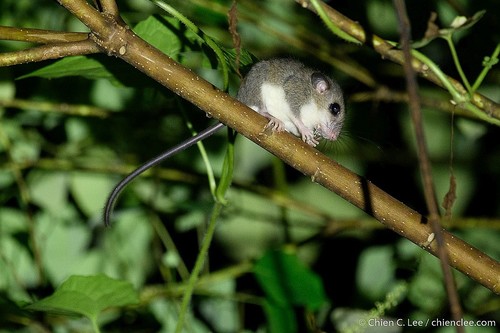
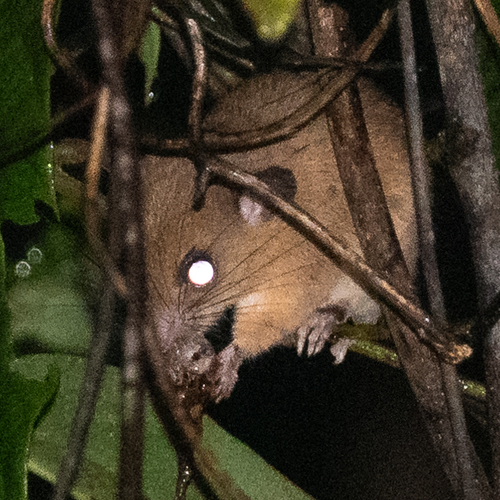
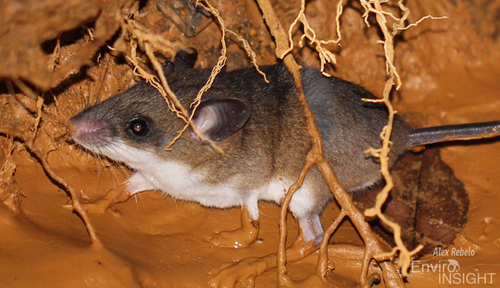
Soft, short fur is usually grayish-brown to reddish-brown dorsally with paler, whitish or grayish underparts. The tail is long, sparsely haired, and ends in a distinctive tuft of longer hairs, giving it a 'pencil' appearance.
Size
Head-body length typically ranges from 6 to 9 cm, with a tail of similar or slightly greater length (7-10 cm).
Weight
Adults typically weigh between 12 and 25 grams.
Distinctive features
Distinguished from other small Southeast Asian rodents by its pencil-tipped tail, large rounded ears, and specialized hind feet adapted for climbing thin branches and bamboo.
Differences between males and females
Minimal sexual dimorphism; males and females are similar in size and coloration.
Behaviour and diet of the Indomalayan Pencil-tailed Tree Mouse
Generally solitary or found in small family groups; not strongly territorial but may share nesting sites with a few individuals, especially breeding pairs or mothers with young.
When it is active
Primarily nocturnal, becoming active after dusk to forage and move through the canopy under cover of darkness.
Diet
Omnivorous, feeding mainly on fruits, seeds, flowers, nectar, and occasionally small insects; particularly fond of soft fruits and buds found in trees and bamboo.
How it feeds and hunts
Not a hunter in the traditional sense; forages by climbing through branches and bamboo stalks to locate fruits, seeds, and insects, using its tail for balance and grip.
Communication
Communicates primarily through soft vocalizations, scent marking, and tactile interactions; whiskers and body posture likely play a role in navigating dense arboreal environments.
Interactions with other species
Preyed upon by small carnivorous mammals, snakes, and birds of prey; may compete with other small arboreal rodents and bats for fruit and nectar resources.
Role in its ecosystem
Plays a role in seed dispersal and possibly pollination of certain flowering plants due to its foraging on fruits and nectar within forest canopies.
Reproduction and lifecycle
Breeding can occur throughout the year in favorable conditions, with gestation lasting approximately 19-21 days and litters typically consisting of 2-4 pups.
Raising the young
Females build nests in tree hollows, bamboo internodes, or dense vegetation and provide most of the parental care, nursing and protecting the young until weaning at a few weeks of age.
Maturity and lifespan
Reaches sexual maturity within a few months of birth; lifespan in the wild is estimated at 1-2 years, potentially longer in captivity with reduced predation pressure.
Taxonomy and naming of the Indomalayan Pencil-tailed Tree Mouse
Classification
Class Mammalia > Order Rodentia > Family Muridae > Genus Chiropodomys > Species Chiropodomys gliroides
Subspecies
Several subspecies have been described across its range, including C. g. gliroides (mainland Southeast Asia) and C. g. peninsulae (Malay Peninsula), though taxonomy remains under review and some forms may be synonyms.
Scientific synonyms
Mus gliroides (original combination), Chiropodomys pusillus
What research says
Recent studies
Recent taxonomic and phylogenetic studies have focused on clarifying species boundaries within the genus Chiropodomys using molecular data, revealing potential cryptic diversity.
Genome and DNA
Specific karyotype data exist for the genus, with chromosome numbers reported around 2n=44-48 in some studied populations, though detailed genomic studies are limited.
Compared with similar species
Similar in size to other small Muridae like Apodemus species, but distinguished by its arboreal adaptations and pencil-tufted tail, unlike the more terrestrial habits of many related rodents.
The Indomalayan Pencil-tailed Tree Mouse and people
Its tail tip resembles the eraser end of a pencil, giving rise to its common name; it can climb bamboo stalks so thin that few other mammals can access them, allowing it to exploit a unique ecological niche.
Where and how to see it
Best observed at night using a flashlight in lowland tropical forests or bamboo thickets of Southeast Asia, particularly in protected reserves where forest structure remains intact.
Risks to humans
No notable risk to humans; it is a small, non-aggressive rodent that avoids direct contact with people.
Human uses
Not commonly used by humans, though it may occasionally be kept as a small exotic pet due to its size and climbing behavior.
Countries where the Indomalayan Pencil-tailed Tree Mouse is recorded
The 8 countries named in the range description of its IUCN Red List assessment.
Questions about the Indomalayan Pencil-tailed Tree Mouse
Where does the Indomalayan Pencil-tailed Tree Mouse live?
The Indomalayan Pencil-tailed Tree Mouse is recorded in Cambodia, Indonesia, Laos, Malaysia and Myanmar, among 8 countries in total across Asia. These countries come from the range description of its IUCN Red List assessment, and they are what place the species on the interactive map.
Is the Indomalayan Pencil-tailed Tree Mouse endangered?
The IUCN Red List assesses the Indomalayan Pencil-tailed Tree Mouse as Least Concern. The species is widespread and abundant enough not to qualify for any threatened category. It does not mean the species is safe forever, only that nothing in the current data raises an alarm.
How many are left in the wild?
No precise global population estimate exists, but the species is considered common within suitable habitat; overall population trend is believed to be stable. This figure comes from the species assessment on the IUCN Red List; population estimates for wild mammals are ranges, not counts, and are revised at each assessment.
What habitat does the Indomalayan Pencil-tailed Tree Mouse live in?
Primarily inhabits tropical and subtropical lowland forests, secondary forests, bamboo groves, and forest edges; also found in plantations, orchards, and sometimes human settlements where trees or bamboo are present.
What is the scientific name of the Indomalayan Pencil-tailed Tree Mouse?
The Indomalayan Pencil-tailed Tree Mouse is Chiropodomys gliroides, in the family Muridae, order Rodentia.
Other species in the genus Chiropodomys

Other species in the family Muridae
Species that share its range
Sources
Conservation status, range description and population estimate come from the IUCN Red List assessment for Chiropodomys gliroides. Countries are derived from that range description, not from a mapped country list. Last refreshed on .
The distribution map is drawn from the IUCN Red List spatial data compiled in 2008. IUCN (International Union for Conservation of Nature)