
Greater Pencil-tailed Tree Mouse
Chiropodomys major
Red List assessment
Least Concernon the IUCN Red List
- EXExtinct
- EWExtinct in the Wild
- CRCritically Endangered
- ENEndangered
- VUVulnerable
- NTNear Threatened
- LCLeast Concern
The Greater Pencil-tailed Tree Mouse is recorded in 3 countries across Asia. The IUCN Red List assesses the Greater Pencil-tailed Tree Mouse as Least Concern. No precise population estimate exists; the species is considered relatively common within suitable habitat, with a presumed stable overall population trend.
- Family
- Muridae
- Order
- Rodentia
- Genus
- Chiropodomys
- Countries recorded
- 3
- Continents
- Asia
- Red List category
- Least Concern
- Data updated
- August 9, 2026
What is the Greater Pencil-tailed Tree Mouse?
Chiropodomys major is a small arboreal rodent endemic to the island of Borneo, notable for its slender build and specialized climbing pencil-shaped tail. It inhabits lowland and hill forests, where it moves nimbly through vegetation to forage for food. As the largest member of the pencil-tailed tree mouse genus, it is a distinctive but poorly studied component of Bornean forest ecosystems.
Where does the Greater Pencil-tailed Tree Mouse live?
Borneo (Malaysia, Brunei, Indonesia)
Endemic to the island of Borneo, occurring in Malaysian Borneo (Sabah and Sarawak), Brunei, and Indonesian Kalimantan.
Altitude and depth
Typically found from sea level up to around 1000-1200 meters elevation in hill forests.
Habitat of the Greater Pencil-tailed Tree Mouse
Primarily found in primary and secondary lowland tropical rainforest, as well as hill dipterocarp forest; often associated with dense understory vegetation and forest edges.
Adaptations to its environment
Possesses a long prehensile-like tail and specialized flexible feet adapted for climbing thin branches and vines in the forest canopy. Its small, lightweight body allows it to navigate delicate vegetation while foraging for fruits and seeds.
Conservation status and numbers
Listed as Least Concern by the IUCN due to its relatively wide distribution across Borneo and tolerance of some habitat disturbance, though localized deforestation may affect subpopulations.
Estimated population
No precise population estimate exists; the species is considered relatively common within suitable habitat, with a presumed stable overall population trend.
What threatens the Greater Pencil-tailed Tree Mouse?
Habitat loss from logging, oil palm plantation expansion, and forest conversion pose the primary threats, along with fragmentation of remaining forest patches.
What is being done to protect it?
Benefits indirectly from protected areas and national parks across Borneo, such as those in Sabah and Sarawak, though no species-specific conservation programs are known.
Recommended actions
Continued protection and expansion of lowland forest reserves, monitoring of population trends, and further ecological research to better understand its habitat requirements.
What the Greater Pencil-tailed Tree Mouse looks like
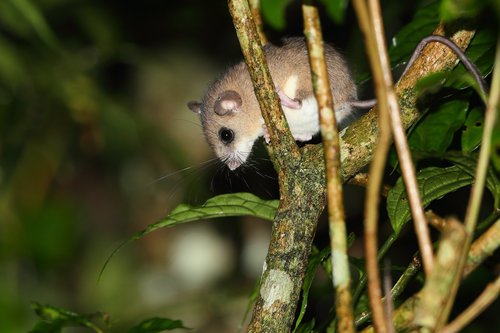
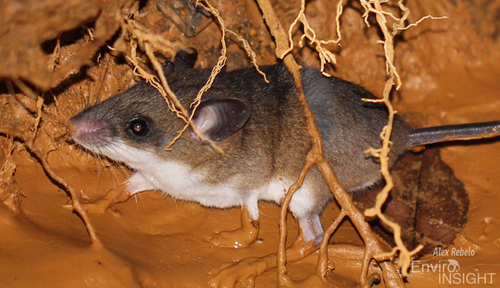
Soft brownish to grayish-brown dorsal fur with paler, often whitish or cream underparts; large eyes and ears adapted for nocturnal activity, with a distinctively long tail ending in a tuft of hair resembling a pencil tip.
Size
Head-body length approximately 70-90 mm, with a tail typically longer than the body, around 100-130 mm.
Weight
Estimated body weight ranges from 15-25 grams.
Distinctive features
Distinguished from other Chiropodomys species by its notably larger body size, making it the largest species in the genus; the pencil-like tail tuft is shared among genus members but proportionally more developed in this species.
Differences between males and females
Minimal sexual dimorphism has been reported, with males and females similar in size and coloration.
Behaviour and diet of the Greater Pencil-tailed Tree Mouse
Generally solitary or found in small family groups; limited data suggests low sociality typical of small nocturnal arboreal rodents.
When it is active
Primarily nocturnal, becoming active after dusk to forage and move through the forest canopy and understory.
Diet
Omnivorous, feeding mainly on fruits, seeds, nectar, and possibly small invertebrates encountered while foraging in vegetation.
Communication
Likely relies on scent marking and ultrasonic vocalizations typical of small murid rodents, though specific studies on this species are scarce.
Interactions with other species
Preyed upon by nocturnal forest predators such as snakes, owls, and small carnivorous mammals; competes with other small arboreal rodents for fruiting resources.
Role in its ecosystem
Plays a role in seed dispersal and possibly pollination within Bornean forest ecosystems by consuming and transporting fruit and seed material.
Reproduction and lifecycle
Breeding biology is not well documented, but likely follows patterns similar to related Chiropodomys species with multiple small litters per year and short gestation periods of around 20-25 days.
Raising the young
Presumed that females provide primary care to altricial young in nests built within tree cavities or dense vegetation, though detailed observations are lacking.
Maturity and lifespan
Specific data unavailable, but likely reaches sexual maturity within a few months as typical for small murid rodents, with a wild lifespan probably under 2 years.
Taxonomy and naming of the Greater Pencil-tailed Tree Mouse
Classification
Mammalia > Rodentia > Muridae > Chiropodomys > Chiropodomys major
What research says
Recent studies
Limited recent taxonomic and ecological studies exist; most information stems from historical museum specimens and regional biodiversity surveys in Borneo.
Compared with similar species
Compared to the smaller and more widespread Chiropodomys gliroides, C. major is notably larger in body size and has a more restricted range confined to Borneo.
The Greater Pencil-tailed Tree Mouse and people
This tiny mouse has a tail longer than its own body, aiding balance while climbing thin branches; it is one of the least studied rodents in Borneo despite being the largest in its genus.
Where and how to see it
Best observed at night in lowland or hill dipterocarp forests of Sabah or Sarawak using spotlighting techniques, focusing on low vegetation and vine tangles where it forages.
Risks to humans
No notable risk to humans.
Countries where the Greater Pencil-tailed Tree Mouse is recorded
The 3 countries named in the range description of its IUCN Red List assessment.
Questions about the Greater Pencil-tailed Tree Mouse
Where does the Greater Pencil-tailed Tree Mouse live?
The Greater Pencil-tailed Tree Mouse is recorded in Brunei, Indonesia and Malaysia across Asia. These countries come from the range description of its IUCN Red List assessment, and they are what place the species on the interactive map.
Is the Greater Pencil-tailed Tree Mouse endangered?
The IUCN Red List assesses the Greater Pencil-tailed Tree Mouse as Least Concern. The species is widespread and abundant enough not to qualify for any threatened category. It does not mean the species is safe forever, only that nothing in the current data raises an alarm.
How many are left in the wild?
No precise population estimate exists; the species is considered relatively common within suitable habitat, with a presumed stable overall population trend. This figure comes from the species assessment on the IUCN Red List; population estimates for wild mammals are ranges, not counts, and are revised at each assessment.
What habitat does the Greater Pencil-tailed Tree Mouse live in?
Primarily found in primary and secondary lowland tropical rainforest, as well as hill dipterocarp forest; often associated with dense understory vegetation and forest edges.
What is the scientific name of the Greater Pencil-tailed Tree Mouse?
The Greater Pencil-tailed Tree Mouse is Chiropodomys major, in the family Muridae, order Rodentia.
Other species in the genus Chiropodomys

Other species in the family Muridae
Species that share its range
Sources
Conservation status, range description and population estimate come from the IUCN Red List assessment for Chiropodomys major. Countries are derived from that range description, not from a mapped country list. Last refreshed on .
The distribution map is drawn from the IUCN Red List spatial data compiled in 2017. IUCN SSC Small Mammal Specialist Group