
Lesser Pencil-tailed Tree Mouse
Chiropodomys pusillus
Red List assessment
Data Deficienton the IUCN Red List
- EXExtinct
- EWExtinct in the Wild
- CRCritically Endangered
- ENEndangered
- VUVulnerable
- NTNear Threatened
- LCLeast Concern
Data Deficient has no position on the scale above — it records the absence of an assessment, not a degree of risk.
The Lesser Pencil-tailed Tree Mouse is recorded in 3 countries across Asia. The IUCN Red List records the Lesser Pencil-tailed Tree Mouse as Data Deficient. No reliable population estimates exist; the species is presumed to be relatively common in suitable habitat but overall abundance and trend are unknown due to lack of targeted surveys
- Family
- Muridae
- Order
- Rodentia
- Genus
- Chiropodomys
- Countries recorded
- 3
- Continents
- Asia
- Red List category
- Data Deficient
- Data updated
- August 9, 2026
What is the Lesser Pencil-tailed Tree Mouse?
The Lesser Pencil-tailed Tree Mouse is a tiny, arboreal rodent native to the lowland and hill forests of Sundaland. It is named for its slender, sparsely-haired tail tipped with a small tuft of hair resembling a pencil brush. This species is remarkable for its highly specialized climbing adaptations, including semi-opposable digits that allow it to move nimbly through bamboo and forest vegetation. Due to its secretive, nocturnal, canopy-dwelling habits, it remains poorly studied and is classified as Data Deficient by the IUCN.
Where does the Lesser Pencil-tailed Tree Mouse live?
Southeast Asia, primarily the Malay Peninsula, Sumatra, and Borneo
Distributed across the Malay Peninsula, Sumatra, and Borneo, including parts of Peninsular Malaysia, Indonesia, and Brunei. Its range overlaps broadly with other Chiropodomys species, making precise distribution mapping difficult due to taxonomic uncertainty.
Altitude and depth
Generally found from sea level up to around 1,200 meters in hill forests
Seasonal movements
No strong evidence of seasonal migration; breeding may be linked to fruiting seasons and rainfall patterns typical of Southeast Asian tropical forests
Habitat of the Lesser Pencil-tailed Tree Mouse
Primarily found in primary and secondary lowland tropical rainforest, as well as bamboo thickets and forest edges. It is also known to inhabit disturbed and regenerating forest patches, showing some tolerance for secondary growth. Bamboo stands are particularly important as nesting and foraging sites.
Adaptations to its environment
Possesses highly flexible digits and long claws adapted for gripping thin branches, vines, and bamboo stems during arboreal locomotion. Its long, prehensile-like tail aids in balance while climbing. Nocturnal activity and small body size help it avoid diurnal predators and thermal stress.
Conservation status and numbers
Listed as Data Deficient (DD) by the IUCN due to insufficient information on population size, distribution limits, and threats. Taxonomic confusion with related Chiropodomys species further complicates conservation assessment.
Estimated population
No reliable population estimates exist; the species is presumed to be relatively common in suitable habitat but overall abundance and trend are unknown due to lack of targeted surveys
What threatens the Lesser Pencil-tailed Tree Mouse?
Deforestation and habitat loss from logging, palm oil plantations, and agricultural expansion pose the primary threats. Bamboo forest clearance is a specific concern given the species' reliance on this habitat type.
What is being done to protect it?
No species-specific conservation programs exist; the species may incidentally benefit from protected areas within its range such as national parks in Borneo and Sumatra. Broader forest conservation initiatives in Sundaland indirectly support its habitat.
Recommended actions
Priority actions include taxonomic clarification of the Chiropodomys genus, targeted field surveys to assess population status, and protection of lowland forest and bamboo habitats from conversion to plantations.
What the Lesser Pencil-tailed Tree Mouse looks like
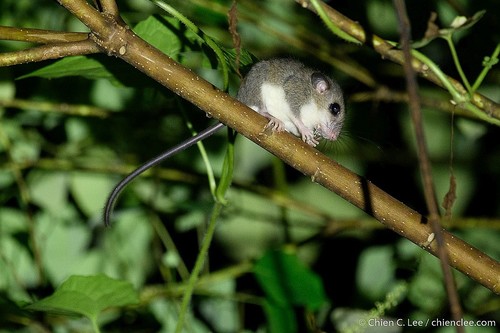
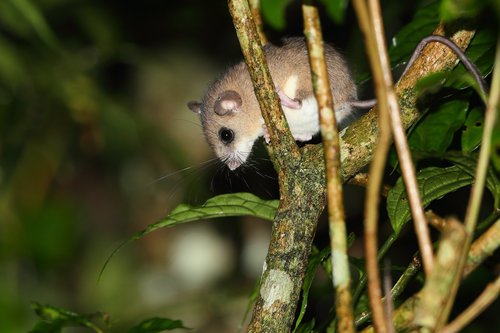
Small rodent with soft, grayish-brown to reddish-brown dorsal fur and paler, whitish-gray underparts. It has large, prominent eyes and ears suited to nocturnal life, along with a long, thin tail featuring a small tuft of hair at the tip.
Size
Head-body length approximately 60-80 mm, with a tail typically longer than the body at 80-110 mm
Weight
Approximately 10-15 grams
Distinctive features
Distinguished from other Chiropodomys species primarily through subtle differences in skull morphology, tooth structure, and body size, as external features are highly similar across the genus. Its notably small size compared to Chiropodomys gliroides is a key distinguishing trait.
Differences between males and females
Minimal sexual dimorphism reported; males and females are similar in size and coloration
Behaviour and diet of the Lesser Pencil-tailed Tree Mouse
Believed to be largely solitary or living in small family groups, though detailed social behavior remains poorly documented due to its cryptic, arboreal lifestyle
When it is active
Strictly nocturnal, spending daylight hours resting in nests built within bamboo internodes, tree hollows, or dense vegetation
Diet
Omnivorous diet consisting mainly of fruits, seeds, and plant matter, supplemented occasionally with small invertebrates
Communication
Likely relies on ultrasonic vocalizations, scent marking, and tactile communication typical of small nocturnal murid rodents, though species-specific studies are absent
Interactions with other species
Preyed upon by nocturnal forest predators such as owls, snakes, and small carnivorous mammals; may compete with other small arboreal rodents for food and nesting sites within bamboo habitats
Role in its ecosystem
Plays a role in forest ecology as a seed disperser and consumer of fruits, and serves as prey within the forest food web, contributing to energy transfer between plant material and higher predators
Reproduction and lifecycle
Breeding likely occurs year-round in tropical conditions with possible peaks tied to fruit availability; litter sizes are typically small, estimated at 2-4 young based on related species
Raising the young
Presumed altricial young cared for by the mother alone within a nest, with weaning likely occurring within a few weeks, though specific data for this species is lacking
Maturity and lifespan
Sexual maturity likely reached within a few months, consistent with small murid rodents; lifespan in the wild is estimated at 1-2 years, with potentially longer survival in captivity
Taxonomy and naming of the Lesser Pencil-tailed Tree Mouse
Classification
Class Mammalia > Order Rodentia > Family Muridae > Genus Chiropodomys > Species Chiropodomys pusillus
Scientific synonyms
Mus pusillus (original combination by Peters, 1864); occasionally confused taxonomically with Chiropodomys gliroides in older literature
What research says
Recent studies
Recent molecular phylogenetic studies of the genus Chiropodomys have aimed to clarify species boundaries, though comprehensive genetic work specifically on C. pusillus remains limited
Compared with similar species
Closely resembles the larger Common Pencil-tailed Tree Mouse (Chiropodomys gliroides) but is smaller in body size and skull dimensions; both species share the characteristic tufted tail and arboreal lifestyle
The Lesser Pencil-tailed Tree Mouse and people
Its tail tip resembles a tiny paintbrush, giving rise to the common name 'pencil-tailed.' Despite weighing barely more than a coin, it can navigate thin bamboo stems with remarkable agility using specialized grasping feet.
Where and how to see it
Best observed at night in lowland rainforest or bamboo groves in Borneo or the Malay Peninsula, using a red-light torch to avoid disturbing its nocturnal behavior; patience and quiet movement near bamboo clusters increase chances of sighting.
Risks to humans
No notable risk to humans
Countries where the Lesser Pencil-tailed Tree Mouse is recorded
The 3 countries named in the range description of its IUCN Red List assessment.
Questions about the Lesser Pencil-tailed Tree Mouse
Where does the Lesser Pencil-tailed Tree Mouse live?
The Lesser Pencil-tailed Tree Mouse is recorded in Brunei, Indonesia and Malaysia across Asia. These countries come from the range description of its IUCN Red List assessment, and they are what place the species on the interactive map.
Is the Lesser Pencil-tailed Tree Mouse endangered?
The IUCN Red List assesses the Lesser Pencil-tailed Tree Mouse as Data Deficient. There is not enough information to judge the risk of extinction, usually because the species is rarely seen or has never been surveyed. It is not a reassuring category: several species were Data Deficient right up to the point they were found to be Critically Endangered.
How many are left in the wild?
No reliable population estimates exist; the species is presumed to be relatively common in suitable habitat but overall abundance and trend are unknown due to lack of targeted surveys This figure comes from the species assessment on the IUCN Red List; population estimates for wild mammals are ranges, not counts, and are revised at each assessment.
What habitat does the Lesser Pencil-tailed Tree Mouse live in?
Primarily found in primary and secondary lowland tropical rainforest, as well as bamboo thickets and forest edges.
What is the scientific name of the Lesser Pencil-tailed Tree Mouse?
The Lesser Pencil-tailed Tree Mouse is Chiropodomys pusillus, in the family Muridae, order Rodentia.
Other species in the genus Chiropodomys

Other species in the family Muridae
Species that share its range

Sources
Conservation status, range description and population estimate come from the IUCN Red List assessment for Chiropodomys pusillus. Countries are derived from that range description, not from a mapped country list. Last refreshed on .
The distribution map is drawn from the IUCN Red List spatial data compiled in 2008. IUCN (International Union for Conservation of Nature)