
Hummelinck's Vesper Mouse
Calomys hummelincki
Red List assessment
Least Concernon the IUCN Red List
- EXExtinct
- EWExtinct in the Wild
- CRCritically Endangered
- ENEndangered
- VUVulnerable
- NTNear Threatened
- LCLeast Concern
The Hummelinck's Vesper Mouse is recorded in 4 countries across North America and South America. The IUCN Red List assesses the Hummelinck's Vesper Mouse as Least Concern. No precise global population estimate exists, but the species is considered locally common within suitable habitat; overall trend is presumed stable.
- Family
- Cricetidae
- Order
- Rodentia
- Genus
- Calomys
- Countries recorded
- 4
- Continents
- North America and South America
- Red List category
- Least Concern
- Data updated
- August 9, 2026
What is the Hummelinck's Vesper Mouse?
Hummelinck's Vesper Mouse is a small, arid-adapted rodent native to the xeric coastal regions of Venezuela, Colombia, and nearby Caribbean islands. It is a member of the diverse Calomys genus known as vesper mice, common in South American semi-arid habitats. The species is notable for its ability to thrive in extremely dry, thorny scrub environments with minimal water availability. It plays a modest but important role in local desert ecosystems as a seed disperser and prey species.
Where does the Hummelinck's Vesper Mouse live?
Northern Venezuela, northeastern Colombia, and the Dutch Caribbean islands of Aruba, Curaçao, and Bonaire
Found along the arid Caribbean coast of northern Venezuela and adjacent Colombia, as well as on the islands of Aruba, Curaçao, and Bonaire (ABC islands). Its range is restricted to this narrow xeric coastal belt and associated island ecosystems.
Altitude and depth
Sea level to approximately 500 meters elevation
Seasonal movements
Breeding activity may increase following seasonal rains, which are sparse and irregular in its arid habitat, but no true migration or hibernation occurs.
Habitat of the Hummelinck's Vesper Mouse
Arid and semi-arid xeric scrubland, thorny cactus-dominated habitats, coastal desert areas, and dry tropical forest edges. It favors sandy or rocky substrates with sparse vegetation typical of the Caribbean coastal desert biome.
Adaptations to its environment
Exhibits physiological adaptations for water conservation, including highly efficient kidneys to minimize water loss in its dry habitat. Nocturnal activity patterns help it avoid extreme daytime heat, and it can obtain much of its water needs from food sources like succulent plants and seeds.
Conservation status and numbers
Listed as Least Concern (LC) by the IUCN due to a relatively wide distribution and presumed stable population without major documented declines. However, its restricted island populations may face localized vulnerability from habitat degradation.
Estimated population
No precise global population estimate exists, but the species is considered locally common within suitable habitat; overall trend is presumed stable.
What threatens the Hummelinck's Vesper Mouse?
Habitat loss from urban development and tourism infrastructure on Caribbean islands, agricultural expansion in mainland arid zones, and potential competition or predation from introduced species such as cats and rats.
Diseases and parasites
As with many rodents, it may host ectoparasites such as fleas and mites, and could potentially serve as a reservoir for zoonotic pathogens, though specific studies on this species are limited.
What is being done to protect it?
No species-specific conservation programs are known; general habitat protection occurs incidentally through protected areas on Aruba, Bonaire, and Curaçao, including some national parks that preserve xeric scrub habitat.
Recommended actions
Increased habitat surveys on Caribbean islands, monitoring of introduced predator impacts, and protection of remaining arid scrub habitat from tourism-driven development.
What the Hummelinck's Vesper Mouse looks like
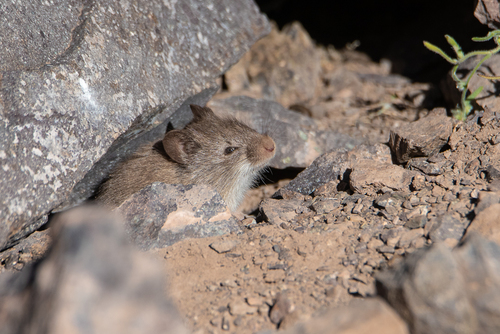
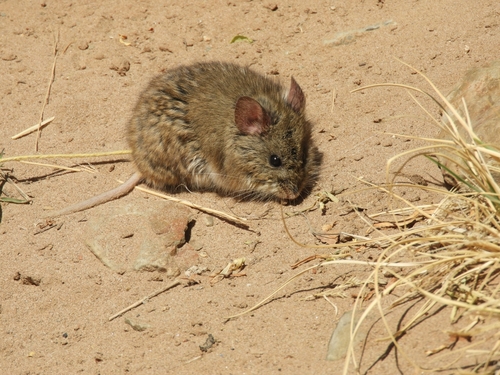
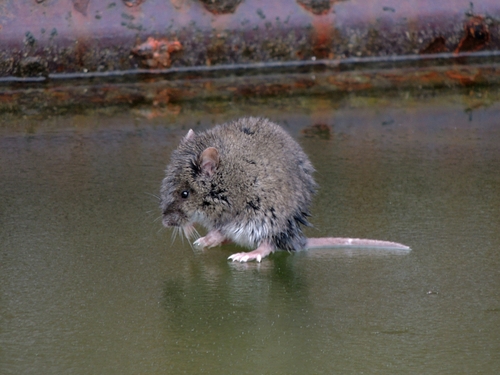
Small rodent with soft, short fur that is grayish-brown to tawny on the dorsal surface and paler, whitish-gray on the ventral side. It has large, prominent eyes and ears typical of nocturnal rodents, along with a moderately long, sparsely-haired tail.
Size
Head-body length approximately 60-90 mm, with a tail roughly equal to or slightly shorter than body length (50-80 mm)
Weight
Approximately 10-20 grams, typical of small Calomys species
Distinctive features
Distinguished from close relatives within the Calomys genus by subtle differences in skull morphology, pelage coloration, and molecular genetic markers rather than obvious external features.
Differences between males and females
Minimal sexual dimorphism; males and females are similar in size and coloration with only slight average size differences.
Behaviour and diet of the Hummelinck's Vesper Mouse
Generally solitary or found in loose, low-density populations, though some social tolerance may occur near shared resources such as burrows or food sources.
When it is active
Primarily nocturnal, becoming active after dusk to forage and avoid the intense heat of the arid daytime environment.
Diet
Omnivorous, feeding primarily on seeds, plant material, and opportunistically on insects and other small invertebrates available in its scrub habitat.
How it feeds and hunts
Forages on the ground by searching leaf litter and soil for seeds and small invertebrates rather than active hunting; uses keen olfactory and tactile senses via whiskers to locate food in low light.
Communication
Communicates primarily through scent marking using urine and glandular secretions to establish territory, along with ultrasonic vocalizations for social and reproductive signaling.
Interactions with other species
Preyed upon by owls, snakes, and small carnivorous mammals; may compete with other small rodents and introduced species like house mice for food resources in shared habitats.
Role in its ecosystem
Functions as a seed disperser and consumer within the arid scrub ecosystem, while also serving as an important prey base supporting local predator populations.
Reproduction and lifecycle
Breeding likely occurs opportunistically in response to rainfall and resource availability, with gestation lasting approximately 20-25 days as typical for the genus, producing litters of 3-6 pups.
Raising the young
Females provide primary parental care, nursing and protecting pups in a nest until weaning, which typically occurs within 3-4 weeks after birth, consistent with other small cricetid rodents.
Maturity and lifespan
Sexual maturity is likely reached within 2-3 months, typical for small Calomys species; lifespan in the wild is probably less than 1-2 years, with captive individuals potentially living slightly longer.
Taxonomy and naming of the Hummelinck's Vesper Mouse
Classification
Class Mammalia > Order Rodentia > Family Cricetidae > Genus Calomys > Species Calomys hummelincki
Scientific synonyms
Previously classified under Calomys laucha or considered a subspecies of Calomys hummelincki complex; some older literature lists it as Calomys sp. from the Venezuelan arid zone
What research says
Recent studies
Recent taxonomic and molecular studies have focused on clarifying phylogenetic relationships within the Calomys genus, helping to better define the boundaries and distinctiveness of C. hummelincki from related mainland and island populations.
Compared with similar species
Similar in size and ecology to other Calomys species such as Calomys laucha, but distinguished by its specific island and coastal Venezuelan distribution and subtle cranial characteristics identified through genetic and morphological analysis.
The Hummelinck's Vesper Mouse and people
This species is named after Dutch naturalist P. Wagenaar Hummelinck, who conducted early biological surveys of the Caribbean ABC islands. It is one of the few native rodent species found on Aruba, Bonaire, and Curaçao, islands otherwise dominated by introduced rodent species.
Where and how to see it
Best observed at night using a flashlight in dry scrubland areas of Aruba, Bonaire, or Curaçao, particularly near cactus-dominated habitats; patience and quiet movement increase chances of sighting this small, shy rodent.
Risks to humans
No notable risk to humans; it is a small, non-aggressive rodent with no venom, though like all rodents it could theoretically carry zoonotic parasites.
Countries where the Hummelinck's Vesper Mouse is recorded
The 4 countries named in the range description of its IUCN Red List assessment.
Questions about the Hummelinck's Vesper Mouse
Where does the Hummelinck's Vesper Mouse live?
The Hummelinck's Vesper Mouse is recorded in Aruba, Colombia, Curaçao and Venezuela across North America and South America. These countries come from the range description of its IUCN Red List assessment, and they are what place the species on the interactive map.
Is the Hummelinck's Vesper Mouse endangered?
The IUCN Red List assesses the Hummelinck's Vesper Mouse as Least Concern. The species is widespread and abundant enough not to qualify for any threatened category. It does not mean the species is safe forever, only that nothing in the current data raises an alarm.
How many are left in the wild?
No precise global population estimate exists, but the species is considered locally common within suitable habitat; overall trend is presumed stable. This figure comes from the species assessment on the IUCN Red List; population estimates for wild mammals are ranges, not counts, and are revised at each assessment.
What habitat does the Hummelinck's Vesper Mouse live in?
Arid and semi-arid xeric scrubland, thorny cactus-dominated habitats, coastal desert areas, and dry tropical forest edges.
What is the scientific name of the Hummelinck's Vesper Mouse?
The Hummelinck's Vesper Mouse is Calomys hummelincki, in the family Cricetidae, order Rodentia.
Other species in the genus Calomys
Other species in the family Cricetidae
Sources
Conservation status, range description and population estimate come from the IUCN Red List assessment for Calomys hummelincki. Countries are derived from that range description, not from a mapped country list. Last refreshed on .
The distribution map is drawn from the IUCN Red List spatial data compiled in 2008. IUCN (International Union for Conservation of Nature)